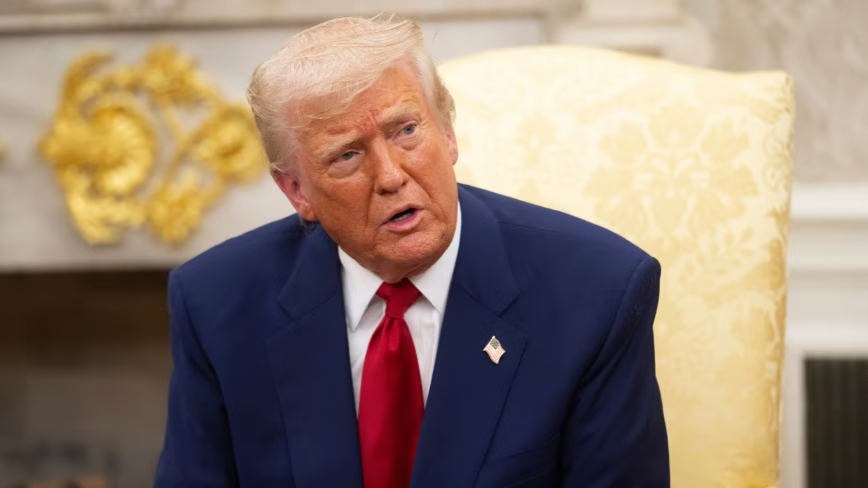
WASHINGTON D.C., USA – April 7, 2025: United States President Donald Trump meets with Israeli Prime Minister Benjamin Netanyahu in the White House in Washington DC.
 Credit: Noamgalai / Shutterstock.com
Two executive orders set a research-grade target, push the post-quantum cryptography deadline to 2031, and tie $2bn in grants to government equity stakes.
President Donald Trump signed two executive orders on quantum computing on 22 June 2026, the first directing the federal government to help build a quantum computer “powerful enough for scientific research” by 2028 and the second hardening national security against the same technology. Between them, the orders set a timeline, name a price, and leave at least one large question hanging.
The first order, reported by NBC News, asks for a research-grade machine within two years and for “commercially relevant” quantum computers by the end of Trump’s term. What “powerful enough for scientific research” actually means is not yet defined.
The Department of Energy is to set the threshold later, based on scale, which leaves the headline target without a fixed yardstick until the department publishes one.
Funding is the part with numbers attached. The administration said it would award $2bn in grants spread across nine quantum companies, with the US government taking equity stakes in return, an arrangement tied to the goal of a commercially relevant machine by 2028.
According to reporting around the orders, the largest slice, roughly $1bn, would go to IBM, with $375m to GlobalFoundries and $100m each to several others, among them D-Wave Quantum, Rigetti Computing, and Infleqtion.
Those per-company figures come from reporting rather than directly from the White House text, and should be read as reported allocations.
Taking equity in return for grants is not how the federal government has typically funded basic research, which has more often meant money handed out with no claim on the upside.
Here the state would sit alongside private backers as a shareholder, betting that the firms it is funding eventually turn a profit it can share in. It also gives the administration a direct stake in companies it is now publicly championing, a wrinkle that tends to attract questions later.
The equity-for-grants structure echoes a pattern that has crept across the chip and AI economy this year, in which public or private money is exchanged for a stake rather than handed over outright.
It rhymes with the kind of large equity bets reshaping who owns the AI supply chain, only with the government on the cap table.
The second order is the quieter and arguably more consequential of the two. It focuses on national security and, as CyberScoop reported, accelerates the government’s migration to post-quantum cryptography, the encryption designed to survive a quantum computer powerful enough to break today’s standards.
The new deadline is 2031, pulling forward a transition that agencies have been planning at a more leisurely pace.
That migration is not a small undertaking. Post-quantum cryptography means re-engineering the algorithms that protect classified communications, financial systems, and critical infrastructure, all against the prospect of a machine that may not yet exist but could arrive within the decade the order is trying to plan for.
The same package, according to Nextgov, was expected to direct intelligence agencies to shield domestic quantum research from foreign threats, a nod to the worry that whoever reaches a useful quantum computer first gains a decryption advantage over everyone still relying on classical encryption.
Taken together, the orders read as a bet placed on two horses at once: that American firms can be pushed toward a working quantum computer faster with federal money and an ownership stake as the lever, and that the government can armour its own systems before anyone, friendly or otherwise, gets there.
The same government-as-investor instinct has been visible in the wider chip-policy scramble, where strategic technology and public funding have grown harder to separate.
What happens next sits largely with the Department of Energy, which has to convert “powerful enough for scientific research” into a measurable standard before anyone can say whether the 2028 target was met, missed, or quietly redefined. Until that threshold lands, the orders set a direction and a budget, and leave the scoreboard for later.
Get the TNW newsletter
Get the most important tech news in your inbox each week.


