TL;DR
A federal judge struck down Trump’s $100,000 H-1B visa fee as an unlawful tax, ruling the president cannot levy taxes without congressional authorisation. The decision is a reprieve for tech companies but the government is expected to appeal.
The ruling is a reprieve for tech companies that depend on foreign talent, but the administration is expected to appeal.
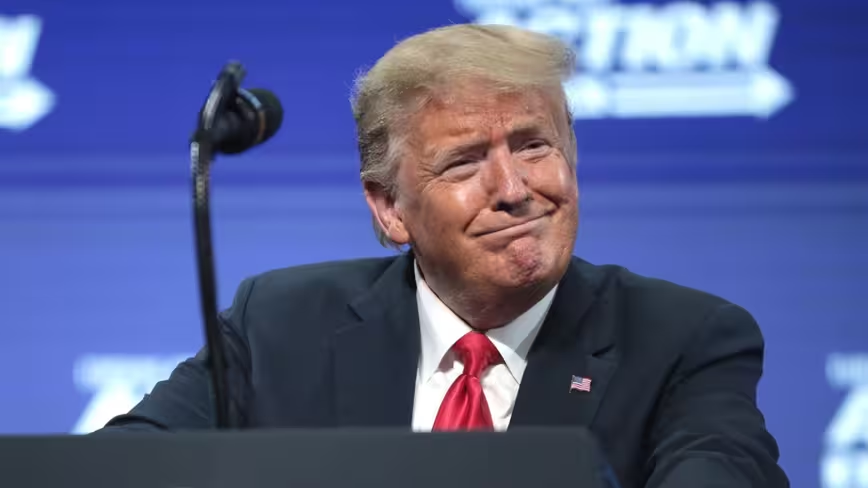
A smiling Donald Trump
A federal judge struck down Trump’s $100,000 H-1B visa fee as an unlawful tax, ruling the president cannot levy taxes without congressional authorisation. The decision is a reprieve for tech companies but the government is expected to appeal.
US District Judge Leo T. Sorokin in Massachusetts ruled on Monday that the $100,000 fee President Donald Trump imposed on H-1B visa applications is an unlawful tax and must be vacated. The ruling found that the proclamation violated both the federal Administrative Procedure Act and the Constitution, because Congress had not delegated the power to levy such a tax to the executive branch.
Trump signed the proclamation last September, adding the fee on top of existing application costs that already run to several thousand dollars. Administration officials framed it as an incentive for companies to hire Americans instead of importing foreign workers.
The $100,000 charge applied to new H-1B applications and was generally paid by the sponsoring employer. Immigration lawyers warned at the time that it would effectively turn the H-1B into a luxury work permit, accessible only to the wealthiest corporations and highest-paid workers.
For mid-sized tech companies and startups, the fee was prohibitive. The H-1B is the primary visa used to hire skilled foreign-born engineers, researchers, and scientists, and its annual cap of 85,000 was already oversubscribed before the fee increase.
The lawsuit was brought by a coalition of employers and trade groups. The US Chamber of Commerce filed its own separate challenge in October, arguing the fee would harm American competitiveness at a moment when demand for AI and engineering talent is at historic highs.
Judge Sorokin agreed with the plaintiffs that the fee was a tax in substance and application, regardless of what the administration called it. The distinction matters because the president cannot impose a tax without congressional authorisation.
The ruling lands in the middle of a global war for AI talent. China has restricted travel for researchers at its top AI labs. Nine-figure compensation packages are now standard at frontier labs like OpenAI, Anthropic, and Meta.
The H-1B programme is the pipeline through which much of that talent enters the United States. Roughly 70% of H-1B approvals go to workers in computer-related occupations, and Big Tech companies are among the largest sponsors.
At the same time, the domestic tech workforce is being reshaped by AI-driven restructuring. Companies are cutting mid-level roles while offering million-dollar salaries for AI specialists. The tension between restricting foreign workers and competing for the small number of researchers who can build frontier models is the policy contradiction at the heart of the H-1B debate.
The government is expected to appeal. The ruling applies nationwide, but a higher court could reinstate the fee or narrow the decision.
For now, H-1B applications revert to the pre-proclamation fee structure. Companies that paid the $100,000 fee while it was in effect may seek refunds, though the mechanics of that process are unclear.
The deeper question is whether the administration will try a different legal route to achieve the same outcome. A fee imposed through formal rulemaking, rather than presidential proclamation, might survive judicial review, though the process would take months and face its own political obstacles. For the moment, the pipeline stays open.
Get the most important tech news in your inbox each week.


