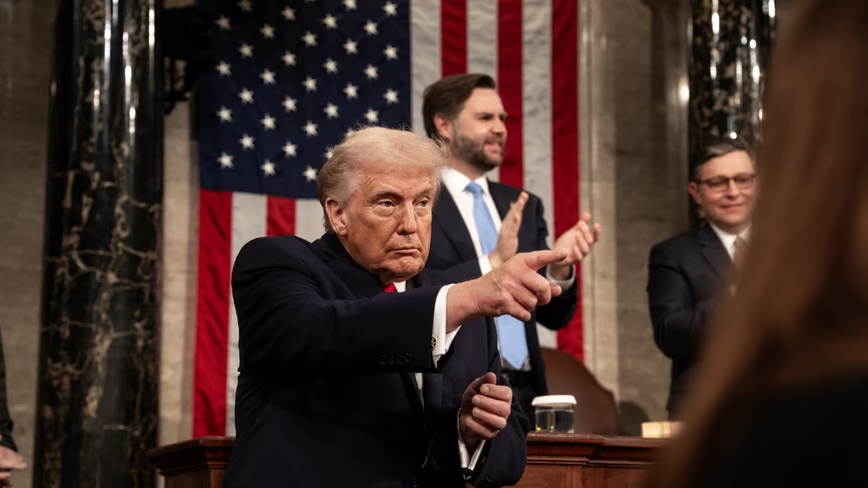
President Donald Trump’s State of the Union address, Tuesday, February 24, 2026, on the House floor at the U.S. Capitol in Washington, D.C.
 Credit: Official White House Photo by Emily J. Higgins
Donald Trump bought up to $50,000 of SpaceX stock on 23 June, roughly a fortnight after the company completed the largest initial public offering in history, according to a financial disclosure reported this week.
The purchase places the sitting president on the shareholder register of a company whose federal contracts and regulatory treatment his own administration determines, an arrangement the conflicts around the listing had already made a live question.
The White House has offered a procedural explanation rather than a defence of the position itself. A spokesman said the president’s portfolio is managed by third-party financial institutions and replicates recognised indexes, naming the Schwab 1000 as an example.
That explanation is plausible on its face, and it points at something structurally odd about this particular stock. SpaceX lobbied the major index providers to accelerate its inclusion before going public, which means a great many investors now hold it without having chosen to.
Anyone tracking a broad US index acquired exposure to SpaceX automatically, and a portfolio built to replicate one would have bought in around the time the disclosure records. Whether the president personally directed the purchase is a different question from whether it appears on his disclosure, and the document itself cannot settle it.
The timing is unhelpful regardless of who pressed the button. SpaceX priced at $135 a share, traded up after listing, and shares changing hands in the mid-$150s in late June would put the position slightly underwater against Monday’s close, which returned to the $135 issue price.
A holding capped at $50,000 is trivial against Trump’s declared wealth, and disclosure rules report holdings in bands rather than exact amounts. The significance is not the sum but the identity of the counterparty.
SpaceX derives a substantial share of its revenue from federal contracts through NASA and the Department of Defense, and its Starlink business depends on spectrum decisions and launch licensing that federal agencies control. The company has also benefited from the administration’s broader deregulatory posture on commercial spaceflight.
Elon Musk’s relationship with the president has been more turbulent than most, having gone through a public falling-out and a subsequent reconciliation, but the commercial relationship between his companies and the federal government has continued throughout.
Starlink in particular has been expanding its government business, selling connectivity to federal agencies and pitching for defence communications work, which puts it in front of procurement officers who report up a chain ending at the president.
Presidents are not legally required to divest, which is the root of the issue. The conflict-of-interest statute that binds most federal officials does not apply to the president, leaving blind trusts and voluntary divestment as norms rather than obligations, and this administration has declined to observe them.
Disclosure is what remains of the safeguard, and it works only retrospectively. The June purchase became public knowledge in late August, by which point the position had been held through two months of decisions affecting the company.
The IPO itself was extraordinary by any measure, raising $75bn on demand that reached roughly $250bn, with BlackRock alone ordering $5bn of stock. A listing of that size drags almost every institutional portfolio in the United States into the same position the president now occupies.
That is arguably the more consequential fact. When a single company enters the indexes at this scale, the question of who has a financial interest in its regulatory treatment stops being a question about individuals.
Ethics lawyers have argued for years that the index-tracking explanation, while accurate, does not resolve the underlying problem, since a president can influence the value of a holding regardless of whether he selected it. The counterargument is that the same is true of every index constituent, which is precisely why the norm was divestment rather than disclosure.
Neither SpaceX nor Musk has commented on the disclosure. The filing covers holdings as of a set reporting date and does not indicate whether the position has since been increased, reduced, or sold.
Get the TNW newsletter
Get the most important tech news in your inbox each week.
Also tagged with


