TL;DR
Federal agencies pledged over $5 billion to the Genesis Mission, funding 278 AI-for-science projects selected from more than 5,000 applications
OSTP Director Michael Kratsios also released a report urging the government to redirect federal research funding toward individual scientists and AI-ready systems rather than universities, in the biggest rethink of US science policy in 80 years
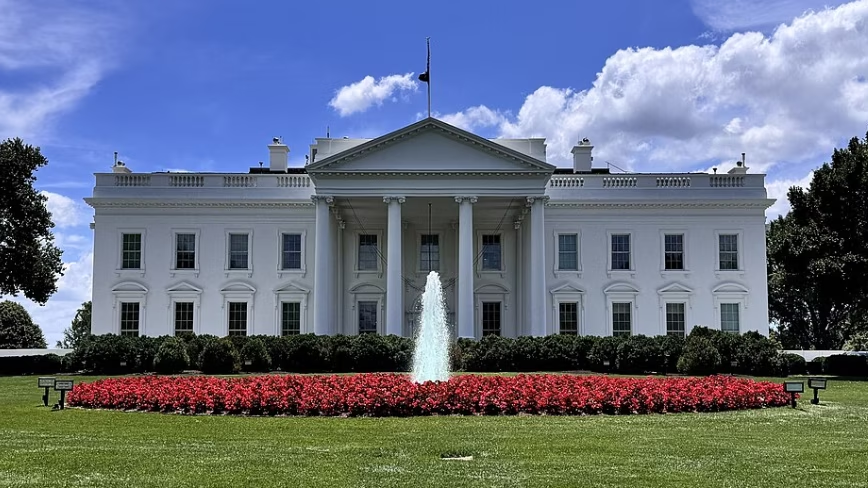
White-House
 Credit: DJTechYT
Federal agencies pledged over $5 billion to the Genesis Mission, funding 278 AI-for-science projects selected from more than 5,000 applications
Federal agencies have committed more than $5 billion to the Genesis Mission, an Energy Department-led effort to use artificial intelligence to accelerate scientific research, White House science adviser Michael Kratsios announced on Wednesday. The initiative selected 278 projects from more than 5,000 applications, Energy Secretary Chris Wright said at a summit in Washington. More than 15 federal agencies are contributing research awards, funding, datasets, and facilities to the programme.
The Genesis Mission was established by a November 2025 executive order and is part of what the administration describes as the largest marshalling of federal scientific resources since the Apollo programme. Under Secretary for Science Dario Gil, who is directing the effort for the Energy Department, said the mission brings together leading researchers, institutions, and technology partners to build what he called the next generation of scientific capability. The DOE received the largest response rate for any programme in the department’s history, according to Gil.
The largest single award is a $60 million investment in nuclear energy, funding a three-year project called Prometheus that will use AI to help design, license, manufacture, and operate nuclear reactors. The project team has raised more than $200 million in industry cost share and $30 million in private capital alongside the federal funding. Other funded areas include biomedical research, energy grid reliability, national security, quantum computing, and microelectronics manufacturing.
Alongside the Genesis Mission announcement, Kratsios released a report to President Trump titled “Science: A New Golden Age,” which the White House described as the first comprehensive rethinking of the US science enterprise in more than 80 years. The report calls for federal research funding to shift toward AI-powered research systems and individual scientists rather than universities, which have historically dominated federally funded scholarship. Agencies with at least $3 billion in research authority will be required to submit implementation plans within 90 days.
The funding shift represents a deliberate attempt to reshape roughly $200 billion in annual federal research spending. The report cites the NIH Director’s Pioneer Award, which gives selected researchers up to $700,000 annually for five years without requiring a detailed experimental plan, as a model for the kind of flexible, investigator-driven funding the administration wants to expand. The blueprint also identifies national missions including commercial fusion power and returning Americans to the lunar surface by 2028.
The announcement comes as the US-China AI competition intensifies, with Stanford’s 2026 AI Index finding that the performance gap between the best American and Chinese AI models has collapsed to under three percent despite the US spending 23 times more on private AI investment. The Genesis Mission sits alongside other recent federal AI initiatives, including billions in EXIM export financing for US-built AI infrastructure and executive orders on quantum computing, as part of a broader push to maintain American technological leadership through public funding rather than export controls alone.
Get the most important tech news in your inbox each week.


