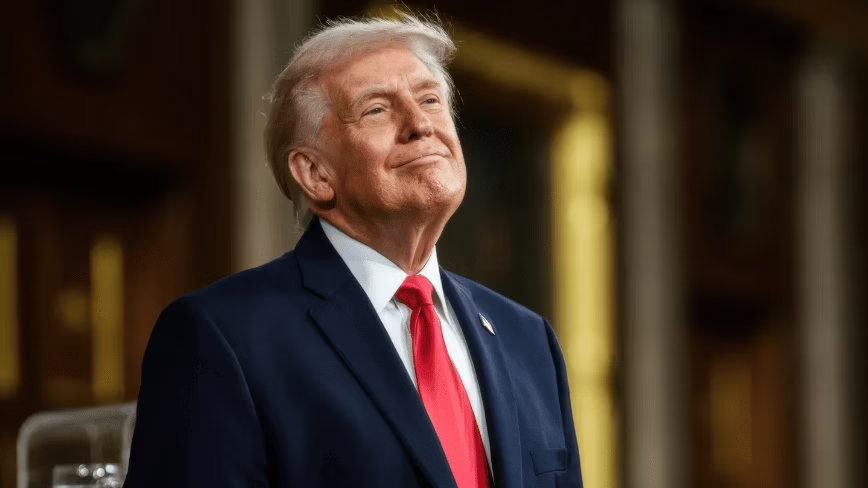
President Donald Trump delivering his first official State of the Union address of his second term before a joint session of Congress
 Credit: Robert V Schwemmer via Shutterstock.com
The ink was barely dry. The EU had just signed a trade deal with Washington. A day later, Trump threatened to blow a hole in it.
On Friday, the president posted the threat on Truth Social. Any country that imposes a digital services tax on US firms, he wrote, would face “a 100% TARIFF on any and all Goods sent to the United States.” It would “supersede Trade Deals,” he added, “whether implemented, signed, or not.”
The timing was pointed. A day earlier, the EU had given final approval to the Turnberry trade deal. It caps most tariffs on European exports at 15%. Trump’s post threatens to override that the moment any member state moves on a digital tax.
What a digital services tax is
A digital services tax, or DST, is a levy on the local revenue of large tech firms. Most of those firms are American. France, Italy, Spain and the UK already run versions, aimed at the likes of Google, Apple, Amazon and Meta. Those firms book vast sales in Europe but little taxable profit there. Trump’s view is blunt. The taxes single out US companies, he says, and he will punish any country that keeps them.
Brussels is not flinching
The reply from Brussels was unusually firm. The European Commission called taxation its “sovereign right.” Its taxes, it said, were “non-discriminatory by design” and applied to all large companies, whatever their origin. It would “respond swiftly and decisively” if pushed, it warned, as Bloomberg reported. It still prefers a global deal on taxing the digital economy.
That defiance matters. Europe has spent years asserting its right to tax tech giants. The Digital Markets Act is part of the same push to rein them in. Folding now would undercut the whole project. European tech groups have a warning of their own. Fresh US tariffs, they say, would hit hardware and software alike on both sides of the Atlantic.
A weaker weapon than last time
There is a catch for Trump. His tariff gun is partly unloaded. The US Supreme Court struck down his “reciprocal” tariffs this year, ruling that he could not impose them on his own authority. It is now unclear which legal tool would let him slap 100% on many nations without Congress. He found a workaround for a temporary 10% global tariff. A sweeping new levy is another matter.
The threat is not idle, though. This month alone Trump warned France with a 100% levy on its wines unless it dropped a tax. Last year, Canada scrapped its own digital tax under similar pressure. The tactic has worked before, on those willing to blink.
So the question is who blinks now. Canada folded. The EU is a day into a hard-won trade deal, and protective of its digital sovereignty. It is signalling that it will not. The next move decides whether Europe’s right to tax Big Tech survives contact with Trump’s tariffs.
Get the TNW newsletter
Get the most important tech news in your inbox each week.


