TL;DR
The European Parliament voted 440-151 to ratify the Turnberry trade deal with the US, accepting a 15% tariff ceiling on most exports while eliminating duties on US industrial goods. The deal covers semiconductors, but the unresolved fight over Europe’s DMA and DSA enforcement, which the US has explicitly linked to further tariff relief, is the bigger story for tech.
The European Parliament voted on Tuesday to ratify the Turnberry Agreement, the trade deal struck at Donald Trump’s Scottish golf resort in July 2025. The final tally was 440 in favour, 151 against, with 50 abstentions.
Under the deal, the EU will eliminate most tariffs on US industrial goods. In return, the US caps tariffs on most European exports, including cars, semiconductors and pharmaceuticals, at 15%.
What the deal covers
The legislation implements the tariff elements of the August 2025 joint statement. Zero-for-zero tariffs apply to strategic products including aircraft, certain chemicals, generic medicines, semiconductor equipment, natural resources and critical raw materials.
A sunset clause terminates the deal on 31 December 2029 unless renewed. A separate safeguard empowers the Commission to suspend concessions on steel and aluminium if the US fails to cut tariffs on those products below 15% by the end of 2026.
A deal nobody wanted but everybody needed
The path to ratification was turbulent. In January, Parliament suspended work on the deal entirely after Trump renewed demands over Greenland.
It unfroze in February, only for Trump to raise auto tariffs to 25% in what critics called a direct breach of the Turnberry ceiling. The final text, agreed between the Council and Parliament on 20 May, added safeguards MEPs had fought for, but many still viewed the result as lopsided.
“Not a good deal,” one trade committee member told TVP World. The asymmetry is plain: the EU eliminates most import duties while the US keeps a flat 15% on nearly everything coming from Europe.
The tech clause nobody is talking about
The deal covers semiconductors, but the larger tech question sits outside the legislation. US Commerce Secretary Howard Lutnick has explicitly linked further tariff relief to the EU weakening its Digital Markets Act and Digital Services Act, the two laws that impose fines of up to 10% of global turnover on US tech giants.
Trump’s February 2025 executive order branded European digital services taxes “overseas extortion.” The Turnberry deal does not resolve this dispute, it defers it.
The timing is charged. The EU AI Office gains full enforcement power on 2 August, just weeks after Tuesday’s vote, with the authority to fine companies up to 3% of global turnover for violations of its general-purpose AI rules.
Europe’s cloud dependency on US providers has become an explicit bargaining chip in the trade relationship. The EU’s proposed Digital Omnibus Regulation, which would soften several digital enforcement rules, was shaped partly by American trade pressure, according to the ECFR.
Critics argue Brussels is building a tech sovereignty framework with one hand while dismantling it with the other.
What happens next
The vote clears the tariff legislation, but the broader Turnberry agreement includes commitments that remain untested. The EU reportedly committed to purchasing $750bn in American energy exports and delivering $600bn in US-directed investment by 2028, though the Parliament vote covered only the tariff provisions.
The first real deadline is 31 December 2026, when the Commission must report on whether the US has lowered steel and aluminium tariffs as promised. If it has not, the safeguard clause kicks in and the EU can reinstate its own duties.
For European tech, the question is simpler and harder. The Turnberry deal bought time, but whether it bought enough to keep the DMA and DSA intact, or whether those laws become the next concession in a negotiation Europe did not choose, is the fight that starts now.


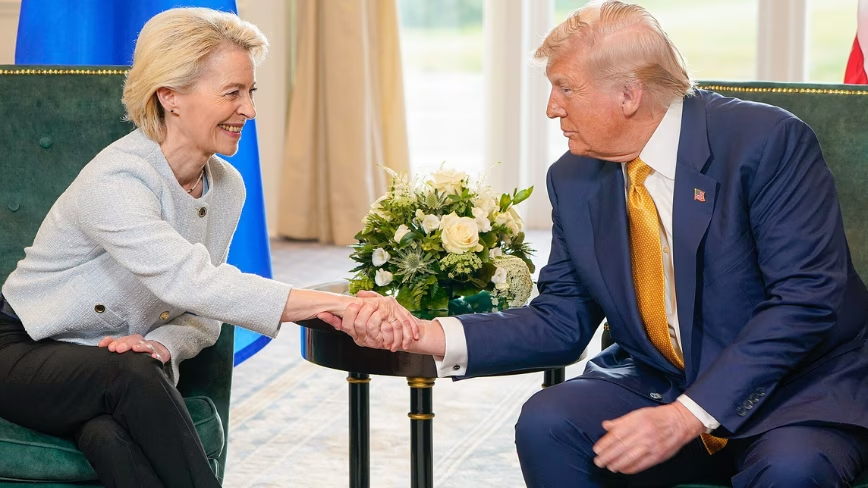
 Credit: Fred Guerdin / European Union, 2025 / EC - Audiovisual Service