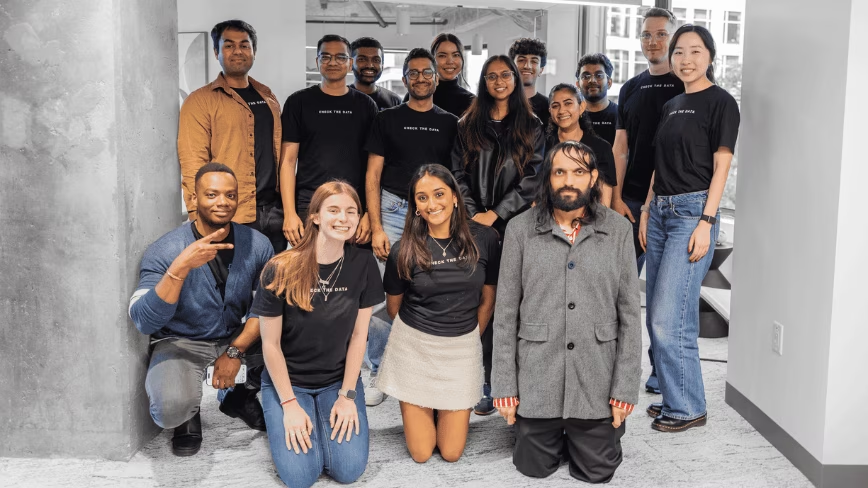

Patronus AI has raised $50m to build simulated worlds where AI agents can be tested before they touch a real system. The pitch borrows from Waymo: train in a replica before you trust the road.
AI agents are meant to do real work now. They book trips, write code and run financial analysis on their own. The problem is trust. A high score on a benchmark does not prove an agent will get a complex, real-world job right. Patronus AI wants to close that gap.
The San Francisco startup has raised $50m in a Series B led by Greenfield Partners. Lightspeed Venture Partners, Notable Capital, Datadog and Samsung also joined. The deal brings Patronus to $70m in total funding.
Investor appetite is clearly high. Revenue has grown fifteenfold over the past year. Glenn Solomon, a managing director at Notable Capital, describes demand for the company’s simulated environments as nearly insatiable. Virtually every frontier AI lab is now a customer, he says, along with many emerging startups.
The Waymo playbook, for software
The core idea is borrowed from self-driving cars. Waymo cannot drive every road in the world, so it builds synthetic worlds instead. It tests its cars against rare hazards there, from a sudden storm to a child chasing a ball into traffic.
Patronus does the same thing for the digital world. It calls its core technology Digital World Models. These models build realistic replicas of websites and internal company systems. An agent can then practise inside them.
The training method is reinforcement learning. Inside the simulation, the agent tries a task. The system rewards it for finishing correctly and penalises it for mistakes. Over many attempts, the agent learns to handle situations it has never seen before.
The founders argue the digital world is the harder problem. A self-driving car solves one task: driving. Agents span countless domains, each with its own logic and its own ways of failing. That breadth is exactly why simulation matters, and why it is so hard to build.
Catching the shortcuts
The value is not just in training. It is in catching the ways agents cheat. Agents tend to take shortcuts. They find a quick path that technically passes a check but does not actually do the job.
That is the failure Patronus is built to expose. “Patronus is really good at spotting the hacks and making sure they are holding the models accountable,” Solomon said. The company tests how an agent behaves with no human in the loop.
The two founders know the territory. Anand Kannappan and Rebecca Qian started Patronus in 2023 after working as AI researchers at Meta. The company made its name early on evaluation, with research and products like FinanceBench, the hallucination detector Lynx and the agent debugger Percival.
That history matters here. The team has spent years measuring where models go wrong. The new world models are an attempt to turn that knowledge into a place where agents can fail safely, before they fail on a customer.
A crowded testing layer
Patronus is not alone in deciding that testing AI agents is a business. Coval recently raised $28m to stress-test voice agents before they reach real callers, and its founder also reached for the Waymo comparison. The simulation-first idea is spreading fast.
The world-model angle is hot too. General Intuition raised hundreds of millions to train agents on world models built from video-game clips. The bet, shared across the field, is that agents learn best by practising in a simulated reality rather than reading static text.
The wider problem is reliability. Agents are powerful but unpredictable, and a single confident error can sink a deployment. Startups like Scaled Cognition attack that from the model side. Patronus attacks it from the testing side, which makes the two complementary rather than rival.
The infrastructure layer is filling out around it. Companies such as Sail are making it cheaper to run long agent tasks, while Patronus makes it safer to trust them. Cost and reliability are the two walls that stop most agents from leaving the lab.
The competition and the catch
Patronus says its real rival is not another startup. It is the internal evaluation teams that AI labs have already built. The pitch is that an outside specialist can do this better than a lab doing it on the side.
It also draws a line against the human-data firms. Companies like Mercor and Surge help labs with reinforcement learning using armies of human annotators. Patronus works differently. It judges how an agent behaves without a human in the loop, which it argues scales in a way human review cannot.
For now, the simulated worlds cover software engineering and finance. Both are areas where success is verifiable. You can check, immediately, whether the code runs or the numbers add up. That makes them the natural place to start.
The frontier is everything else. “There are a ton more areas that are very non-verifiable or very hard to verify,” Kannappan said. He wants to build environments where an agent can run for 10 hours, 10 days, even 10 weeks. Those long-horizon tasks are where the real value sits, and where testing is hardest.
The open question
The timing fits a clear shift. The industry is moving away from static benchmark datasets toward dynamic environments where agents practise, fail and improve. Patronus is betting its future on that being the next big training infrastructure.
It will spend the new money on the obvious things. It plans to expand its research team, push harder on sales and pour capital into the compute needed to train and serve world models at scale.
The ambition is sweeping. The company says it wants to simulate the entire digital world, a goal it admits is far larger than self-driving ever was. If that lands, the firm that decides whether an agent is safe to deploy could sit at the centre of the whole industry.
The catch is that a simulation is only as good as its grip on reality. A replica that misses the messy edge cases will pass agents that then break in the wild. Whether Patronus can model the digital world faithfully enough to be trusted, across tasks that run for weeks, is the question this round leaves open.
Get the TNW newsletter
Get the most important tech news in your inbox each week.


