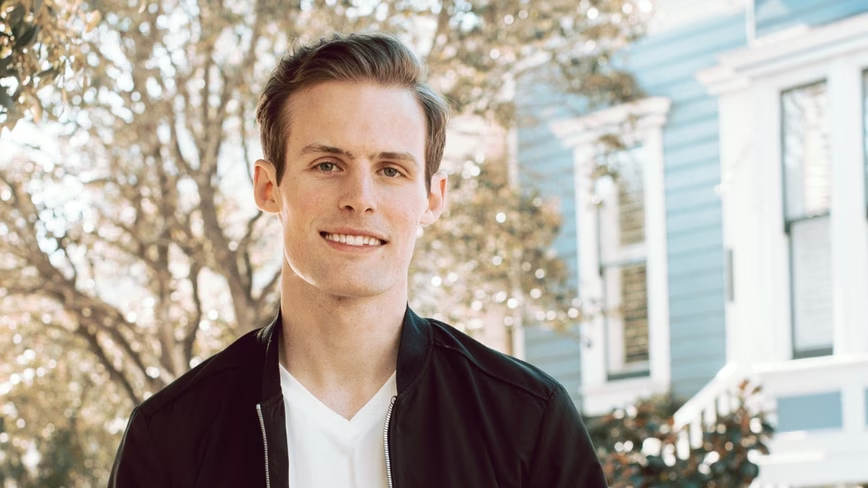
Barret Zoph, Co-founder and CTO at Thinking Machines

Barret Zoph is joining Google DeepMind as vice president of research, returning to the organisation he spent six years in before it was DeepMind at all.
He announced the move on Wednesday, arriving three weeks after Demis Hassabis stepped aside as chief executive in a reshuffle that also saw some DeepMind teams folded back into corporate Google.
The route he took to get back is the more interesting part. Zoph was a research scientist at Google Brain for six years, left for OpenAI where he rose to vice president of research, departed with Mira Murati to co-found Thinking Machines Lab, left that too, briefly returned to OpenAI, and has now gone back to where he started.
Google Brain merged with DeepMind in 2023, so the organisation he is rejoining is not quite the one he left. What has not changed is that the frontier labs are largely staffed by the same few hundred people passing between them, and Meta’s systematic raid on Thinking Machines’ founding team made the point rather bluntly earlier this year.
None of this is a scandal, and nobody involved is doing anything unusual for the field. It is simply that the number of researchers who have trained a frontier model end to end is small enough that every hire is visibly somebody else’s loss.
Thinking Machines has had a difficult run of it. Roughly a third of its founding team has left, two co-founders returned to OpenAI in January, and the departures came while the company was raising at valuations that climbed from $12bn towards a reported $50bn.
That combination is unusual enough to be worth noting. Companies raising at those multiples do not normally shed founders, and the standard explanation of compensation packages elsewhere only goes so far when the equity at stake is already worth a great deal.
Murati has kept the company visible through it, resurfacing with a governance warning and a product few had predicted after a long quiet stretch. The founding cohort that was meant to differentiate the lab has thinned considerably since.
For DeepMind, the hire lands in a period of visible reorganisation rather than steady state. Hassabis stepping back from the chief executive role in early August was the largest leadership change the lab has seen since the merger, and moving teams into Google proper suggests a shift towards shipping rather than research for its own sake.
A senior research hire at that moment carries a particular signal. Bringing in a vice president of research from outside, when the organisation is being restructured around product, reads as an attempt to hold the research side together while the rest changes shape.
Zoph’s own work sits mostly in neural architecture search and large-scale model training, which is unglamorous foundational territory rather than the application layer everyone is currently fighting over. That is arguably what DeepMind needs more of if it is being pulled towards Gemini product cycles.
The wider pattern is one of talent circulating rather than accumulating. OpenAI has itself lost a product chief, its Sora lead, and an enterprise chief technology officer in a single-day triple exit this year, and the people leaving each lab are largely turning up at the others.
Neither Zoph nor Google has said much about what he will actually work on. There is no published remit, no team named, and no comment from either side beyond the announcement itself.
The compensation question hovers over all of it without anyone confirming a figure. Packages at this level are reported in the tens of millions and almost never disclosed, so the public record consists largely of people moving and nobody explaining why.
What the move does tell you is that Google is still able to attract people back, which was not obviously true two years ago when the traffic ran almost entirely the other way. Whether Zoph stays longer than the roughly eighteen months he gave Thinking Machines is the question his last few moves invite.
Get the TNW newsletter
Get the most important tech news in your inbox each week.
Also tagged with


