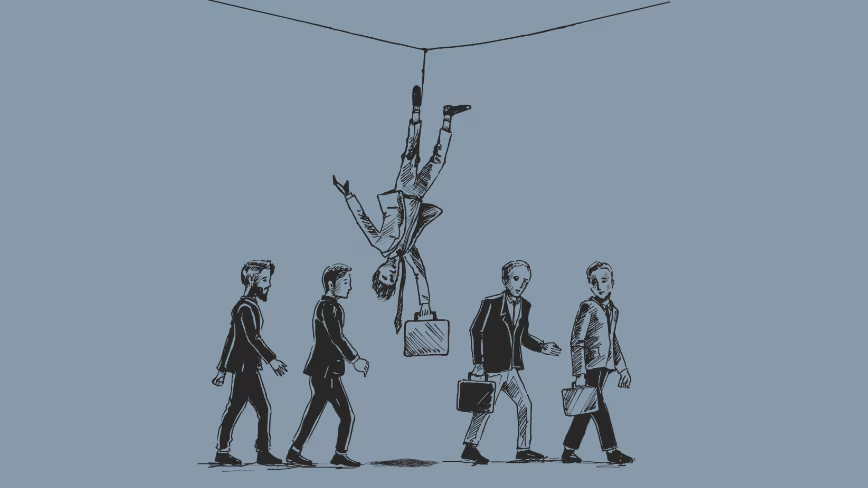
If you opened a tech newsletter or even the internet in early 2026 and thought you’d stepped into a dystopian screenplay, or you are the main character in one of Isaac Asimov’s writings, you wouldn’t be alone.
Headlines trumpet layoffs, companies blame “AI transformation,” and somewhere in the background, billionaires cheer hot-off-the-press artificial intelligence strategies. Here’s the uncomfortable truth: people are still losing their jobs, while AI gets most of the credit.
According to the most recent tracking data, the pace of layoffs in tech remains high in 2026. Outplacement firm Challenger, Gray & Christmas reported that U.S. employers announced 108,435 job cuts in January 2026, the strongest January for layoffs since 2009, and more than double the total from the same month a year earlier
Let’s put some names to these numbers because real humans were behind them.
In late January 2026, Amazon confirmed 16,000 corporate job cuts, part of a wider reduction that has already seen tens of thousands of roles eliminated since late 2025. Revenue was high, investment in AI infrastructure was soaring, and yet people were still shown the door.
Salesforce, a company that frequently boasts about its AI products, quietly cut fewer than 1,000 jobs across teams, including marketing and product roles. These cuts even hit a division tied to their own AI products, which had been touted internally as strategic.
Layoff reports also include giants like Meta and Block, financial institutions, and even non-tech conglomerates retrenching under cost pressures.
Almost every layoff announcement seems to arrive with the same footnote: “This reflects our focus on AI and automation.” It’s catchy and convenient, and it shifts the conversation from “people lost their livelihoods” to “we are evolving.”
But there’s growing skepticism. Journalists and analysts have begun to use the term “AI-washing” to describe how companies attribute layoffs to artificial intelligence without clear evidence that AI systems replaced workers. They note that many organisations had no mature, scalable AI implementations capable of genuinely absorbing the tasks of entire teams before the cuts were announced.
This matters because real evidence of AI displacing large numbers of workers in the sense of robots doing jobs humans used to do is still limited. A recent firm-level study suggests that the use of AI tools can substitute some contracted labour over time, but the magnitude of this substitution remains modest and gradual rather than explosive.
So when a corporate press release asserts “AI is transforming our workforce,” match that upbeat line with the more prosaic reality: financial pressures, slower markets, and the legacy of pandemic hiring adjustments still account for a large share of job losses. Analysts have pointed out that many layoffs associated with AI could be driven as much by economic necessity or managerial optics as by genuine automation.
Europe is part of the story, too.
Tech layoffs aren’t an American story alone. In Europe, companies from telecommunications to manufacturing have either frozen hiring or cut jobs in response to slowing markets and external pressures.
The semiconductor maker ASML announced cuts of about 1,700 positions, while Ericsson is trimming around 1,600 roles in Sweden to adapt to a prolonged downturn in 5G spending. The consumer goods sector, banks, and industrial firms also announced job reductions in late 2025 and early 2026, reflecting a broader economic slowdown that goes far beyond a single technology trend.
In many of these cases, AI barely enters the conversation, but the human impact certainly does.
Biggest layoffs ever? Not quite. But it feels like it.
Putting it bluntly, 2026 isn’t yet the year robots suddenly outperformed entire industries and made humanity redundant. Historical layoffs like IBM’s roughly 60,000 job cuts in the 1990s or massive reductions during economic downturns like 2008 still rank among the largest single events in corporate labour history.
But what is different now is the narrative that accompanies it. Unlike blunt economic downturns, today’s layoffs are often framed as strategic transformations, a necessary step to embrace the shiny promise of artificial intelligence.
That frame protects executives and investors, but offers little consolation to the people whose positions are eliminated in the name of “efficiency.”
So, where are we headed?
Let’s call it what it is. People are losing valuable jobs, and many of the reasons offered for those losses are wrapped in tech buzzwords. AI has the potential to change how work is done; no reasonable person denies that, but conflating investment in algorithms with wholesale human job replacement is an oversimplification that does a disservice to anyone trying to make sense of this moment.
If 2026 teaches us anything, it’s this: layoffs are real, painful, and often rooted in economic and strategic decisions that have little to do with machines spontaneously deciding they need fewer humans.
And the rush to blame AI as a convenient scapegoat obscures the deeper, harder questions we should be asking about how we value people, work, and community in a world that is increasingly enamoured with the idea of automation.
So yes, layoffs are sweeping across companies large and small. No, there isn’t clear evidence that AI has replaced humans en masse. And if we continue to let that narrative dominate, we risk forgetting that behind every data point is a human life, someone whose value isn’t measured in lines of code or the future earning potential of a machine.
Where we go from here depends on whether we treat people as assets to optimize away or as the very reason innovation should serve society in the first place.
Get the TNW newsletter
Get the most important tech news in your inbox each week.


