
Smartphone with Digital Sound Wave and Cloud
 Credit: jittawit21/Canva
Most voice agent pricing starts with a single number: voice agent cost per minute. However, this figure doesn’t reveal much about the real cost of running a production system.
I discovered this firsthand while building and running a voice agent for enterprise use. When you factor in speech recognition, text-to-speech, model usage, telephony, and infrastructure, a production minute involves several different costs.
This is why it’s more helpful to look at the cost per successful outcome instead.
What sits inside a voice minute
A production voice agent usually has five main cost layers, mainly:
- Speech-to-text converts incoming audio to text and is typically priced per audio minute.
- LLM inference charges by tokens, not by time. Longer calls can cost more as the model processes instructions, conversation history, and tool results.
- Text-to-speech turns responses back into audio and is usually priced by characters, tokens, or the amount of speech generated. If the agent talks a lot, TTS can become a high variable cost.
- Telephony and transport add charges based on connected time, depending on the provider, call type, and location.
- Real-time voice infrastructure includes media servers, orchestration, computing, session rate, logging, and monitoring. Managed platforms often include these in their per-minute price, but if you build your own system, you take on more engineering costs.
So, when you see a conversational AI pricing like “$0.05 per minute,” it doesn’t mean much unless you know what’s actually included.
A 35-minute call has two sizes
Consider a 35-minute interview-style conversation. Someone might speak for 20 minutes, while the agent for 12. Pauses, interruptions, and turn transitions take up the remaining time.
Each cost layer sees that call differently. STT mostly cares about participant speech. TTS cares about agent speech. Telephony and infrastructure may meter the entire 35 minutes.
The LLM sees another dimension: accumulated context.
At the start of a call, the model might only process system instructions and a few exchanges. After 20 turns, it may need to include earlier answers, recent dialogue, tool outputs, and instructions again before making the next response. This means that a later turn can cost more than the earlier one, even if both responses take the same amount of time to say.
Teams can slow down context growth by summarising old dialogue, removing outdated information, only pulling in what’s relevant, or using caching if the model allows it. So, each method has pros and cons. If you remove too much, the collection might forget something important. But keep everything, and your token usage keeps going up.
I noticed this difference in long conversations. A participant can give 5 clear answers. Another might interrupt, ask for clarification, then go back to the original question. Both calls might take about the same time, but the second one creates more turns and works for the model.
While the call length sets the starting point, how the conversation goes will decide how much time it will actually cost.
Silence, interruptions, and latency add cost
Real conversations have moments of silence. Someone might pause to think or look for a document. While speech recognition won’t charge for every silent second, telephony and session infrastructure keep charging as long as there’s an open connection.
Interruptions add another cost. If you start talking while the agent is speaking, the system will stop its response, even though the TTS service already created audio that no one hears.
Latency can make the problem worse. Responding too slowly can make people repeat themselves or start another sentence. This creates another turn, more processing, and longer connected time.
To reduce latency, you need faster models, better turn detection, improved infrastructure, or more engineering work. While these can increase direct costs, these options can prevent slow systems that can become expensive with extra turns.
Failed calls belong in the numerator
Say, your system needs 108 attempts to produce 100 successful outcomes. The eight failures may have already used transcription, model tokens, generated speech, telephony, and infrastructure before ending. If users retry, another set of costs starts.
Practical models often look like this:
Cost per successful outcome = (Voice stack + failure & retry overhead + human handling + evaluation & operations) / Successful outcomes
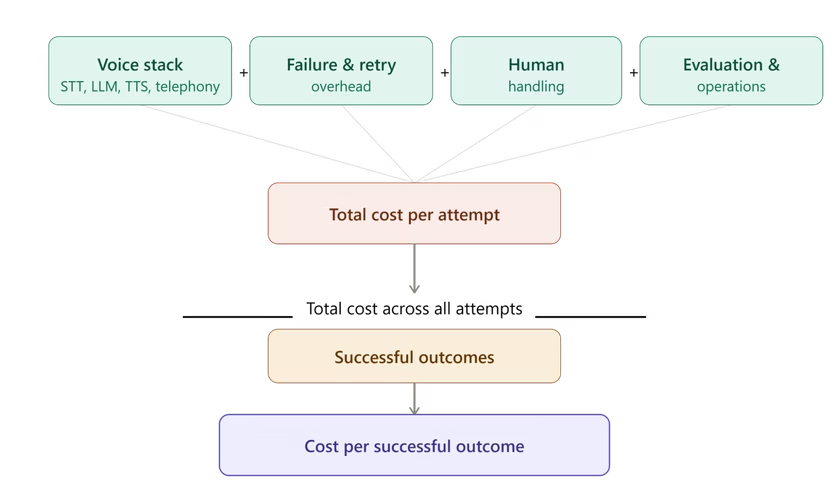
When a failure happens matters, too. Losing a call after minute 34 costs more than losing it after minute 1. A low headline price can’t make up for poor completion rates.
Non-english voice changes the economics
Working in a non-English language changed how I evaluated components. Recognition quality mattered more than the headline price because an error could trigger another answer, model turn, and a longer call.
Voice quality also had to stay clear during long calls. Turn detection had to handle real accents, different speaking speeds, interruptions, and everyday phrasing instead of clean benchmark audio.
Some providers charge more for multilingual or higher-capability speech models. But the high cost often comes from what happens next. If a cheaper recognizer causes more repetition and classification turns, the conversation ends up costing more.
And that changed my focus: improve the conversation first, then the component.
Human handoff and evaluation count too
Some conversations should move to a person. That can be the correct outcome, but human handling still belongs in the cost model. If a workflow frequently requires several minutes of manual follow-up, shaving half a cent from TTS pricing may barely affect the business case.
Production systems also need observability and evaluation. Observability tells you when latency rises, a tool fails, or a transfer stops working. Evaluation tells you whether the conversation achieved the intended result. Both require infrastructure and engineering effort, even though neither appears in the headline per-minute rate.
Build versus buy is a volume question
Managed platforms charge for work a self-built stack must otherwise absorb: orchestration, media handling, scaling, integrations, and failure recovery. Self-assembly can reduce variable API cost, but it adds fixed engineering and operating expenses.
The useful comparison is:
Platform premium per minute x expected volume
versus:
Engineering and operating cost of owning the stack
At modest volume, paying a higher variable rate can still be cheaper overall. At very large volumes, saving a few cents across millions of minutes can justify owning more infrastructure. The crossover point depends on team cost, reliability requirements, traffic shape, and platform pricing.
Voice AI Unit Economics Decide What Scales
Model quality sets the minimum bar. After that, economics determines whether a use case works.
A 30-minute interview, intake session, or scheduling workflow can justify higher costs if successful completion creates enough value or replaces meaningful human effort. A two-minute interaction can still have poor economics if it retries, escalates, or delivers little value.
Track connected time, speaking time, generated speech, turn count, context growth, interruptions, retries, escalation, and completion rate. Then compare the full cost of a successful outcome with its value.
AI voice agent costs are falling, but not evenly. Model, speech, orchestration, and infrastructure prices change at different rates, continually shifting the viability of different use cases.
The voice agents that scale won’t simply use the best model. They’ll combine sufficient model quality with a conversation design and operating model that produces enough value per successful outcome.
Until you calculate that number, you don’t know what your voice agent costs. You only know what its components charge.
References:
Andreessen Horowitz. (2024, May 29). Hi, AI: Our thesis on AI voice agents. https://a16z.com/ai-voice-agents/
Andreessen Horowitz. (2025, January 29). AI voice agents: 2025 update. https://a16z.com/ai-voice-agents-2025-update/
Deepgram. (2025). State of voice AI 2025. https://deepgram.com/2025-state-of-voice-ai-report
Inworld AI. (2026, July 8). Voice agent cost per minute: A worked cost model. https://inworld.ai/resources/voice-agent-cost-per-minute-2026
Softcery. (n.d.). AI voice agents calculator. https://softcery.com/ai-voice-agents-calculator
Get the TNW newsletter
Get the most important tech news in your inbox each week.
Contributed article. Not produced by the TNW newsroom and does not reflect the editorial stance of TNW.
Also tagged with


