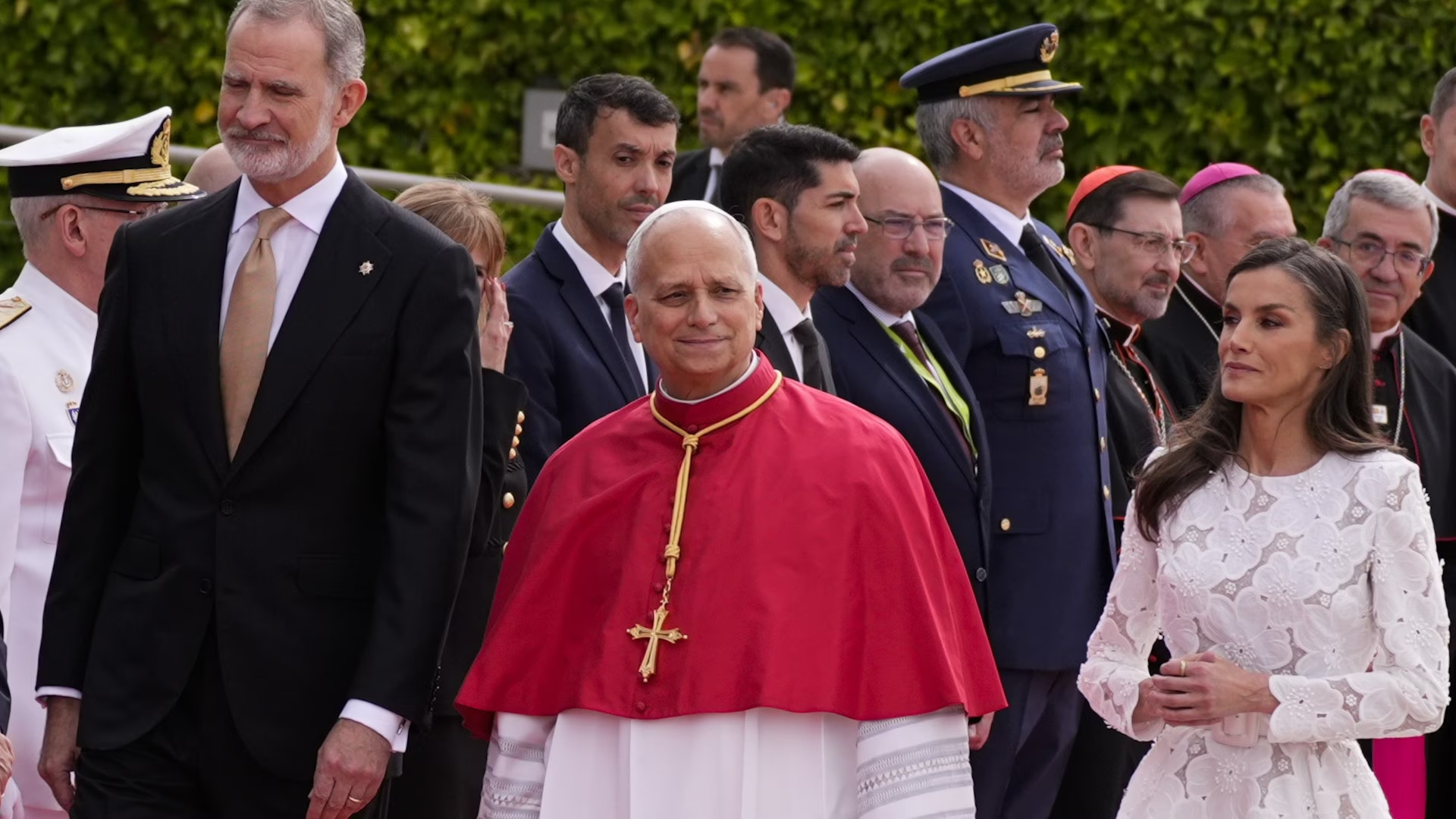
Pope Leo XIV with King Felipe VI and Queen Letizia at his official welcome in Madrid, June 2026.

Pope Leo XIV called on Friday for artificial intelligence to be “disarmed”. Decisions on human life, freedom and the use of force must always stay under human oversight, he said.
In an address published by the Vatican, he urged the states meeting in Geneva in November to move towards banning lethal autonomous weapons. He spoke in the Consistory Hall of the Apostolic Palace. His audience was taking part in a meeting on the future of AI, which the Pontifical Academy for Life and the Future of Life Institute ran together.
Machines are tools, not persons
The pope set out five points. First, the future of AI depends on the choices people make. People have a duty to guide, change and, when necessary, reject its uses, he said.
“The decisive question, then, is not simply ‘What can AI do?’ but rather, ‘What purpose should it serve?’” he said.
He warned that treating AI as a race to be won risks forgetting the people left behind. A reliable system that serves people is worth more than a very powerful one, he said, if nobody can foresee or control its effects.
His second point was that machines are tools, not persons. He rejected proposals to give AI systems rights or legal personhood.
“Such an approach risks obscuring human responsibility and leaving those who suffer harm to confront a faceless entity,” he said.
Third, people must never hand some decisions to machines. He gave two examples: a target list and a border control database. A person on either risks becoming a mere data point, he said. This is where his call to disarm AI came in.
Institutions, not more principles
Fourth, AI must serve the common good and not the interests of a privileged few. The fifth point, perhaps the most urgent in his view, was about institutions. The world already knows many of the ethical principles, he said. What the world needs now are effective international bodies that can put them into practice.
“This calls for shared standards, independent oversight and clear mechanisms of accountability,” the pope said.
States discuss lethal autonomous weapons under the UN Convention on Certain Conventional Weapons. Its Seventh Review Conference meets in Geneva from 16 to 20 November, according to Reaching Critical Will.
A position the pope keeps returning to
The pope also recalled the words of Pope Francis to the G7 in 2024. No machine should ever choose to take a human life, Francis said then. Each of Friday’s five points cites Magnifica Humanitas, the AI encyclical Leo published in May.
He has made the case before. In May he called AI-directed warfare a spiral of annihilation. In September he said AI safety fears were not fake news. Not everyone in the industry agrees. Mistral’s chief executive, Arthur Mensch, has rebutted the pope on AI in warfare.
Get the TNW newsletter
Get the most important tech news in your inbox each week.


