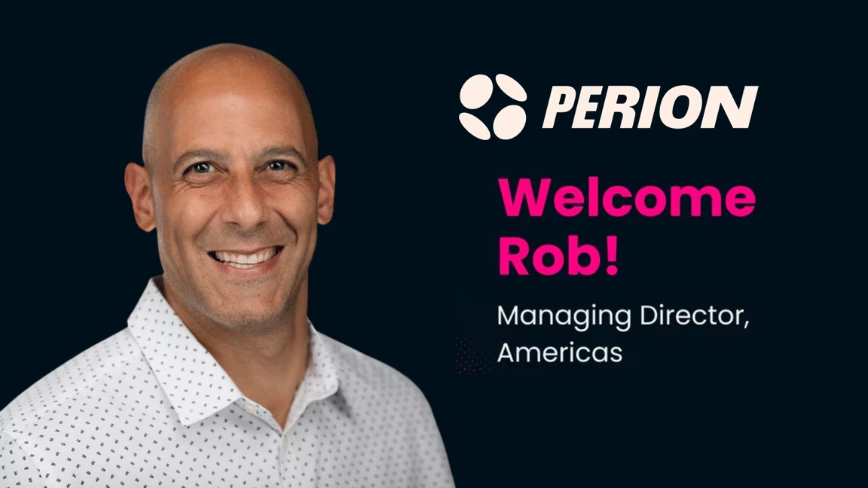
Rob DeSalvo, Managing Director, Americas at Perion.
 Credit: Perion
American advertisers are operating in a media environment with more channels, more data, and more technology than ever before. Yet for marketers, the central challenge is shifting. It is less about finding another place to advertise. It is more about understanding how every investment contributes to the broader business.
That is the environment Rob DeSalvo is returning to at Perion. He spent more than a decade with the company. That included a stint as Chief Revenue Officer at Undertone, the Perion subsidiary. He now steps back into the role of Managing Director, Americas, which he held previously. He brings 25 years of experience spanning publishing, digital media, and adtech.
“I knew the company, the people and the culture,” DeSalvo said. “But what brought me back was where Perion is going next. The business has evolved significantly, both in terms of the technology and the breadth of what it can offer advertisers.”
For DeSalvo, that evolution reflects a larger change taking place across advertising. Marketers are being asked to manage an increasingly fragmented ecosystem. At the same time they must demonstrate a much clearer connection between media spending and business performance.
Beyond the media brief
The expectations placed on advertisers have changed, and so have the expectations they place on their media partners. DeSalvo argues that marketers increasingly need a different kind of partner. They want one that understands the commercial objective behind a campaign. Executing against a media plan is no longer enough.
“Advertisers need their partners to understand the business problem, not just the media brief,” he said.
The distinction matters. Budgets now spread across CTV, digital out-of-home, retail media, social, the open web and other environments. Each channel can offer new opportunities to reach consumers. It can also introduce another workflow, dataset and measurement system.
“It has done both,” DeSalvo said. The question was whether the advertising ecosystem’s expansion has created more opportunity. It was also whether it has made budgets harder to track.
“Marketers have more ways than ever to reach consumers in relevant environments, which is a tremendous opportunity. But each new channel or platform can also introduce another workflow, another data set and another measurement framework.”
As a result, the question facing advertisers is increasingly not simply where to spend, but how those investments work together.
From metrics to business outcomes
The shift is also visible in how marketers evaluate performance. Impressions, clicks and engagement remain useful campaign indicators. But DeSalvo sees growing pressure to connect those metrics to outcomes that matter at the business level.
“Because marketers are under the same pressure as every other part of the business to demonstrate return on investment,” he said.
Those outcomes can vary by company, from sales and customer acquisition to conversions, store visits or lifetime value. The underlying expectation is the same: media partners need to help advertisers understand what their investment actually produced.
That demand is changing the nature of the advertiser-partner relationship. Agencies and brands once focused largely on inventory or audience access. Now they ask how different investments connect, how quickly campaigns can respond to performance changes, and how results can be shown internally. Similar questions are driving investment in real-time decisioning.
AI raises the bar
Artificial intelligence is adding another dimension to the equation. DeSalvo sees AI changing expectations around speed. Marketers can analyze campaign signals and make optimization decisions faster than before, the same pattern now visible in how AI is changing SEO.
“AI is changing expectations around speed and decision-making,” he said.
Perion is positioning its technology around an AI-native approach spanning CTV, DOOH, Retail Media, Social and the Open Web through Perion One and Outmax. The premise reflects a broader industry movement toward connecting traditionally separate media environments, a shift visible elsewhere in the market, including ads in ChatGPT.
“The core issue is that consumers do not experience advertising in channel silos, even though the industry often still plans and manages media that way,” DeSalvo said.
At the same time, he cautions against treating AI as a replacement for human decision-making.
“Where I think the industry sometimes overestimates AI is in assuming that automation removes the need for human judgment. It does not,” he said.
Instead, he expects AI to take on more of the operational complexity. Commercial teams would then focus more on strategy, context and customer relationships. That split is the bet behind recent agentic AI marketing deals.
What comes next for the American advertiser
DeSalvo’s return comes as Perion seeks to deepen its position across the Americas and help advertisers manage a market that is likely to become both more fragmented and more automated.
“My first priority is making sure we are as close as possible to our customers and partners and that we are solving the problems they actually have,” he said.
He expects media fragmentation to continue, even as the technology used to manage it becomes increasingly unified. For advertisers, that could mean placing greater emphasis on flexibility, transparency and systems capable of responding quickly to changing performance, pressures already visible in the X ad boycott.
“Ultimately, I think the next phase of advertising will be less about managing individual media channels and more about managing outcomes across them,” DeSalvo said.
Get the TNW newsletter
Get the most important tech news in your inbox each week.
Contributed article. Not produced by the TNW newsroom and does not reflect the editorial stance of TNW.


