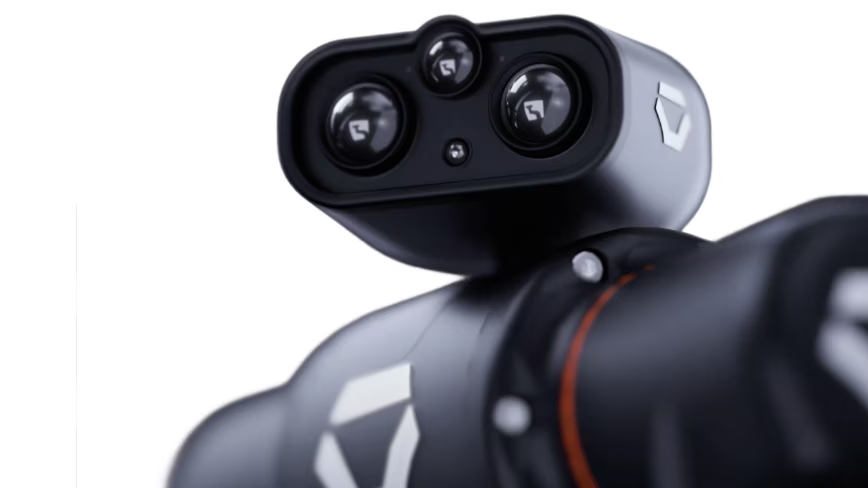
 Credit: Standard Bots
Standard Bots has raised $200 million at a $1 billion valuation to expand US manufacturing of AI-powered robotic arms. The round was led by General Catalyst and RoboStrategy, a robotics-focused fund, and follows a $63 million raise nearly two years ago at an undisclosed valuation.
The New York-based company makes robotic arms for industrial automation, handling tasks like complex assembly, machine loading, and unloading. CEO Evan Beard told Bloomberg the company is “on pace to do 10% of industrial robot deployments in the United States” by the end of the year.
How the arms learn
Standard Bots says its robotic arms can learn a specific task after seeing a single demonstration, using AI systems running in the back end. The approach eliminates the lengthy programming that traditional industrial robots require for each new task.
The company positions this as the advantage that lets smaller manufacturers adopt automation without dedicated robotics engineers. Demonstration-based learning is a growing category in industrial AI, with competitors including Covariant, Realtime Robotics, and several Chinese firms pursuing similar approaches.
US manufacturing bet
The funding will expand Standard Bots’ manufacturing facility on Long Island, New York, and fund engineering hires. Building robotic arms domestically positions the company to benefit from the US push to reduce dependence on Chinese robotics and manufacturing supply chains.
Beard said the company eventually sees an opportunity in home robotics but remains focused on industrial use for now.
The flags
The “10% of industrial robot deployments in the United States” claim is Beard’s projection, not a confirmed figure. The International Federation of Robotics recorded approximately 44,000 industrial robot installations in the US in 2024, so 10% would mean roughly 4,400 to 5,000 units, depending on 2026 totals. Standard Bots has not disclosed current unit volumes, revenue, or profitability.
The $1 billion valuation on $263 million in total funding implies significant revenue growth expectations. Revenue figures have not been made public. The company’s previous raise was at an undisclosed valuation, so the trajectory from $63 million to $1 billion cannot be independently benchmarked.
“The round came together really because investors saw we were growing tremendously,” Beard said. That may be true, but without disclosed financials, the growth remains a private assertion rather than a public fact.
Get the TNW newsletter
Get the most important tech news in your inbox each week.


