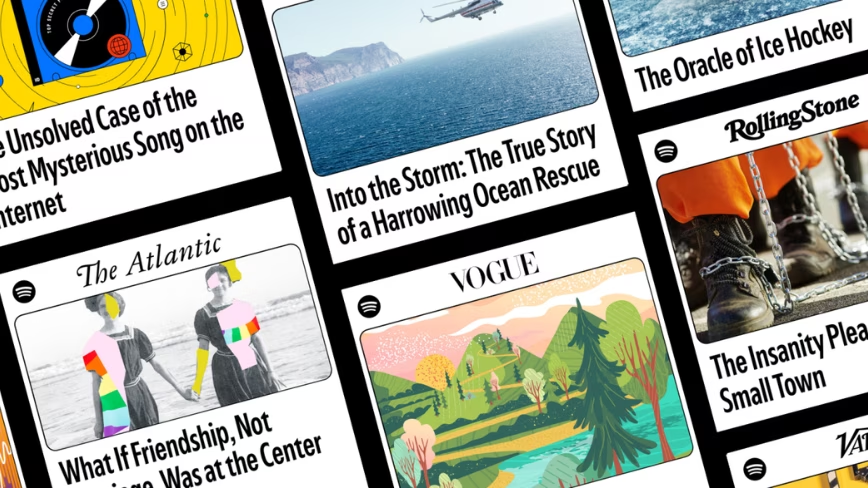
Spotify began testing a new content format on Tuesday: narrated long-form magazine articles, slotted in alongside audiobooks rather than podcasts.
The launch announced from the company’s newsroom on Tuesday morning, includes more than 650 English-language pieces from a roster that runs through Rolling Stone, The Atlantic, Vogue, Variety, Billboard, Vibe, GQ, WIRED, Vanity Fair and Pitchfork.
The Articles, as Spotify is calling them, are each under two hours long and produced in-house by the company’s Spotify Audiobooks team. Premium users in the 22 markets where audiobooks are available can listen as part of their monthly audiobook allowance.
Free users can buy individual pieces for $1.99. The product is positioned, in Spotify’s framing, as a gateway between podcasts and full-length books, on the same logic the company has used to defend its audiobook bet: shorter listens reduce the friction that puts new readers off committing to a 12-hour novel.
The strategic interest here is the timing. Spotify spent the back half of the 2010s acquiring narrative-journalism podcast studios at scale, including Gimlet Media for around $230m and The Ringer for $200m.
Both have since been substantially restructured, with repeated rounds of layoffs at The Ringer and Spotify Studios across 2024 and 2025 as the company pulled back from expensive narrative documentary work in favour of cheaper conversational and video podcasts.
Today’s Articles launch is, in effect, Spotify re-entering the journalism business through the audiobook door rather than the podcast one, this time as a licensor of finished magazine work rather than as a producer of original reporting.
The licensing economics also look different. Magazine articles are cheaper to acquire than commissioned narrative podcasts, narration costs are lower than studio production, and the supply pool is enormous. T
he model also lets Spotify avoid the editorial and trust-and-safety overhead that has dogged its podcast business. Publications are doing the editing; Spotify is doing the narration and the distribution.
The launch sits inside an unusually busy stretch for the audiobook division. Spotify hit roughly 700,000 audiobook titles across the 22 markets where the product is live, up from 150,000 since launch, with listening hours growing 60% year-on-year.
The Bookshop.org partnership for selling physical books in the US and UK launched in April; Audiobook Charts arrived in February; Page Match, which lets a reader scan a printed page to jump to the corresponding audiobook timestamp, now works in more than 30 languages. Audiobooks+, the €10-per-month add-on, is nearing $100m in annualised revenue.
What remains untested is whether magazine readers actually want to listen to articles rather than read them. Audible has offered a narrated New York Times product for years; The Economist, FT and others have invested heavily in app-native narration; none has produced a clear monetisation breakout.
The 650-piece test is small enough that Spotify can scale it back quickly if engagement disappoints, large enough to signal intent to the magazine industry that Spotify is open for licensing.
The publishers participating in the launch did not separately disclose financial terms. Spotify, in keeping with its general approach to product trials, is calling this one a test rather than a launch. The pricing, the markets and the title roster are all explicitly subject to change.
Get the TNW newsletter
Get the most important tech news in your inbox each week.
Also tagged with


