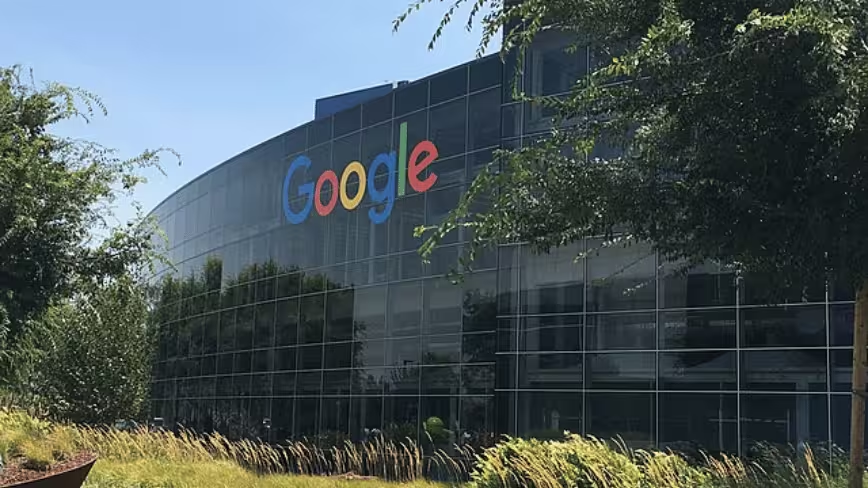
Google Headquarters
 Credit: The Pancake of Heaven!
Google, Meta, Spotify and Sony have taken Belgium to Europe’s top court. They say its copyright law forces platforms to pay creators far beyond what the EU intended.
Four of the biggest names in tech asked the EU’s Court of Justice on Tuesday to rein in Belgium. They say the country rewrote who gets paid when news, music and video spread online, Courthouse News reports.
Belgium, with several EU governments behind it, says the law simply gives publishers and artists a fairer cut. The judges must now decide one question. Did Belgium faithfully implement the EU’s 2019 copyright directive, or rewrite it?
What Belgium added
The directive aimed to help publishers and creators capture more value when their work circulates online. Belgium went further. It added mandatory negotiations, disclosure duties, and new compulsory payments for some creators. The four companies argue those extras go beyond what EU lawmakers approved.
Google says the law breaks that balance. It recently lost a record €4.1bn EU fine on appeal. Its lawyer told the court that Google Search already holds more than 1,500 licensing deals covering over 5,500 press publications. YouTube pays music firms and creators too.
Belgium’s system, Google said, forces binding payment talks. It also demands sensitive business data before anyone proves a platform used the content. The demands come from odd places, too. Google said it hears from plumbing trade associations, gaming websites, podcast operators and real estate listings. “This places online service providers in a dilemma,” lawyer Olivier Vrins told the court.
Host or publisher?
Meta pressed a different point. It argues the Belgian law blurs the line between platforms that host content and publishers that create it. Facebook does not choose which stories appear, it said. Users do. “Otherwise, every online platform would effectively become a user of the content uploaded by its own users,” lawyer Benoit Van Asbroeck told the court.
Spotify and Sony took aim at another clause. Belgium hands authors and performers a mandatory top-up right, even after they license their work through labels and collecting societies. The two firms warn this could make platforms pay twice for the same stream.
Why it matters
Belgium and its allies, including France, Spain, Italy, Poland and Germany, say the giants miss the point. Creators bargain against firms of vastly greater power. Without extra safeguards, they argue, copyright rights mean little in practice.
The stakes reach past Belgium. The court will decide how much room any member state has to write tougher rules than Brussels. Advocate General Maciej Szpunar delivers his opinion on 19 November. A final ruling follows later. For every publisher and platform in Europe, the outcome sets the price of content.
Get the TNW newsletter
Get the most important tech news in your inbox each week.
Also tagged with


