The hard part of electrifying a motorcycle in Lagos or Nairobi was never the motorcycle, it was the charging. A rider who earns by the trip cannot afford to sit for hours waiting for a battery to fill, which is why Spiro built its business around swapping instead: pull in, trade a flat pack for a charged one, ride off in the time it takes to buy petrol.
That model has now drawn a Chinese investor, and with it Spiro has edged closer to becoming one of Africa’s few billion-dollar startups.
The company has secured an additional $55mn from NewTrails Capital, a Chinese firm, to expand its battery-swapping network, manufacturing, and energy infrastructure across the markets where it already operates.
The cheque comes only weeks after a $215mn equity round backed by Impact Fund Denmark, Equitane, and Afreximbank’s FEDA, and it pushes Spiro’s total disclosed funding to roughly $557mn, among the most raised by any electric-mobility company on the continent.
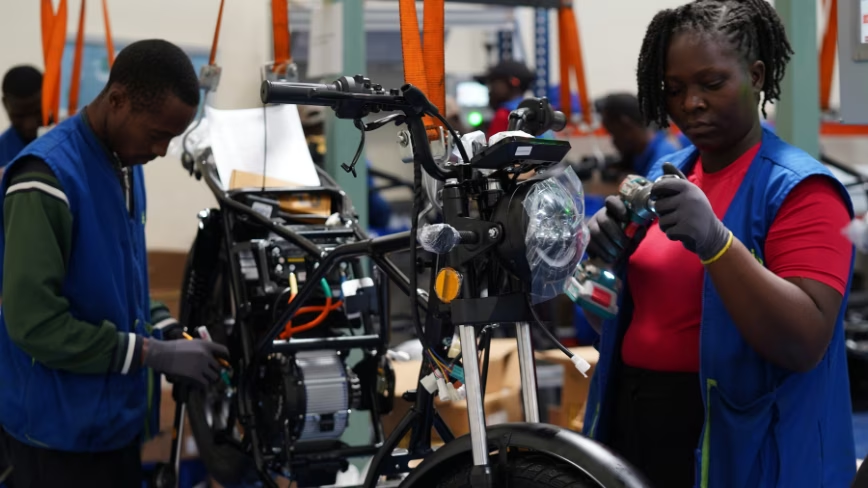
What NewTrails is buying into is less a vehicle company than a network. Spiro runs more than 100,000 electric motorcycles and around 2,500 automated swap stations across seven countries: Kenya, Rwanda, Uganda, Togo, Benin, Nigeria, and Cameroon.
The firm has described Spiro as an “infrastructure-like business,” and the framing is the point. A swap station, once built, throws off steady revenue the way a toll road or a power line does, and Yufan Zhang, a founding partner at NewTrails, cast the investment as a long-term bet on Africa’s energy transition rather than a quick ride on an EV cycle.
Spiro is not a small operation dressed up as a big one. Founded in 2022 and based in Dubai, it grew out of Equitane, the investment platform of its chairman, Gagan Gupta, and it has built a technology base far from its markets, with a centre in Pune, India, staffed by scores of engineers and holding a portfolio of patents.
The new money is earmarked partly for expansion into Malawi, Mali, and Ethiopia, three markets that would widen its footprint well beyond its current base.
It also follows a steady drumbeat of fundraising, a $100mn equity round led by Afreximbank’s FEDA in October 2025, a $50mn debt facility early this year, the $215mn round in June, and now the NewTrails cheque, a pace that points to how capital-hungry a network of physical swap stations really is.
The Chinese angle is what makes the deal more than a funding line. China dominates the supply chain that makes battery swapping possible, from cells to swap-station hardware, and Chinese capital has been moving steadily into African infrastructure for two decades.
A Chinese investor taking a stake in the company building Africa’s swap network is, in that sense, the supply chain following the money it already supplies. It also lands as battery swapping, long treated as a curiosity in the West, has found its clearest proof of concept in exactly the kind of high-mileage, two-wheel market Spiro serves.
That is a debate TNW has followed closely, from whether swap stations can go mainstream to the case that motorbikes may succeed where electric cars failed.
China has done the most to push the model, keeping the technology alive when carmakers elsewhere gave up on it. Spiro’s bet is that the same logic that works for a fleet in Hangzhou works for a boda-boda in Kampala.
Spiro has not disclosed a precise valuation, and “nearing unicorn status” is the company’s own framing rather than a confirmed mark. What is not in question is the scale of the wager being placed on African e-mobility, or that a Chinese investor has now decided the continent’s largest swap network is worth owning a piece of.
The motorcycles were always going to be electric. The question was who would build the grid beneath them, and increasingly the answer involves Beijing.
Get the TNW newsletter
Get the most important tech news in your inbox each week.


