TL;DR
SpaceX has lowered its IPO valuation target from above $2 trillion to at least $1.8 trillion after investor consultations. Marketing begins as soon as 4 June with pricing as early as 11 June. The company reported $18.7 billion in 2025 revenue but swung to a $4.94 billion loss after acquiring xAI.
SpaceX is targeting a valuation of at least $1.8 trillion in its initial public offering, down from the $2 trillion-plus it was aiming for as recently as April, according to Bloomberg. The target was adjusted after consultations with advisers and investors, and could still move higher depending on feedback during the formal marketing period, which is expected to begin as soon as 4 June. Pricing could come as early as 11 June.
The company is seeking to raise as much as $75 billion in the offering, which would make it the largest IPO in history. SpaceX will trade on Nasdaq and Nasdaq Texas under the ticker SPCX. Goldman Sachs, Morgan Stanley, Bank of America, Citigroup, and JPMorgan are leading the deal alongside 18 other banks.
The numbers behind the pitch
SpaceX’s S-1 filing on 20 May revealed a company that has grown rapidly but is not yet profitable at its current scale. Revenue rose from $14 billion in 2024 to $18.7 billion in 2025. But the company swung from a profit of $791 million in 2024 to a loss of $4.94 billion last year, driven by the costs of integrating xAI and expanding AI infrastructure.
The February acquisition of Elon Musk’s AI company xAI, which includes the Grok chatbot and social media platform X, gave SpaceX a valuation of $1 trillion and xAI a value of $250 billion at the time. The merger transformed SpaceX from a rocket and satellite internet company into what its IPO pitch describes as an AI services and infrastructure company with a total addressable market of $28.5 trillion, encompassing orbital data centres and space-based computing.
Why the valuation came down
The reduction from $2 trillion-plus to $1.8 trillion reflects the standard dynamics of IPO pricing rather than a crisis of confidence. Companies routinely set ambitious initial targets and then calibrate based on what institutional investors signal they are willing to pay. At $1.8 trillion, SpaceX would still debut as one of the most valuable companies on any exchange, larger than Amazon and trailing only Apple, Nvidia, Microsoft, and Alphabet.
The financial structure around Musk may also be a factor. The S-1 revealed a $20 billion bridge loan at 4.58% that replaced $17.5 billion of high-interest junk debt from X and xAI, cutting annual interest costs roughly in half. Musk controls roughly 79% of voting power despite owning approximately 42% of equity, a dual-class structure that some investors have flagged as a governance concern.
The Blue Origin explosion adds context
The valuation news arrived on the same night that Blue Origin’s New Glenn rocket exploded during a static fire test at Cape Canaveral, destroying the vehicle and its only launch pad. The incident underscores SpaceX’s dominance in commercial launch. SpaceX is targeting 140 to 145 launches in 2026 and has already completed more orbital missions than any other provider. Blue Origin had planned 8 to 12 launches this year.
SpaceX has had its own setbacks, including a Starship V3 booster failure three weeks before the IPO filing. But the company has built enough redundancy, with multiple pads and a proven fleet of Falcon 9 rockets, that individual failures have not disrupted its commercial operations. Blue Origin’s loss of its sole New Glenn pad is a qualitatively different problem.
What comes next
The formal marketing period, known as the roadshow, will give SpaceX’s management team roughly a week to make its case to investors. The pitch centres on Starlink’s satellite internet business, which generated $10.6 billion in revenue in 2025 and serves more than 10 million subscribers, alongside the xAI division’s AI infrastructure ambitions.
At $1.8 trillion, SpaceX would be valued at roughly 96 times its 2025 revenue, a multiple that reflects investor expectations of sustained hypergrowth rather than current profitability. The IPO includes an unusually large 30% retail investor allocation, a decision that could drive first-day demand but also introduces volatility. Whether the final pricing lands at $1.8 trillion, higher, or lower will depend on how institutional investors respond to a company that lost nearly $5 billion last year but claims to be building the infrastructure for an AI-powered space economy.


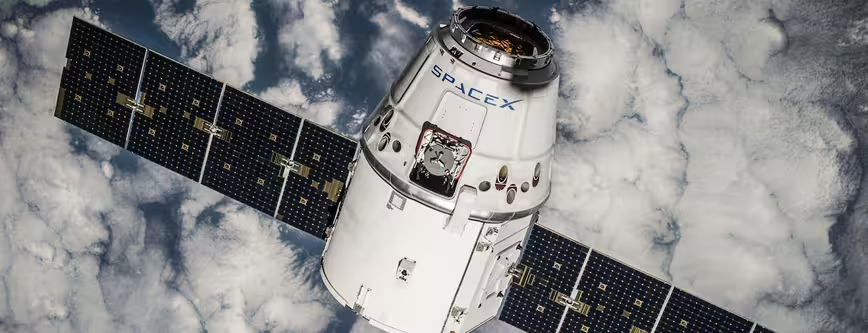
 Credit: SpaceX