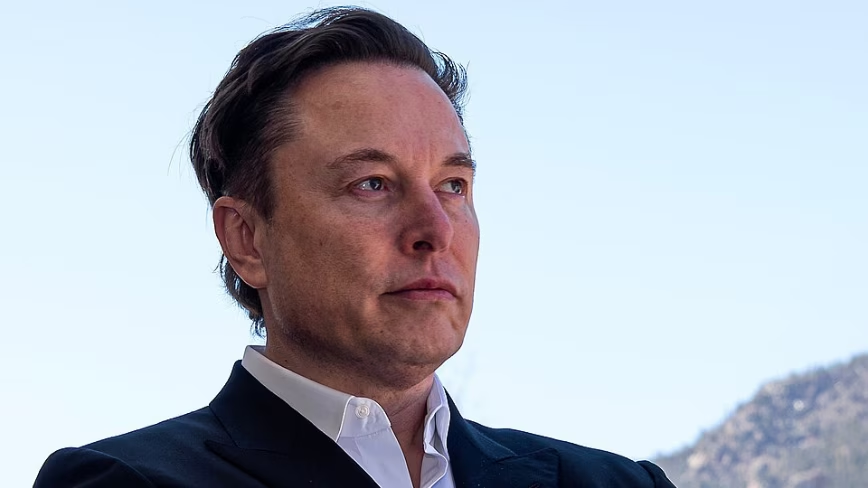
Elon Musk
 Credit: Courtesy Photo
SpaceX posted a 30-minute all-hands to X on Tuesday. Elon Musk used it to make two claims, and they only make sense together. The first is a number. AI revenue will pass everything else the company sells by next month. The second is a method. SpaceX will train Grok on its own information, including the people who work there.
The arithmetic is the story
Look at what that first claim requires. SpaceX reported second-quarter revenue of $7.81bn, of which AI was $2.56bn, Business Insider notes. Connectivity brought in $4.29bn and space products $962m. So everything that is not AI came to $5.25bn.
For AI to exceed all of that, it has to more than double while the rest stays still. Musk gave himself until September. He seemed aware of how it sounded. “Not probably, definitely,” he said, correcting his own hedge mid-sentence. He added that AI would “significantly exceed” the rest in the fourth quarter.
Employees as training data
The second claim is where it gets uncomfortable. “We’re going to be training Grok on the sum total of all SpaceX information,” Musk told the meeting. Then came the line that has travelled since. “So in a way, it will be trained on you.”
He framed that as a safety argument rather than a data grab. Staff are “a collection of some of the very best humans on Earth”, he said. A model built on them ought to inherit decent values. “You will effectively be the parents of the AI. It will inherit your thoughts and ideas and beliefs, and I think that’s a good thing.”
Nobody has said what the data is
The detail is missing entirely. SpaceX has not said which employee data it means. It has not said how it plans to collect it, or whether staff can decline. The company did not respond to a request for comment. That leaves a very large promise resting on an undefined noun.
There is a recent precedent, and it did not go well. Meta began collecting employee keystrokes and mouse movements in April to train its models. It paused the programme in June. Private conversations and performance data had become visible across the whole company.
Why the company needs it
This is not sentiment, it is supply. AI companies have exhausted the readily available internet. What they want now is data showing how humans actually operate a computer. That is exactly what agents need.
SpaceXAI launched Grok Bot the same day. They are agents with their own cloud machine, and they sign into apps to finish multi-step work. This desk covered that launch on Tuesday. Training something to work like a colleague requires recordings of colleagues working.
So the two announcements are really one. The revenue target needs the agent product. The agent product needs the training data. The training data is the staff.
The company this now is
SpaceX absorbed xAI shortly before its June listing and renamed itself SpaceXAI. Its first results as a public company showed AI at roughly a third of revenue. The spending matches the rhetoric. It is buying Cursor for $60bn, committing to Nvidia hardware, and planning data centres in orbit.
Musk closed on the reward rather than the risk. Anyone at SpaceX who wants to go to the moon or Mars will be able to, he said. He gave his word on it.
The reasons to wait and see
Grok is not winning. It trails OpenAI and Anthropic on several major benchmarks. That is awkward for a company betting its revenue mix on it. Musk’s AI products also have a habit of stalling. Grokipedia was going to beat Wikipedia and then simply stopped updating.
Big promises are the house style here. This is the same company that floated factories on the Moon. Musk introduced that one by saying he knew it sounded nuts.
The September claim is different, because it is checkable. In roughly six weeks SpaceX will either report AI revenue above $5.25bn or it will not. Unlike a lunar factory, there is a date attached. The employee data question has no such deadline, and that is the one staff should be asking about now.
Get the TNW newsletter
Get the most important tech news in your inbox each week.
Also tagged with


