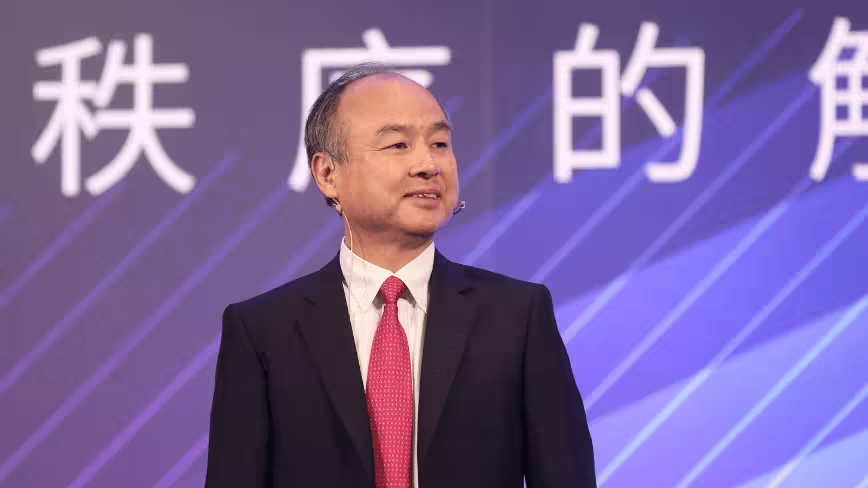
SoftBank founder and CEO Masayoshi Son on stage in Taipei, 22 June 2019.
 Credit: glen photo via Shutterstock.com
SoftBank is seeking a further $10bn loan to fund its OpenAI stake, Bloomberg reported on Friday. It closed a loan of exactly that size, secured against the same asset, 22 days earlier.
TNW has not independently verified the report and could not review its full terms, so what follows sets the reported request against the public record of how SoftBank has financed this position. That record is unusually detailed, because almost every step of it has been reported as it happened.
Start with the obligation. SoftBank signed a $40bn unsecured bridge facility in March to fund its OpenAI commitments, and that facility has to be repaid or refinanced by March 2027.
A bridge is meant to be temporary by design, and the work of the past five months has been the search for something permanent to replace it. The group has committed more than $60bn to OpenAI and adjacent AI infrastructure, which is a large amount of exposure to hold on short-dated debt.
The margin loan was the first attempt at a durable answer. SoftBank approached lenders in April for $10bn secured on OpenAI shares, and ran straight into the problem with pledging a private company: nobody could agree what the collateral was worth.
The target was cut to $6bn in May, then revived at $10bn in July once SoftBank added a corporate guarantee, giving lenders recourse to the parent if the pledged shares fell short. Reuters, which broke the revival, reported the concession as the thing that unlocked the deal.
Bloomberg reported on 6 August that the $10bn margin loan had closed, four months after the first approach and with a structure materially friendlier to lenders than the one originally proposed.
Three weeks later the financing machinery was moving again. On 26 August, Bloomberg reported SoftBank was weighing a bond sale of up to $20bn to refinance the OpenAI borrowing, and two days after that came the report of a second $10bn loan.
The borrowing has not been confined to the OpenAI stake either. SoftBank went to Japanese retail investors this year with a record $6.3bn bond sale, a market it turns to when institutional appetite needs supplementing.
The equity side has, for now, been forgiving. SoftBank overtook Toyota as Japan’s most valuable listed company on the strength of the AI rally, which is what makes the leverage tolerable to shareholders who might otherwise object to it.
Read as a sequence, none of this is a surprise. A $40bn bridge does not get retired by a single $10bn facility, and the arithmetic has always required several instruments arriving in succession.
The original ambition was larger still, since SoftBank sought a record facility of up to $40bn for the OpenAI stake back in March. The run of smaller instruments since then is what that ambition looks like once lenders have finished pricing it.
Read as a cadence, it is harder to ignore. SoftBank is now returning to credit markets at intervals measured in weeks rather than quarters, and each approach is priced against a collateral valuation that only exists on paper.
OpenAI filed confidentially with the SEC in June, which points to an eventual listing and, with it, a market price for the shares SoftBank keeps pledging. Until that happens, every lender is taking a view on a number nobody can look up.
The syndication has held up so far. Twenty-one further lenders joined the $40bn facility after its initial signing, which suggests appetite has not yet been exhausted, whatever the pace of the asks.
Masayoshi Son has built the group around this position, and SoftBank’s debt-fuelled AI bet now moves with OpenAI’s fortunes more than with anything else on its balance sheet. That is a deliberate choice, repeatedly restated.
SoftBank has not commented publicly on the latest report, and no terms, lenders, or timeline have been confirmed. The next fixed point in the story is not a loan but a deadline: March 2027, and $40bn.
Get the TNW newsletter
Get the most important tech news in your inbox each week.


