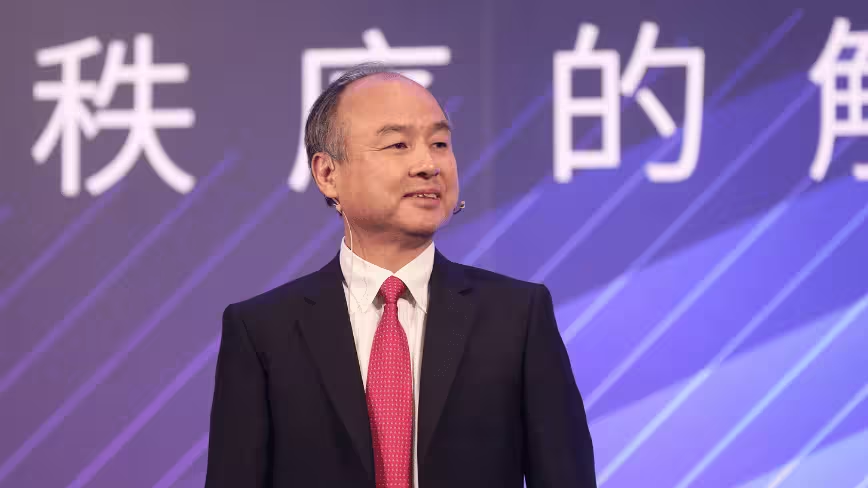
SoftBank founder and CEO Masayoshi Son on stage in Taipei, 22 June 2019.
 Credit: glen photo via Shutterstock.com
Lenders pushed back on valuing OpenAI shares as collateral. The downsize lands a fortnight after the $10bn ask first surfaced and is the clearest signal yet that even an $852bn primary round has not closed the gap between sticker and what banks will lend against.
SoftBank Group has trimmed the size of a margin loan it is trying to raise against its OpenAI stake to as little as $6bn, down from the $10bn it originally pitched, after several creditors balked at the valuation, Bloomberg reported on Friday.
The Tokyo-listed conglomerate and bankers running the syndication have spent recent weeks separately walking lenders through a smaller transaction, according to Bloomberg’s sources.
Discussions are continuing, and the final size could change again. Pricing has not been re-disclosed; the original pitch carried an indicative margin of around 425 basis points over SOFR, which would put the borrowing rate near 7.9% at current rates.
The borrowing structure is unusual for SoftBank, not in scale but in collateral. Margin loans against listed shares are a standard treasury tool.
Margin loans against private-company stakes, even very large ones, are less so, and pricing them depends on a creditor’s confidence that the underlying valuation will hold under stress and that recourse is meaningful if it does not.
What lenders pushed back on
OpenAI’s $852bn post-money valuation, struck in March’s primary round, is recent and large; lenders SoftBank’s original $10bn margin-loan ask against it were already conservative on advance rates, with terms reflecting a substantial haircut. The further downsizing suggests the haircut they are willing to apply has widened.
Two pieces of evidence sit in the lender’s file. First, the secondary market. Reported price talk on OpenAI secondary lots since the primary close has skewed below the $852bn mark, with sellers outnumbering buyers by roughly five to one in some recent venues. Second, the volume of debt SoftBank has already piled on against its position.
The group secured a $40bn bridge for the latest OpenAI follow-on and is using OpenAI shares to leverage a tertiary pot on top. Each new layer reduces the cushion banks have if a mark-to-market shock hits the collateral.
S&P lowered SoftBank’s credit outlook last month, citing concerns that the scale of OpenAI exposure could impair the group’s liquidity and the credit quality of its broader asset base.
The agency did not flag the margin loan specifically; it would not have needed to. The directional signal is the same.
How big is the SoftBank-OpenAI stack now
SoftBank’s cumulative committed exposure to OpenAI will reach roughly $64.6bn once the latest $30bn follow-on closes, giving the group around 13% of the company.
To get to that number, Masayoshi Son sold the entire Nvidia stake (about $5.83bn) and the residual T-Mobile holding (about $12.73bn) between June and December 2025, then borrowed the $40bn bridge it secured to fund the OpenAI follow-on, syndicated across eight banks.
Group debt now sits at roughly ¥20.45 trillion ($135bn). The downsized margin loan would push that further, but would do so at the most opportunistic point in the structure: collateralised, drawable, and refinanceable rather than baked into long-dated bonds.
The capital is being deployed at a comparable cadence. Beyond the OpenAI round itself, SoftBank has put money into Stargate, the joint AI infrastructure vehicle with OpenAI and Oracle, and into adjacent infrastructure, such as converting a Sharp LCD factory into a battery plant for AI data centres. Each of those commitments needs cash within a multi-quarter window.
SoftBank is not short of liquidity. The group has access to debt across several tenors and has historically been able to refinance through the cycle.
The interest in this margin-loan story is not whether the firm closes it at $6bn, $8bn, or back at $10bn, but what the trajectory says about how the financing world is now valuing OpenAI relative to its primary marks.
Two readings sit on the table. The benign one is that creditors are being procedurally cautious about a young collateral class and that the haircut will compress as OpenAI ages and a more public valuation tape emerges.
The less benign one is that the secondary-market pricing is right and the primary round was already an outlier; in that case, the asset base of the entire SoftBank-OpenAI thesis is worth materially less than the headline.
Neither reading is provable today. Both will get tested when SoftBank reports earnings in early August, when OpenAI is expected to disclose updated revenue figures, and when the next secondary lot clears.
A close at $6bn at the original 425bps spread, or a wider spread for the same size, will both reflect the true cost of borrowing against private AI equity. Second, whether other holders of OpenAI stock try similar facilities. A
ndreessen Horowitz and D. E. Shaw Ventures are recent buyers; their treasury teams will be watching SoftBank’s process closely.
Third, OpenAI’s own posture. The company has so far supported its investors’ use of its shares as collateral; if pricing deteriorates further, that posture could change.
For now, the headline is narrower than the wider question. SoftBank wanted to borrow $10bn and is on track to borrow $6bn. The number tells the story; the trend is what matters.
Get the TNW newsletter
Get the most important tech news in your inbox each week.


