TL;DR
Snap’s Specs AR glasses cost $2,195, preorder now with $200 deposit, ship fall 2026 in US/UK/France. Self-contained with 4-hour battery and AI.
The self-contained glasses run on two Snapdragon processors, offer a 51-degree field of view, and ship this fall in the US, UK, and France as the company that cut 16% of its workforce tries to build a new hardware category
Snap
 Credit: Snap
Snap’s Specs AR glasses cost $2,195, preorder now with $200 deposit, ship fall 2026 in US/UK/France. Self-contained with 4-hour battery and AI.
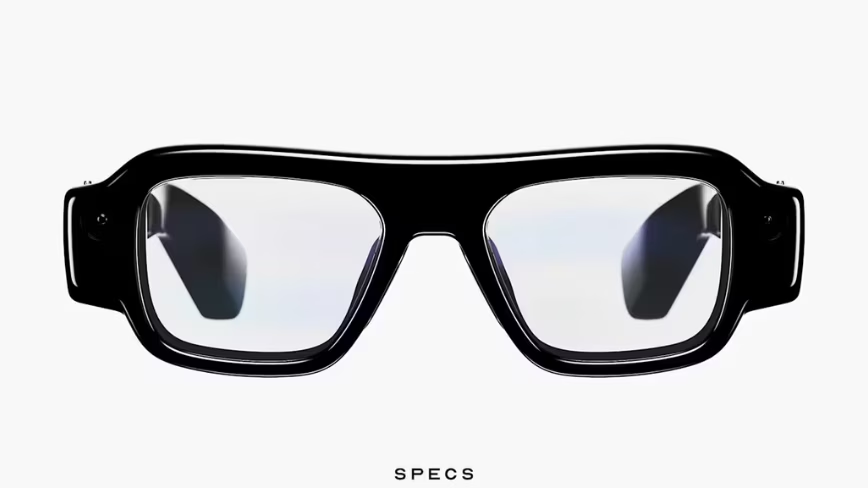
Snap unveiled the consumer version of its augmented reality glasses on Monday at the Augmented World Expo in Long Beach, California, pricing them at $2,195 with preorders opening immediately through a $200 refundable deposit. The glasses, which the company calls Specs, ship this fall in the United States, the United Kingdom, and France. They are self-contained computing devices that require no phone tether, no external processing puck, and no cable, a distinction Snap is emphasising against every AR headset that has come before.
The hardware runs on two Qualcomm Snapdragon processors, one handling the operating system and applications and the other dedicated to computer vision. Snap has not disclosed the specific chipset models. The glasses deliver a 51-degree diagonal field of view across 16 million colours and offer four hours of continuous battery life with an additional 20 hours from a charging case.
They come in two sizes: 47mm at 132 grams and 52mm at 136 grams. Both are lighter than most over-ear headphones, though heavier than conventional eyewear.
What Snap has not disclosed is equally notable. The company refused to share the display resolution, brightness in nits, refresh rate, RAM, storage capacity, or camera specifications. For a $2,195 product entering a market where consumers are accustomed to detailed spec sheets, the omissions are conspicuous. Whether the missing numbers reflect specifications Snap considers uncompetitive or a deliberate strategy to avoid direct comparisons with rivals is unclear.
The software side is where Snap is making its differentiation argument. An AI assistant powered by partnerships with both OpenAI and Google provides contextual awareness, answering questions about what the wearer is looking at, translating text and speech in real time, and surfacing relevant information without requiring the user to reach for a phone. EyeConnect, a feature Snap describes as a first for AR, activates shared multiplayer augmented reality experiences when two Specs wearers make eye contact, overlaying collaborative content in both users’ fields of view simultaneously.
A privacy LED illuminates whenever the glasses are recording, following the approach Meta adopted for its Ray-Ban smart glasses after sustained criticism about covert recording. Meta’s indicator light has been widely criticised as too dim to notice in daylight, and it remains to be seen whether Snap’s implementation is more visible.
The launch comes from Specs Inc., a wholly owned subsidiary Snap spun off in January to insulate the AR programme from the broader company’s financial pressures. Those pressures are significant. Snap cut approximately 1,000 employees in April, roughly 16% of its full-time workforce, and closed more than 300 open roles to save over $500 million annually.
The company is not consistently profitable. Its Q1 2026 advertising revenue grew just 3% while Meta’s grew 33%, and the $400 million Perplexity AI partnership that was supposed to bring AI search into Snapchat collapsed before launch.
The competitive landscape makes the $2,195 price point a gamble. Meta’s Ray-Ban smart glasses start at roughly $350 and have sold more than seven million units, though they are camera-equipped sunglasses with audio rather than full AR displays. Apple’s Vision Pro costs $3,500 but is a spatial computing headset, not glasses.
Google announced Android XR smart glasses at I/O with Samsung, Warby Parker, and Gentle Monster as hardware partners, targeting a fall 2026 launch, but those devices are audio-first with no display and no confirmed price. Snap’s Specs occupy an awkward middle ground: more expensive than Meta’s glasses, less capable than Apple’s headset, and launching into a market where the category leader has a seven-million-unit head start.
The bet is that consumers will pay a premium for what Snap says no other product offers: lightweight, untethered AR glasses with a full-colour display, AI integration, and social features designed for face-to-face interaction rather than isolation. Whether that pitch resonates with anyone beyond developers and early adopters at $2,195 is the question that will determine whether Specs Inc. justifies its existence or joins the long list of ambitious AR hardware that never found a market. Snap has not disclosed sales targets or production volumes.
Get the most important tech news in your inbox each week.


