TL;DR
Smart #2 production version revealed via Chinese MIIT filing. Fortwo successor with 186-mile range (3x the old EQ Fortwo), 80 hp, 1,130 kg, CATL LFP battery, V2L. Under €22,500 in Europe. Paris debut October. China and Europe markets.
The production Smart #2 weighs 1,130 kg, measures 2.76 metres long, has an 80 hp motor and a CATL LFP battery. It charges 10-80% in under 20 minutes. Global debut at the Paris Motor Show in October.
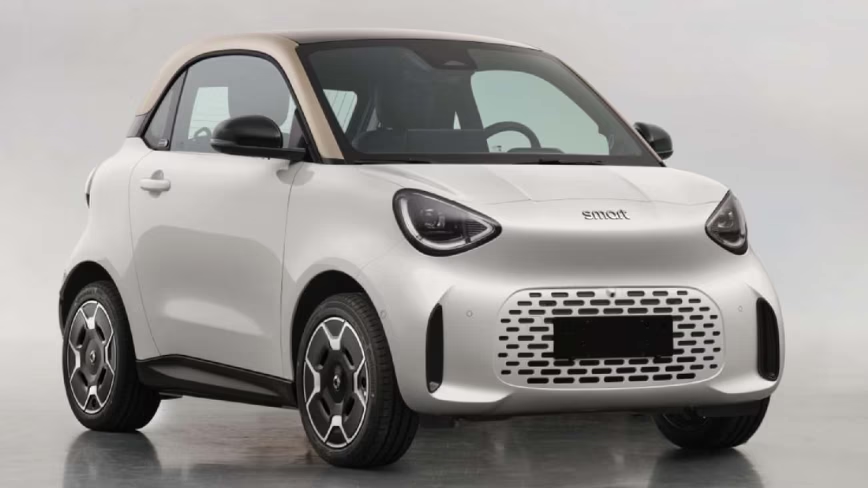
Smart #2 production version revealed via Chinese MIIT filing. Fortwo successor with 186-mile range (3x the old EQ Fortwo), 80 hp, 1,130 kg, CATL LFP battery, V2L. Under €22,500 in Europe. Paris debut October. China and Europe markets.
Smart’s Fortwo is back, and this time it is electric-only. The production version of the Smart #2 has been revealed through a Chinese MIIT filing, showing a tiny two-door city car that looks almost identical to the concept shown in April. It is 2.76 metres long, weighs 1,130 kg, and is powered by an 80 hp rear-mounted motor developed by Infimotion. The floor-mounted LFP battery uses CATL cells, and Geely, which owns half of the Smart brand alongside Mercedes-Benz, handles final assembly.
The range is the headline improvement. Smart says the European version will get a 35.7 kWh battery with a manufacturer-estimated range of 186 miles, nearly triple the 58-mile EPA range of the old EQ Fortwo sold in the US. Charging from 10 to 80% takes less than 20 minutes. Vehicle-to-load is standard, meaning the car can export energy from its battery to power appliances or tools. The top speed is 130 km/h, which is not built for the Autobahn but is perfectly sized for city streets where parking a normal car is a daily battle.
The Smart #2 will debut at the Paris Motor Show in October, with production starting in China afterwards. The Microlino has been trying to revive the micro-EV category in Europe, but the Smart #2 is the first from a brand with actual manufacturing scale and dealer networks. European prices are expected to start below €22,500 ($26,000). Smart has not ruled out localised production in Europe if volumes justify the investment.
The broader context is a European market that is desperate for affordable EVs. European EV sales surged 51% in March as oil prices climbed past $100. Most of those sales were SUVs and crossovers, because that is what manufacturers build. The Smart #2 is the opposite: a car designed to be as small as possible, for a price that undercuts most of the market. Whether European buyers will choose a two-seater over a small crossover is the question. The original Fortwo proved there was a market for it. The #2 is betting the market is still there, just electric now.
Get the most important tech news in your inbox each week.


