 Credit: Salesforce
Slack launched a coding product on Thursday. Slack Code adds project-specific channels where teams and AI agents write, review and ship software together. The work happens inside the chat app rather than in a separate browser tab.
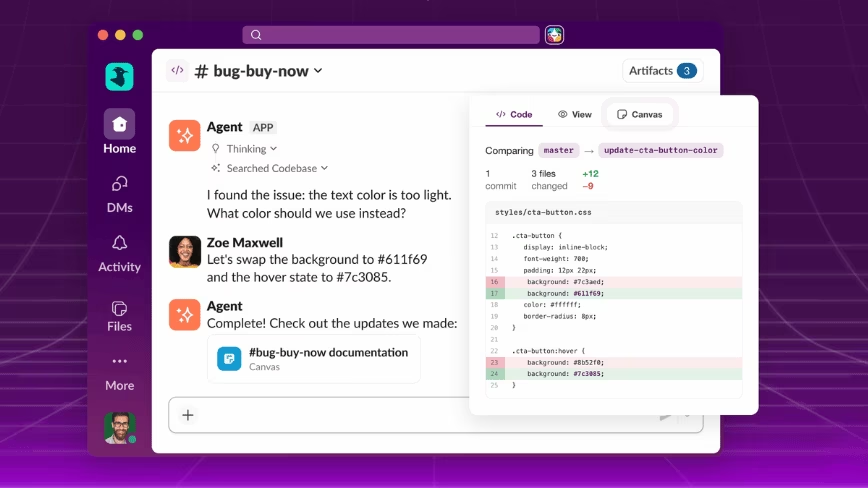
The mechanic is simple. Tag a coding agent from any conversation and it spins up a dedicated code channel. Everyone in that channel follows the work through its own tabs. There is one for the conversation, one for the plan, one for the code diffs, and one for a live preview of the output.
Tasks end, and the channel then archives itself. The record survives as an audit log.
Users can “audit code diffs, get live previews of the agent’s output, give feedback, and approve the work before it ships”, Slack said in its announcement. The diff view is the familiar one: old line struck through, new line beside it. The difference is that the whole channel sees it rather than one reviewer in a separate tool.
Slack Code is available today on any Slack plan, The Verge’s Jess Weatherbed reported. Access to each partner agent is a separate purchase, which is where the money sits.
Benioff said this was coming in May
This is a delivery rather than a surprise. TNW reported in May that Salesforce expected to spend $300m on Anthropic tokens this year. The same piece reported that Marc Benioff wanted coding inside Slack next. Three months later, here it is.
Benioff posted a demo video to X on Wednesday evening, as Gizmodo’s Webb Wright noted. Salesforce bought Slack in 2020. It has spent this year turning the app into the front end for its agent strategy, starting with Slackbot in the spring.
ChatGPT is now a founding partner
The partner list deserves a second look. Slack Code launches with agents from Anthropic, Cognition, GitHub, Vercel and OpenAI. ChatGPT sits alongside Claude as a founding partner of Salesforce’s flagship collaboration product.
That is awkward history. Salesforce staff were already confused about the company promoting Anthropic inside Slack back in June, because Agentforce chases the same budgets. Salesforce has answered by adding more outside agents, not fewer.
Anthropic launched Claude Tag in Slack in June. Its product lead framed today’s launch as the natural extension of that.
“So much engineering work already starts as a conversation in Slack with Claude Tag,” said Cat Wu, head of Claude product at Anthropic. “Slack Code gives teams a dedicated channel where the people, the context, and Claude work together from the start.”
GitHub framed it as a division of labour. “Humans set direction, agents close the loop,” said Mario Rodriguez, the company’s chief product officer.
A human has to sign the risky part
High-stakes actions need approval. Before anything merges to production, the agent packages its work for an expert to sign off inside the channel.
“Slack Code also requires human sign-off on high-stakes actions like merging code to production,” company spokesperson Gianna Dimick told Gizmodo. All of it is governed by Slack’s existing enterprise security model.
The guardrail has a reason. Coding agents have wiped codebases during live sessions, and Gizmodo pointed to two such incidents in its write-up. Agents in code channels inherit Slack’s permissions and admin controls, so IT provisions no new identities.
Anyone in a channel can pause, redirect or stop an agent mid-task. A new Agents tab lists every agent and session across the app. It flags blocked threads and offers the same kill switch.
The pitch is that non-engineers get to build
Slack is selling reach as much as speed. Its own worked example starts with a product manager spotting a bug report. The manager tags an agent, and a fix gets reviewed and merged without an engineer having to pick it up first.
“In the Code channel, the whole team and the agent work together on the build,” Katie Steigman, Slack’s vice president of product, said in the demo video. “Nobody’s out of the loop, nobody needs an extra meeting.”
Rob Seaman, executive vice president and general manager of Slack, put the argument in terms of where value shows up. “AI only creates value when it’s part of how a team actually works, not something people go do alone in another tab,” he said.
Software engineering is the starting point rather than the limit. Slack says the code channel APIs will open to the wider developer community. Custom agents could then join channels for marketing campaigns or legal document review.
A separate “Add to Slack” flow lets teams drop in agents built on Lovable, n8n, LangChain, Superhuman and others in a few clicks. Slack has automated the OAuth handshake and the manifest setup behind it.
The workspace is getting crowded
Slack is not alone in selling agents as colleagues. Jack Dorsey’s Block launched Buzz in July, a workspace built for humans and AI agents together. Viktor raised $75m from Accel in May to put an AI coworker inside Slack and Teams.
Slack’s advantage is incumbency. More than 500 AI apps and agents already sit in its marketplace. So do the conversations that precede the code. The bet is that shared context beats a better editor.
What a code channel does to review culture is the open question. Diffs and previews in a chat window make approval faster and far more visible. They also make it social, and a thumbs up in a busy channel is not a code review.
Salesforce charges nothing for the channels and lets the agent vendors charge for the work inside them, which says plainly which half it expects to be valuable.
Get the TNW newsletter
Get the most important tech news in your inbox each week.
Also tagged with


