 Credit: SkyPilot team
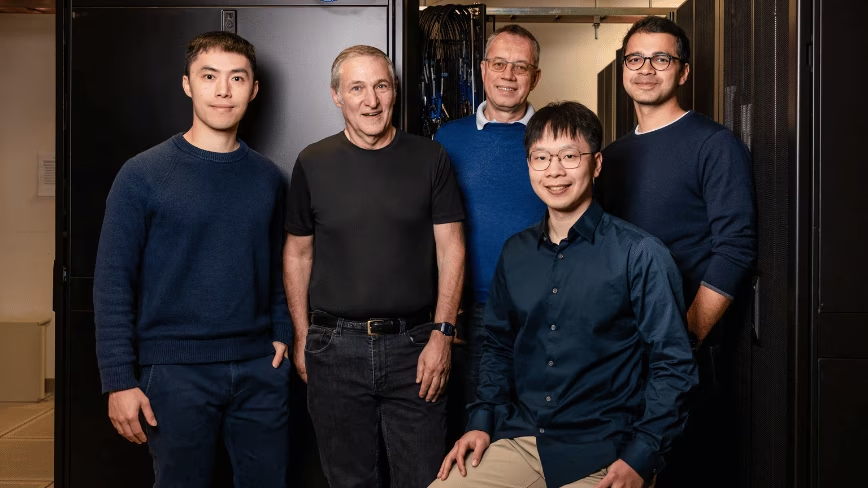
The company came out of stealth on Tuesday. The founders built it at UC Berkeley, in the same lab that produced Spark, Databricks, and Anyscale. The team includes Zongheng Yang and Databricks co-founders Ion Stoica and Scott Shenker.
The star-studded cheque
Lux Capital led the $20 million seed, Fortune first reported. Coatue, Amplify, Foundation, Race, and The House Fund also wrote checks. The angel list is the tell. It runs from Databricks’ Ali Ghodsi and Google’s Jeff Dean to the bosses of Vercel, Replit, and Hugging Face.
They are betting on a layer Nvidia already wanted. It bought Run:ai for about $700 million in 2024 to solve a version of this problem. Analysts expect the AI orchestration market to grow from about $14 billion this year to more than $60 billion by 2034.
One pool of scattered compute
The problem SkyPilot targets is fragmentation. GPU demand far outstrips supply. So every AI team now calls five or ten providers on day one just to scrape together chips, as SiliconAngle explains. Then it struggles to use them together.
SkyPilot is a control plane that pools it all into one interface, across 20-plus clouds, neoclouds, Kubernetes, and Slurm. It picks the most available hardware, packs workloads onto idle chips, and moves jobs without a rewrite. The open-source version has passed 14 million downloads. Top deployments already run over 10,000 GPUs.
Why neutrality is the moat
SkyPilot answers to no single cloud or chipmaker. It counts Nebius and CoreWeave as partners, not rivals. Its edge is simple: it sends your workload wherever it runs cheapest.
That reframes the question hanging over the industry: can AI firms make money? Yang points to Cursor, whose margins were negative until it stopped renting a rival’s models and trained its own. He calls that shift “custom intelligence,” now cheaper thanks to open-weight models that rank near GPT and Claude.
The catch
There is an obvious hole. The code has sat free on GitHub for years, so what stops a customer using it without paying? Lux’s Brandon Reeves has an answer: the free version is, he says, “probably like 1% of the way done.”
The deeper bet is Stoica himself. His Berkeley lab already produced two multibillion-dollar companies. That makes it a magnet for the students who build the next one. SkyPilot is selling a promise as much as a product. Whoever controls the compute layer, not any one chip, may win the next phase of AI.
Get the TNW newsletter
Get the most important tech news in your inbox each week.


