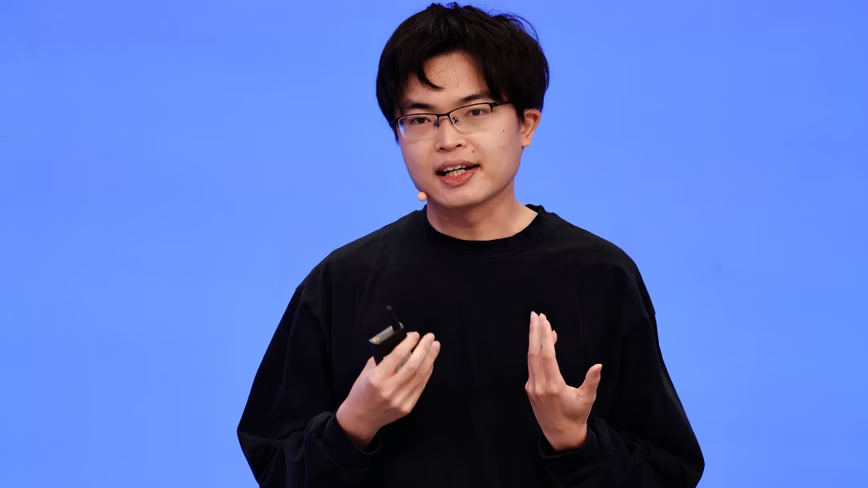
 Credit: Tingshu Wang | REUTERS
Chinese startup Moonshot AI has unveiled Kimi K3, a 2.8-trillion-parameter system it bills as the world’s largest open-weight AI model. The claim, made on 16 July, plants the firm squarely alongside the American frontier labs it has spent two years chasing.
The model arrives weeks after Moonshot was reported to be seeking a $30bn valuation, and it reads like a pitch to justify the figure. On the company’s own benchmarks, K3 ranks second overall behind only Anthropic’s Fable 5 and OpenAI’s GPT-5.6 Sol, the two closed models it is trying to catch.
Moonshot is best known outside China for Kimi, the consumer chat assistant that gave the startup a following among developers before it began releasing frontier-scale weights. K3 is the point at which that reputation meets the biggest model the company has shipped.
The system is a sparse mixture-of-experts design, activating roughly 50 billion of its 2.8 trillion parameters for any given token by routing through 16 of 896 experts.
It carries a 1-million-token context window and ships with what Moonshot calls Kimi Delta Attention, a mechanism the firm says decodes up to 6.3 times faster over million-token inputs.
The architecture is where the company plants its flag. Moonshot claims K3 achieves roughly 2.5 times better scaling efficiency than last year’s Kimi K2, helped by a second trick it labels Attention Residuals, which it credits with about 25% higher training efficiency at under 2% extra cost.
The “largest open model” billing is Moonshot’s, and for now it is hard to dispute. DeepSeek’s V4-Pro tops out at 1.6 trillion parameters and Moonshot’s own K2 at 1 trillion, so K3 roughly doubles the nearest open competitor. Grok 4.5, by comparison, is reckoned to sit near 1.5 trillion.
The catch is timing. Moonshot has published specifications and scores but will not release the weights until 27 July, which means no outside researcher can yet confirm the parameter count or reproduce the benchmarks.
That gap between announcement and download matters more than usual here. The figures that make K3 impressive, the size and the scores alike, are for now the company’s own, and early leaderboard results tend to flatter models before independent testing catches up.
Where independent testing does exist, K3 looks strong rather than untouchable. It scored 77.8 on Program Bench and 93.5 on GPQA-Diamond, leading the American pair on several coding suites, but trailing them on harder software-engineering tasks such as FrontierSWE.
On Arena.ai’s blind front-end coding leaderboard, developers ranked K3 above both GPT-5.6 Sol and Fable 5, a result that will matter more to working programmers than any single benchmark number.
The model is natively multimodal, handling text and images, and Moonshot is offering it through its Kimi apps and an API compatible with the OpenAI software development kit, which lowers the switching cost for anyone already building on American tools.
Price is the sharper weapon. Moonshot is charging $0.30 per million cached input tokens and $15 per million output tokens, undercutting the American incumbents and echoing DeepSeek’s steep discounting across the Chinese market.
The release adds to an increasingly crowded open-weight field. Thinking Machines’ Inkling and a run of Chinese systems have narrowed the distance to closed models from about a year to a matter of weeks.
The geopolitical read is hard to miss. A Chinese lab shipping the largest freely available model, at a fraction of American prices and despite US chip export controls, is exactly the outcome Washington’s restrictions were meant to forestall.
Moonshot is expected to publish K3 under a modified MIT licence, the permissive terms that made Kimi and DeepSeek popular with developers wary of usage caps. The company has not confirmed the final wording, and the weights themselves remain the missing proof.
The launch lands as Moonshot unwinds its VIE structure ahead of a planned Hong Kong listing. On 27 July the largest-open-model claim stops being a specification sheet and becomes something anyone can download and check.
Get the TNW newsletter
Get the most important tech news in your inbox each week.


