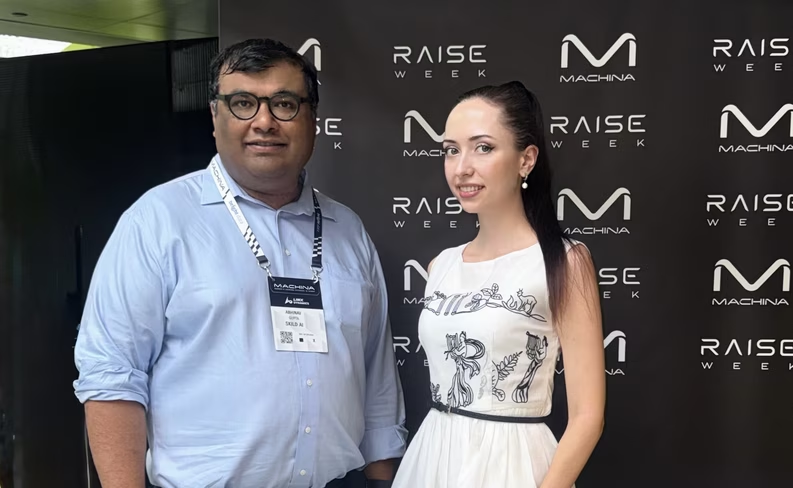
Abhinav Gupta (Co-Founder&President Skild AI) with Anna Tutova (Founder AI Crypto Minds) at Machina Summit in Paris.
 Credit: Anna Tutova
The $14 Billion Robot Company That Doesn’t Make a Single Robot
Inside Skild AI, the Pittsburgh startup building the “universal brain” that already powers hundreds of factory machines
Eight months after Jensen Huang declared the “ChatGPT moment for physical AI is nearly here” at CES 2026, one Pittsburgh startup is proving him right, not with viral demos, but with real robots on real factory floors generating real revenue.
When NVIDIA CEO Jensen Huang took the stage in Las Vegas this January and proclaimed that “the ChatGPT moment for physical AI is nearly here,” the robotics industry cheered. Humanoid prototypes danced on cue. Foundation models were open-sourced. Venture capitalists wrote checks with extra zeros.
Three years old and already valued at more than $14 billion, Skild AIis the Pittsburgh and San Francisco-based robotics brain startup proving Jensen Huang wasn’t just talking to the room. The company closed a $1.4 billion Series C round in January, led by SoftBank, with NVIDIA, Jeff Bezos via Bezos Expeditions, Macquarie Capital, 1789 Capital and a roster of strategic backers including Samsung, LG and Schneider Electric, that valued the company at more than $14 billion. Total capital raised to date: over $2 billion. Revenue in its first meaningful commercial stretch: roughly $30 million in under six months in 2025. Its software is running on hundreds of robots inside factories, data centers, and logistics hubs, with deployments at Nvidia’s Houston factory, several unnamed wiring and construction firms, and the LaGuardia trial. OEM partners such as ABB Robotics, Universal Robots, and Mobile Industrial Robots are embedding the Skild Brain directly into their own machines, turning specialized hardware into general-purpose tools.
“We are starting to see the start of that whole process right now,” says Abhinav Gupta, Skild’s co-founder and president. “We are seeing a lot more robots going into factories and warehouses like Skild has already hundreds of robots live on these scenarios. And so I would say it’s a start of a GPT moment which will happen over the next one, one and a half year.”
Abhinav Gupta would know. Before Skild, he spent four years building Meta’s FAIR Robotics Lab from scratch after a decade in computer vision and robotics research. He left in 2023 to start the company with fellow Carnegie Mellon professor Deepak Pathak. The inflection point, he said, came when demonstrations shifted from polished recordings to real-time, in-person systems that worked. “People are no more showing videos, they are showing live demos, things working live on your face. So then, that’s when I decided that since it’s starting to work, it’s time to do my own thing.”
“Now again, I want to remind you that 2023 is before the ChatGPT came in. So before the hype came in, we were one of the first companies to actually pitch a robotics foundation model. And now you see so many companies talking about it,” Abhinav Gupta says. “But the last three years have been kind of amazing. We have not only built our first foundation model, but we have built it very robust that works across different setups.”
That foundation model is what Skild calls the Skild Brain: an “omni-bodied” AI system designed to control virtually any robot: quadrupeds, humanoids, tabletop arms, mobile manipulators without being custom-built for each body type. Skild doesn’t manufacture hardware. It makes the universal intelligence layer that runs it.
“So we have a very horizontal approach to robotics. What that means is that we are building a platform or a brain that will work for any task, any scenario, and any hardware. Our motto is any task, any hardware, one brain,” Abhinav Gupta explains. The reasoning is quite pragmatic: no single task or robot body generates enough data to train a model that can handle the messiness of the real world. “And the reason is because you need lots and lots of data to build these foundation models and brains and so on. If you take only one task, there’s not enough data. If you take only one piece of hardware, there’s not enough data. You pour in data from everywhere that you can get and you learn one common model that transcends the task and that transcends the hardware form factor.” The result, he argues, is a system that “learns a true physical AI underlying behind it. It reasons about how the world works in a physical world.”
The data scarcity problem has always been robotics’ central bottleneck Unlike large language models, which can feast on the entire internet, robots historically had to be taught one task at a time in the physical world. Skild’s answer is a three-tiered pipeline.
First, internet-scale human videos teach the model what tasks look like across diverse environments. Then, billions of simulated scenarios run on NVIDIA’s Isaac platform, let the brain practice under extreme conditions. Finally, a small amount of real-world teleoperation and deployment data fine-tunes the system for specific jobs with high accuracy.
“At robotics we are very data hungry. We just don’t have enough data,” Abhinav Gupta admits. “So at Skild, we use any data that we can get to train our models.”
He uses a tennis analogy to explain why video alone can`t do the job: “If videos were sufficient, all of us can watch Roger Federer videos and become Roger Federer. That’s not how tennis works. We have to go and practice. And that’s where simulation comes in. We use the tasks that you have learned from videos and practice it in simulation under different conditions. Think of it as a high amount of wind, making the ball wet, and you still learn how to play tennis under these conditions. That gives you the robustness and it gives you how to recover when things are going wrong.”
The deployments are already piling up. Skild’s brain is now running on assembly lines at NVIDIA’s Houston factory, handling complex Blackwell GPU production tasks alongside Foxconn. It’s deployed at LaGuardia Airport. And in March, Skild AI announced partnerships with ABB Robotics and Universal Robots to embed its intelligence into industrial and collaborative robot portfolios worldwide, potentially revolutionizing automation for small and medium manufacturers.
“So our commercial thesis is that robots are ready for today. They’re just not ready for homes tomorrow,” Abhinav Gupta says. Hardware also dictates the pace. Skild’s model can run on dozens of form factors: arms, mobile bases, forklifts, humanoids, but Abhunav Gupta is realistic about which bodies are mature. “Humanoid is still there, some way to go because hardware is not deployment ready, but there’s still a long way to go. And our thesis is to deploy as much as you can, because whoever has the deployment advantage will also get the data advantage at the end of the day.”
That data advantage is the whole game. Every robot Skild deploys feeds real-world performance data back into the brain, making every subsequent deployment smarter. It’s the classic flywheel, except this time, the wheel is physical.
The commercial path is deliberate and sequential. Start with structured environments where ROI is immediate: factories, warehouses, data centers. Move to semi-public spaces like airports and banks. Then, eventually, the home.
“I tell people a lot that the GPT moment is not going to be an overnight moment when it comes to robotics. Because it’s not like an app you can put on a web and then millions of people can use it. With robotics, you have to put one robot one by one into deployment. So it’s a very slow process.” For him, the shift is visible in the gradual appearance of machines in structured environments. “So for me, the GPT moment will be that the robots start appearing more and more around us. So it will start from factories and warehouses. Every factory and every warehouse will have lots of robots. Then, you will have robots appear in public spaces, for example airports, conferences, shopping malls, and then finally the last bit of GPT moment will be robots in every home, the consumer robots.” Skild, he says, already has “hundreds of robots living in these scenarios,” and he believes the cascade will unfold “over the next one, one and a half year.”
For now, the focus is on making the brain even more generalizable. Abhinav Gupta says the team’s north star is reducing the amount of task-specific data needed to deploy on a new job, ideally down to almost nothing.
“Yeah, at Skild we are now trying to make our brain more and more robust. We are trying to make the post-training amount of data lesser and lesser. And our hope is we can actually have such a general model, that can train from zero to one example of a new task and become very, very robust on day zero itself. So again, reducing the amount of data that is required to deploy is what we are working on at this moment of time.”
If they pull it off, Skild won’t just be another AI unicorn with a lofty valuation. It will be the default operating system for the entire robotics industry.
Get the TNW newsletter
Get the most important tech news in your inbox each week.
This is a contributed article. Opinions expressed are the author's own. TNW newsroom and editorial staff were not involved in its creation.


