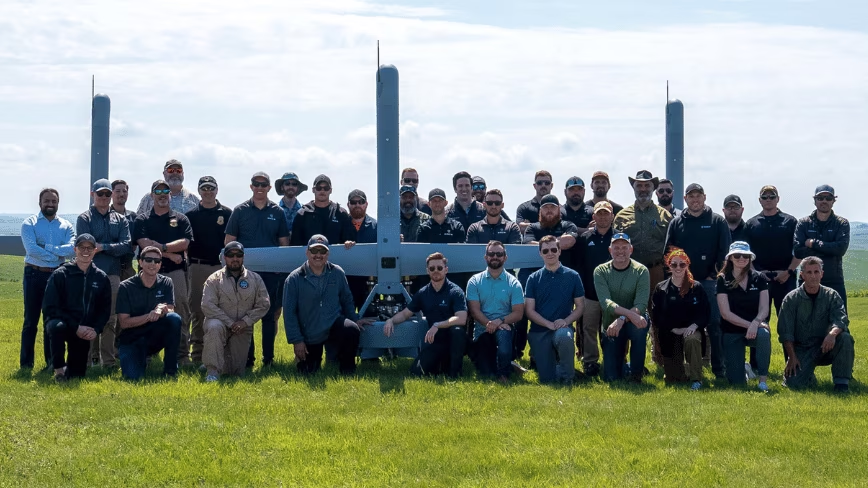

Shield AI, the San Diego defence technology company behind the autonomous pilot system Hivemind, announced on Wednesday that it has raised $2 billion in combined funding at a $12.7 billion valuation. The company will use part of the proceeds to acquire Aechelon Technology, a simulation platform that supports the Pentagon’s Joint Simulation Environment.
The raise comprises two pieces: a $1.5 billion Series G led by Advent International and co-led by JPMorgan Chase’s Security and Resiliency Initiative, and $500 million in preferred equity from funds managed by Blackstone, which also committed an additional $250 million in a delayed-draw facility. Advent’s chairman, David Mussafer, will join Shield AI’s board of directors, and JPMorgan’s Todd Combs will join as a board observer.
The valuation represents a sharp acceleration. Shield AI was valued at $5.3 billion as recently as March 2025, when it closed a $240 million F-1 round with strategic participation from L3Harris and Hanwha Asset Management. Before that, it raised $200 million at $2.7 billion in October 2023. In roughly two and a half years, the company’s valuation has grown nearly fivefold.
What Hivemind actually does
Shield AI was founded in 2015 by brothers Brandon and Ryan Tseng and Andrew Reiter. Brandon Tseng is a former Navy SEAL, and the company’s origin story is rooted in a specific operational problem: how to conduct reconnaissance and strikes in environments where GPS is jammed or unavailable and communications are severed, conditions the military designates as DDIL (disconnected, degraded, intermittent, or low-bandwidth).
The company’s answer is Hivemind, an AI pilot that operates aircraft autonomously using onboard sensors and reasoning rather than relying on external navigation signals. Shield AI’s Nova quadcopter, powered by an early version of Hivemind, became what The Wall Street Journal described as the first autonomous robot of its kind used in combat when it was deployed with US special operations forces in the Middle East in 2018.
Since then, the system has expanded to larger platforms. Shield AI’s V-BAT reconnaissance drone, powered by Hivemind, has logged more than 130 sorties in Ukraine since June 2024, operating in conditions of pervasive electronic warfare. Ukrainian forces used the V-BAT to locate a Russian SA-11 Buk-M1 mobile air defence system, a task that required the drone to navigate without GPS in a heavily jammed environment. Hivemind has also been tested on modified F-16 fighter jets as part of DARPA’s autonomous dogfighting experiments, and in a separate demonstration it successfully flew Anduril’s Fury drone, one of the US Air Force’s next-generation uncrewed combat aircraft contenders.
The X-BAT and the Aechelon bet
Shield AI unveiled the X-BAT in October 2025: a VTOL stealth fighter drone that requires no runway, can be deployed from ships, and is piloted entirely by Hivemind. The company has said its first vertical takeoff flight is scheduled for this year, with operational deployment estimated for 2028. The X-BAT represents Shield AI’s move from reconnaissance into strike capability, a significant expansion of the company’s addressable market and a direct challenge to larger competitors.
The Aechelon acquisition fits into this trajectory. Aechelon builds high-fidelity simulation environments used by the US military and allied forces to train pilots and test autonomous systems before live flights. Its platform supports the Pentagon’s Joint Simulation Environment, which is used to evaluate next-generation aircraft and weapons systems. For Shield AI, Aechelon provides the synthetic training data that Hivemind needs to improve across new aircraft types and mission profiles without the cost and risk of live flight testing. Shield AI has described the combination as a “Hivemind Foundation Model for Defence,” a domain-specific AI model that integrates simulation data with real-world operational data.
The defence tech boom
Shield AI’s raise arrives amid record capital flows into defence technology. Venture capital deals in the sector reached $49.1 billion in 2025, according to PitchBook, nearly double the $27.2 billion recorded the previous year. The largest rounds have gone to a small group of companies building autonomous and AI-powered military systems. Anduril, Shield AI’s most direct competitor, raised $2.5 billion at a $30.5 billion valuation in June 2025 and was reported in March 2026 to be pursuing a $4 billion round at a $60 billion valuation. Helsing, the European defence AI company, has also raised at multibillion-dollar valuations.
The spending is driven by a combination of factors that have aligned with unusual force: the war in Ukraine, which has demonstrated the decisive role of autonomous systems and electronic warfare in modern combat; growing tensions in the Pacific, which have accelerated procurement of long-range autonomous platforms; and a bipartisan political consensus in the United States that defence modernisation requires working with technology startups, not just legacy contractors. NATO’s DIANA initiative, which brings together universities, industry, and governments to work with startups on defence capabilities across more than 200 accelerator sites, is one institutional expression of this shift.
The question for Shield AI, and for the sector more broadly, is whether these valuations reflect genuine revenue trajectories or the kind of speculative enthusiasm that has historically accompanied defence procurement cycles. Shield AI has combat-proven technology, a clear operational track record in Ukraine, and contracts with the US Department of Defense. It also has a valuation that has grown from $2.7 billion to $12.7 billion in two and a half years, during a period when the company has been primarily a research and development operation building toward production-scale deployment. Advent International’s willingness to lead a $1.5 billion round suggests confidence that the production phase is imminent. Whether the X-BAT delivers on its 2028 timeline, and whether Hivemind can scale across the range of platforms Shield AI has promised, will determine whether that confidence was warranted.
Get the TNW newsletter
Get the most important tech news in your inbox each week.


