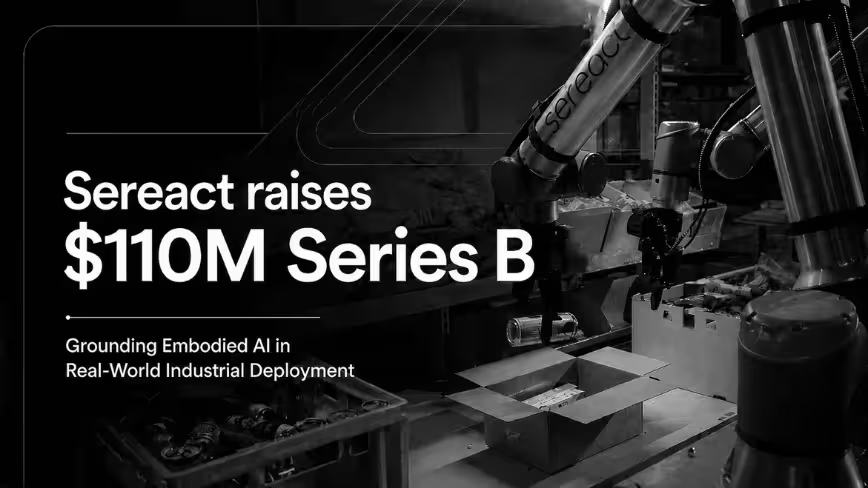
Sereact raises $110 million Series B to build robots
The round is led by Headline, with new investors Bullhound Capital, Felix Capital, and Daphni. Valuation is undisclosed. Sereact’s vision language action models already run in BMW, Daimler Truck, and logistics customers. The $110M is more than four times the €25M Series A raised just 15 months ago.
Sereact, the Stuttgart-based AI robotics software company, has raised $110 million in a Series B round led by Headline, the international venture firm with offices in Berlin, San Francisco, and Paris. New investors Bullhound Capital, Felix Capital, and Daphni joined alongside several existing backers.
The company declined to disclose its valuation. Funds will be used to develop Sereact’s core AI model, one that “makes robots smarter and more adaptable to different tasks”, and to scale deployment across logistics, manufacturing, and, increasingly, humanoid robot platforms.
Sereact was founded in 2021 by Ralf Gulde (CEO) and Marc Tuscher (CTO), both former AI researchers, at the University of Stuttgart.
The company’s technical approach is grounded in Vision Language Action Models (VLAMs): AI systems that combine computer vision, natural language understanding, and action planning into a single model, allowing robots to perceive their environment, interpret instructions, and execute physical tasks without requiring complex programming or environment-specific pre-training.
A robot picking a fragile object can, in principle, evaluate whether its planned grip will cause damage before its gripper closes.That capability is the meaningful differentiator in a market where most industrial robotics still operate on pre-programmed sequences that assume a controlled, predictable environment.
Warehouses, manufacturing floors, and logistics facilities are not controlled environments: objects arrive in unpredictable orientations, packaging varies, and edge cases are constant.
Sereact’s software-first approach, explicitly positioned against the hardware-first strategies of most robotics companies, is designed to make robots adaptable to this variation without requiring engineers to reprogram them for each new object type or layout change.
In Gulde’s formulation from the Series A announcement: “with our technology, robots act situationally rather than following rigidly programmed sequences.”
The commercial record behind the Series B is substantive. Customers include BMW Group, Daimler Truck, the Dutch e-commerce fulfilment company Bol, and logistics specialists MS Direct and Active Ants.
The deployment at automotive OEMs is editorially significant: BMW and Daimler Truck are not pilots or proof-of-concepts, they are production environments where the economic cost of a robot failure is measured in line stoppages.
Sereact’s technology reaching production at that tier of customer is the validation signal that distinguishes it from the large number of AI robotics companies still operating at the demonstration stage.
The funding trajectory makes the ambition of the round clear. Sereact raised $5 million in seed funding in 2023, €25 million (approximately $26 million) in a Series A led by Creandum in January 2025, and now $110 million in April 2026, a more than four-times step-up from the Series A in fifteen months.
Creandum’s Johan Brenner captured the investment thesis at the Series A: “most AI robotics companies are currently hardware-first. What sets Sereact apart is their software-first, foundational approach which means they have the potential to become the brain of any robot that requires vision and autonomous capabilities.”
That thesis, a software-first robotics intelligence layer deployable across any hardware platform, is essentially the same thesis that has made Mobileye valuable in autonomous vehicles and that Nvidia is pursuing through its Isaac robotics platform: the idea that the highest-margin position in robotics is not the robot itself but the intelligence running it.
The broader market context is accelerating. Humanoid robot deployments by Figure AI, Boston Dynamics, and Unitree are moving from controlled tests to commercial production at warehouse and manufacturing customers.
The global humanoid robot market, valued at under $1 billion in 2023, is projected to exceed $38 billion by 2030. Tesla’s Optimus production ramp, targeting volume output from July 2026, will require robotics intelligence software at scale.
Sereact’s explicit intention, stated at the Series A, to expand beyond logistics into humanoid robot platforms positions it to compete for that market. The $110 million Series B is the capital raise that makes that expansion credible.
Get the TNW newsletter
Get the most important tech news in your inbox each week.


