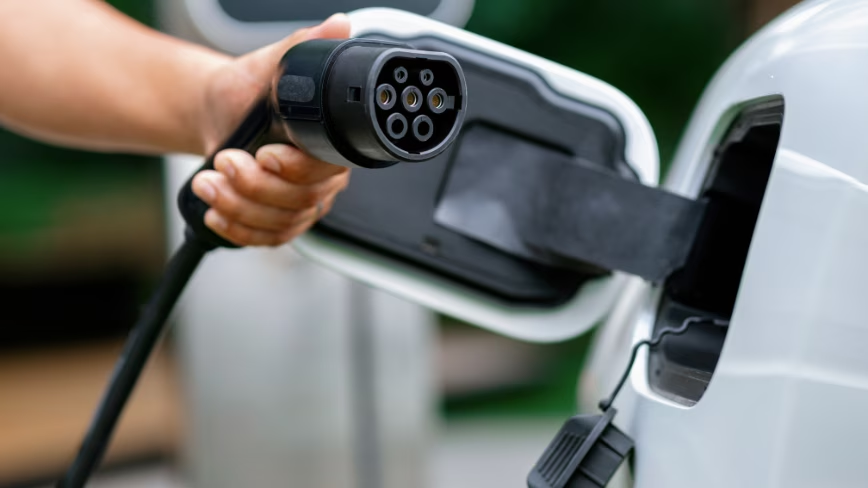
EV car charger
 Credit: Canva
Research published in Science finds that scrapping a petrol car in its first year and replacing it with a battery electric vehicle cuts emissions by 58% over 16 years, with carbon payback in about three years. The benefit does not hold for efficient hybrids, very low-mileage vehicles or the dirtiest electricity grids.
Retiring a petrol car early is better for the climate than driving it out, according to new research in Science. Scrapping one in its first year and replacing it with a battery electric vehicle cuts emissions by 58% over 16 years.
The work comes from Elliott Campbell at UC Santa Cruz and Roland Geyer at UC Santa Barbara, who modelled more than 400 combustion and electric vehicle models against grid mix, efficiency, mileage, battery size and manufacturing emissions.
Carbon payback takes about three years. That is how long an electric car’s lower driving emissions need to cancel out the emissions of building it, including the battery.
Retire means scrap, not sell. Selling simply hands the car to somebody else who keeps driving it, which moves the emissions rather than removing them.
What is missing from most of the coverage is that this does not always hold. The researchers found a reduction in 92% of modelled scenarios, which means it did not appear in the other 8%.
Hybrids are the clearest exception. Standard hybrids are efficient enough that replacing one early with a battery electric car can increase emissions in some cases, and plug-in hybrids raise the same problem.
Low mileage is the second. Below roughly 4,383 miles a year for cars, 4,248 for SUVs and 6,707 for trucks, the replacement does not pay back.
The third is the electricity, and it is the one that travels least well. Where the local grid exceeds 970lbs of CO2 per megawatt hour the benefit shrinks, which is the same point TNW has made before about charging on coal-generated electricity.
That threshold reads differently on this side of the Atlantic. Electric cars in Europe have been measured as roughly three times cleaner than petrol equivalents on the continent’s generation mix, so the case for early retirement is stronger in France or Sweden than in Poland.
The awkward part is the policy that follows. If the gain comes from taking cars off the road rather than passing them on, the intervention this research supports is scrappage, which means paying people to destroy working vehicles.
Get the TNW newsletter
Get the most important tech news in your inbox each week.


