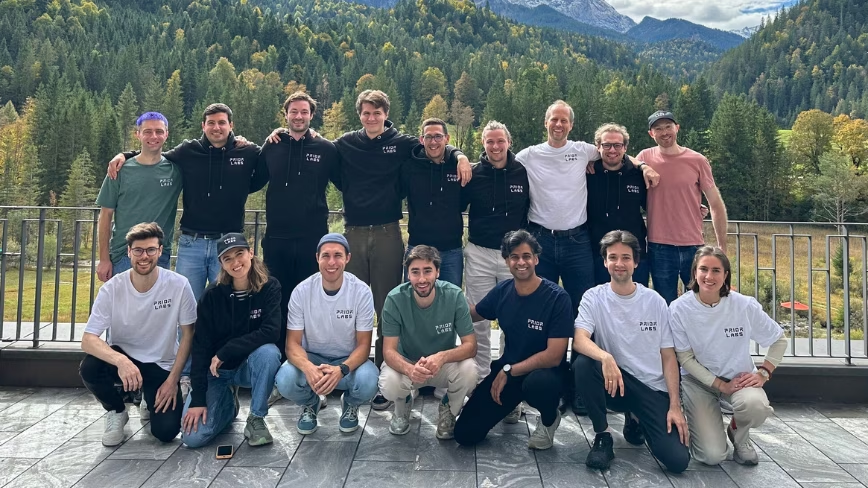
Eighteen months after a €9m pre-seed, the Freiburg-based pioneer of TabPFN is being acquired by SAP and will receive more than €1bn over four years. The terms are not disclosed; the strategic intent is unmistakable.
When Frank Hutter, Noah Hollmann, and Sauraj Gambhir founded Prior Labs in early 2024, the AI world was paying attention to almost everything except the kind of data their company was built around. Language models were absorbing capital, attention, and graduate students.
Tables, the spreadsheets and structured records that actually run businesses, were not part of the AI conversation that was supposed to produce a frontier lab. On Monday, the founders announced that this assumption is about to be tested.
Prior Labs has signed a definitive agreement to be acquired by SAP, with the German enterprise-software giant committing more than €1bn over the next four years to scale the startup into what it calls a globally leading frontier AI lab.
It is, by some distance, the most ambitious enterprise AI research investment ever made in Europe by a European company.
The transaction terms have not been disclosed. SAP’s own announcement describes Prior Labs as the pioneer of Tabular Foundation Models and frames the acquisition as a continuation of work SAP itself began with a model called SAP-RPT-1, which the larger company developed before most of the enterprise-software world had recognised the category.
Prior Labs will continue to operate as an independent legal entity, retaining its brand, headquarters in Freiburg, offices in Berlin and New York, open-source commitments, customer relationships, and existing scientific advisory board, which includes Yann LeCun and Bernhard Schölkopf.
The deal remains subject to regulatory approval and is expected to close in the second or third quarter of this year.
In their joint blog post, the founders chose the unusually direct phrase “the next chapter” to describe what comes next.
What Prior Labs has actually built?
The case for the deal sits in the technical record. Prior Labs’s flagship model, TabPFN, was published in Nature in early 2025 and has, according to the founders, been cited more than 1,000 times and downloaded over three million times since release.
The newest generation, TabPFN-2.5, scales the architecture to datasets of up to 50,000 samples and 2,000 features, and is, by Prior Labs’s published benchmarks, currently at the top of TabArena, the standard benchmark for tabular machine learning.
Crucially, TabPFN does something most foundation models cannot. It runs in a single forward pass, without task-specific training, and matches or exceeds the accuracy of tuned tree-based models, including AutoGluon configurations that have run for hours.
For the kinds of datasets that dominate enterprise systems, customer records, financial transactions, manufacturing telemetry, clinical trial outputs, that is the technical inflection point.
A general-purpose model that does not require domain-specific retraining changes both the cost and the deployment timeline of structured-data AI.
That, more than the abstract notion of an AI lab, is what SAP is buying. SAP’s enterprise customer base sits at the centre of exactly the categories Prior Labs’s models are designed for: financial services, healthcare, manufacturing, and industrials. Constellation Research’s analysis of the deal describes it as a piece of a wider data-platform strategy, alongside SAP’s parallel acquisition of Dremio announced the same week.
The structured-data layer is the part of enterprise AI most companies still cannot do well; SAP has now bought one of the most credible attempts to fix that.
Prior Labs’s only previous funding event was a €9m pre-seed round announced in February 2025, led by Balderton Capital with participation from XTX Ventures, the Hector Foundation, Atlantic Labs, and Galion.exe.
Eighteen months later, the Balderton bet has produced one of the cleaner exits the firm has had in its 19-year history. The exact economics will not be public until SAP’s regulatory filings catch up with the announcement, but the multiple from a €9m round to a €1bn+ post-acquisition investment programme is, by any sober reading, exceptional.
Why this matters for European AI
European AI policy has spent the past two years trying to manufacture exactly the kind of outcome the Prior Labs deal represents. TNW has been tracking the broader effort, which has included sovereign-cloud awards, the AI Act’s compliance regime, and an increasingly explicit push from European technology leaders for capital to be deployed at scale inside the EU rather than exported west.
Mistral’s chief executive has been particularly vocal on the question of whether Europe can build, rather than rent, the AI infrastructure that runs its economies.
The Prior Labs deal is, on at least one reading, a clear answer. SAP, now the most valuable listed company in Europe, is using its market capitalisation to fund a frontier research lab on the continent, anchored to a European founding team, headquartered in a German university town, and focused on the precise category of AI most relevant to the operating businesses SAP serves.
The structure, an autonomous, well-capitalised, open-source-friendly research lab inside a strategic corporate parent, is closer to the Anthropic-Google or Mistral-Microsoft model than to anything European enterprise software has previously attempted.
It is also a marker for European AI talent. TNW has previously reported on the fact that Europe holds more AI researchers than the United States by absolute count but converts fewer of them into commercial outcomes.
Prior Labs is, against that pattern, a Freiburg academic team that produced a Nature paper, an open-source model with a serious community, a credible commercial business, and a billion-euro deployment partner inside two years.
Whether that becomes a template or remains an exception is the question European policy-makers have, for several years, been asking. Monday’s announcement is the most positive empirical evidence so far.
There are a few. The first is integration: large enterprise software companies have a mixed record of preserving the autonomy of acquired research labs.
SAP has been explicit, in both its press release and the founders’ own statement, that Prior Labs will retain its independence, brand, and open-source commitments. The verification of that promise will come in the post-close years. Many similar promises have been made before.
The second is competitive. Tabular foundation models are no longer a quiet research category. Microsoft, Google, AWS, and several startups are all moving into the space. Prior Labs’s lead, particularly TabPFN’s architecture and TabPFN-3 (which the founders flag as imminent), is real but not infinite.
The pace at which SAP can deploy the €1bn investment, hire the additional researchers, and ship productionised versions across SAP’s customer estate will determine whether Prior Labs remains the category leader or becomes the cautionary tale of having sold too early.
The third is geopolitical. Frontier AI labs in Europe are, increasingly, strategic assets in their own right. The same week that Prior Labs is being absorbed into SAP, Techzine has reported that SAP’s parallel acquisition of Dremio brings analytical-data infrastructure into the same corporate umbrella.
The combined effect is that a single European company now controls a meaningful share of the structured-data AI stack. Whether European regulators view that consolidation as sovereignty or concentration is a question that will, at some point, attract attention.
Three indicators will signal whether the announcement is more than corporate ambition. The first is the rate at which Prior Labs’s headcount grows: a €1bn budget over four years implies hundreds of new researchers, and the labour market for tabular-AI specialists is unusually thin.
The second is whether TabPFN-3 ships on the schedule the founders implied (“imminent”) and how it benchmarks against private-sector competitors that will, by the time of release, also have shipped their answers.
The third is whether SAP customers actually adopt the resulting models inside their operating systems at the scale the deal economics assume; it is one thing to have a state-of-the-art tabular model, another to retrofit it across a Fortune 500 finance organisation’s existing stack.
None of these signals will be public for some time. What is public, on Monday, is that Europe has now produced the kind of academic-to-commercial AI outcome its policy-makers have been asking for, and that the strategic acquirer is itself European.
The mission, in the founders’ own words, has not changed. It just got accelerated, and at a scale most European startups never reach.
The acquisition closes, regulators willing, in the second or third quarter. The interesting work begins after that.
Get the TNW newsletter
Get the most important tech news in your inbox each week.


