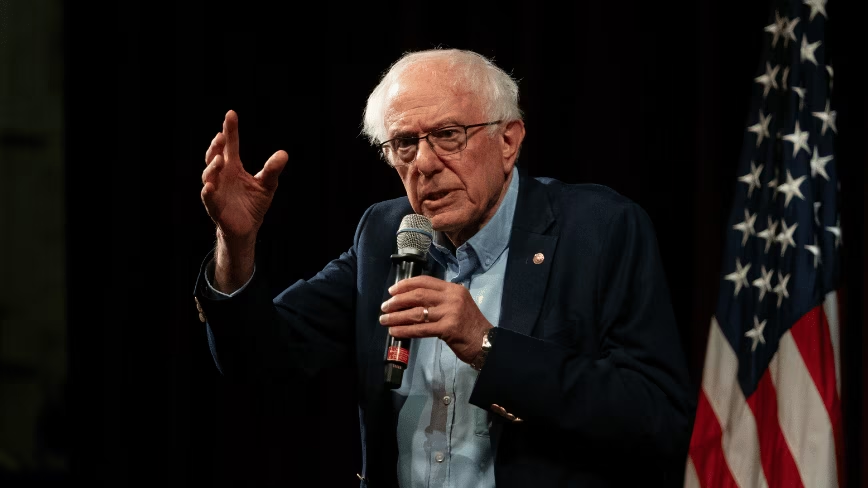
Senator Bernie Sanders speaking at Stanford University in February 2026.

“When you are racing towards a cliff, you hit the brakes,” Senator Bernie Sanders told the Pro-Human Assembly in Washington on Tuesday.
Sanders, a Vermont independent, and Trump ally Steve Bannon both called for stronger AI oversight at the event, Reuters reported. The nonprofit Future of Life Institute hosted it. Several hundred people attended, according to The New York Times.
Sanders asks Trump for a treaty with Xi
“AI has the potential to eliminate tens of millions of jobs, wiping out entire professions and making it harder for our young people to enter the workforce,” Sanders said, as reported by Courtney Rozen for Reuters.
In remarks filmed by Reuters, he said Congress had been “asleep at the wheel” under both parties. He also called on Trump to negotiate a treaty with Chinese President Xi Jinping at their summit next week, to pause advanced AI development and ban superintelligence.
Earlier this month, Sanders and Representative Greg Casar announced a bill with the same two aims. Last week, Sanders also convened a Senate briefing on AI dangers.
Bannon wants executive action
Bannon was a White House strategist in Trump’s first term. He said Congress would take too long to pass a law slowing AI down. “This is going to have to be executive action,” he said.
He also said the US must cut China off from American-made computer chips, Reuters reported. On his Monday podcast, Bannon said Congress should not pass laws that bar states from enforcing their own AI rules.
“American citizens are not going to be supplicants to the oligarchs anymore,” Bannon said, according to The New York Times. On his differences with Sanders, he added: “We have to rise above it. This is a hinge in history.”
Lawmakers and faith leaders
Other speakers included Republican and Democratic lawmakers, religious leaders and artists, the Times reported.
“The answer is simple: We ban A.I. systems that are too powerful for humans to control,” said Casar, a Texas Democrat. Representative Lori Trahan, a Massachusetts Democrat, said: “The future we all want is human. It’s nonnegotiable.”
Representative Chip Roy, a Texas Republican, described constituents who felt powerless as data centres went up in their communities. Salvatore Cordileone, the Catholic archbishop of San Francisco, told the audience: “We have to be the masters of A.I.”
The actor Ashley Judd, chief negotiator for the union SAG-AFTRA, also spoke. So did parents of teenagers who died after developing relationships with chatbots, who called for child safety rules.
A coalition launched at the event
More than 50 organisations announced the Pro-Human AI Coalition at the Assembly, according to a statement from Project Liberty. Project Liberty, the Future of Life Institute and Ergo Impact co-founded the nonprofit. Mila and Omidyar Network sit on its steering committee.
The coalition says its members have already enacted AI legislation in Utah, California, Ohio, Connecticut and South Dakota. It is preparing policy proposals for the Geneva AI Summit in June 2027.
“Humanity deserves a say in who owns it, who governs it, and who benefits from it,” said Project Liberty founder Frank McCourt.
The White House position
On Monday, Trump dismissed AI safety fears as a “hoax” on Truth Social. He said the US already has guardrails in place, Reuters reported.
On Tuesday, House Speaker Mike Johnson ruled out an AI moratorium. He said it would hand China a competitive edge. “They can self-regulate. They don’t need the government to tell them to slow it down,” Johnson told reporters.
This week, Kamala Harris called for an AI regulator and a treaty with China. Congress currently has three AI bills without a timetable for a vote.
Warren backs a pause
On Wednesday, Senator Elizabeth Warren, a Massachusetts Democrat, backed a pause on advanced AI development, her office told Axios. She made the call ahead of a roundtable hosted by Sanders.
“We should immediately press pause on the development of advanced AI while lawmakers and regulators put systems in place to keep people safe,” Warren said. Unlike Sanders, she stopped short of calling for a ban on superintelligence, Axios reported.
Warren also said the industry’s push to “pace the frontier” was “insufficient.” She called suggestions to weaken antitrust protections to address AI risks “transparently self-serving.” Anthropic CEO Dario Amodei has called for an antitrust exemption to help labs coordinate a slowdown.
Get the TNW newsletter
Get the most important tech news in your inbox each week.


