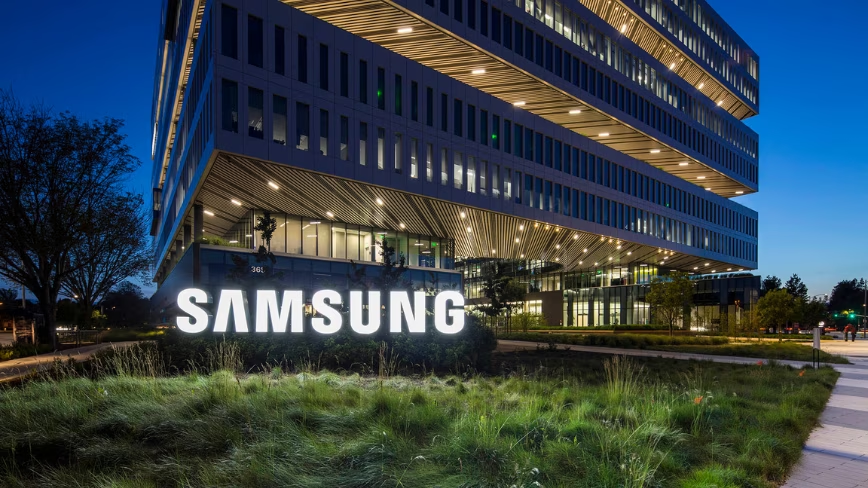
 Credit: Samsung
Talks resumed in Sejong on Monday.
Choi Seung-ho walked into the National Labor Relations Commission building in Sejong on Monday morning, about 110 km south of Seoul, and told reporters he would ‘participate in this second round in good faith’.
The head of Samsung Electronics’ largest union, on Friday’s evidence, had been preparing to talk to the company on 7 June, three days after his members ended an 18-day strike. By Monday, the calendar had shifted forward by three weeks, and the picket-line clock had moved to three days.
Between those two appearances, three things happened in public. Samsung’s chairman Lee Jae-yong bowed his head on Saturday and apologised, in the formal Korean register reserved for chaebol leaders speaking to a national audience, for the ‘worry and anxiety’ the dispute was causing.
The country’s president, Lee Jae-myung, posted on X that ‘in South Korea, which has adopted the basic orders of democracy and free market economy, labour should be respected as much as companies, and corporate management rights should also be respected as much as labour rights’.
And Samsung, having spent ten days saying its previous proposal was the proposal, came to the table with a different one.
None of these changes is the question on the table, which is whether the AI memory cycle Samsung is profiting from translates into a workforce share that lives in the employment contract, or one that lives at the chairman’s discretion.
The Sejong meeting is the third government-mediated round in two weeks. The bonus formula is what it has always been about. It is not about whether workers get more money; it is about who decides, and where the decision is written down.
The shape of the disagreement has been the same since the first round of mediation collapsed earlier this month.
Samsung has offered a one-time payment for 2026 plus what its negotiators have variously described as ‘about 13%’ of chip-division operating profit; the union has held out for 15%, plus the removal of the existing cap that limits performance bonuses at 50% of base salary, plus the obligation, in writing, to honour that formula in future years.
On TNW’s reporting from 14 May, the union’s representative described the position as ‘institutionalisation and transparency’. The phrase has not changed since.
Samsung’s Monday proposal is the new thing in the room. The company is now offering a bonus pool calculated as the greater of 10% of operating profit or an ‘economic value added’ figure, plus a ‘special compensation’ add-on intended to function as a flexibility cushion.
The Korea Herald, citing Yonhap, described the move as a meaningful pivot from the company’s previous position of a fixed one-time payment. The union read it differently.
The 10% floor is closer to the SK Hynix precedent the workers have been pointing at for a year, but it is not the 15% they have asked for and, crucially, the proposal does not contain the line the union has said it needs: a contractual lock that survives the chairman.
The choreography of the past four days has been unusually visible for a Samsung labour dispute. On Friday, the company asked the union to come back to the table without conditions, and the union answered with a date in June. By Saturday morning the chairman had apologised.
By Sunday evening, the union had agreed to talk earlier. By Monday morning, the two sides were in the same room in Sejong, with no deadline set for the round but only three calendar days left before the planned walkout.
President Lee’s X post, posted the same morning, sat under all of it as a reminder that the government had not ruled out the emergency-arbitration mechanism that would suspend industrial action for thirty days.
The leverage on the table is the part most foreign observers underestimate. The strike, if it begins on Thursday, would be the largest in Samsung’s 56-year history. The union’s own estimate of damage to Samsung is around 30 trillion won, or roughly $20bn.
Korea Herald, citing ‘industry observers’, puts the figure that has been quoted to government officials at as much as 100tn won (about $66.7bn) of damage to the wider South Korean economy, given the country’s semiconductor concentration and the AI-cycle dynamics that have lifted the Lee family’s paper wealth from $22.7bn to $45.5bn in twelve months.
The 100tn-won figure is on the upper end of the available estimates and not directly sourced to a named analyst; it is hedged here for that reason. The point survives the hedge.
What makes the bonus formula the right place to hold the line is the comparable next door. SK Hynix agreed in September last year to scrap its bonus cap and allocate 10% of annual operating profit to staff, locked in by contract for ten years.
In 2026 forecasts, the arithmetic produced an average payout of about $477,000 per worker this year and approaching $900,000 next year, across roughly 35,000 staff. The Samsung workforce, watching that maths land at the company they consider their direct peer, has spent the past year asking why the same formula does not apply to them.
The answer they have been given is that it might, in the form of a one-time payment that does not bind future years. The answer they have asked for is that it must be in the form of a contract clause.
Lee Jae-yong’s Saturday apology is the part to read carefully. South Korean chaebol heads do not bow on camera unless the underlying dispute has crossed a threshold inside the company.
The Korea Herald’s account of the apology described it as a ‘rare’ gesture, which in this context means the first such gesture from Lee since his 2017 corruption sentencing era. The apology was not about the bonus formula specifically.
It was about the optics of an 18-day strike beginning in three days, against the backdrop of an AI cycle that has been visibly enriching the family that holds 5% of Samsung Electronics’ direct equity and considerably more of its actual control.
The reason that gesture matters here is that it telegraphs to the union, where the actual ceiling on management’s flexibility sits.
The government’s position is that emergency arbitration remains on the table, but that direct intervention is the option the president would prefer to avoid. President Lee’s X post is the carefully calibrated version of that preference.
South Korea has not invoked the emergency-arbitration mechanism against a major chaebol in recent memory; the political cost of doing so against Samsung specifically, with a worker-side argument framed around AI-era profit-sharing, would be visible enough that the option is more useful as a threat than as a tool.
Both sides know this, and the mediators too. The president’s social-media tone, on Monday morning, suggests the administration is closer to letting the strike begin and reading the resulting pressure than to forcing the issue before Thursday.
The structural fact underneath the past two weeks of choreography is that Samsung’s bonus talks have kept breaking over the same point of disagreement, in the same words, with the same numerical gap, across multiple rounds of mediation and multiple proposals from management.
The two sides are not far apart on the size of the pool. They are far apart on what gets written down. The 10%-or-EVA structure Samsung put on the table on Monday is closer to the union’s number than to the company’s previous offer, and the gap that remains is not, on its face, a number the negotiations cannot bridge.
What the workers are holding out for is the same thing chaebol-era Samsung has historically been reluctant to give up, which is a contractual constraint on how senior management distributes the company’s earnings.
The bonus formula is the proxy for that constraint. Whether the strike begins on Thursday will be decided not by the size of the offer Samsung makes between now and then, but by whether that offer contains the line of text the union has been asking for since 14 May.
Monday’s resumed talks will, in plain mathematical terms, either produce that line of text or they will not. The picket line and the supply chain that runs through it follow from the answer.
Get the TNW newsletter
Get the most important tech news in your inbox each week.
Also tagged with


