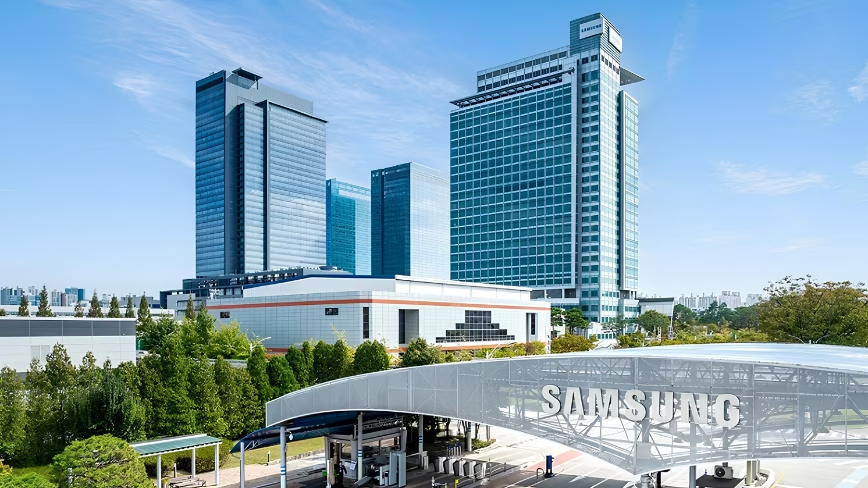
Samsung Electronics guided to second-quarter operating profit of about 89.4 trillion won ($58.4bn) on Tuesday, roughly 19 times what it made in the same period a year earlier and, by most counts, the largest quarterly operating profit any technology company has ever reported.
It is Samsung’s third consecutive record quarter, and it came in ahead of the roughly 84 trillion won analysts had pencilled in, a jump TNW had already flagged as an 18-fold leap when the estimates were still forming.
Revenue reached about 171 trillion won, more than double the 74.57 trillion won of a year earlier, though it landed a touch below the 173 trillion won some analysts had modelled.
Operating profit rose about 56% on the first quarter and close to 1,810% year on year, measured against a base of just 4.68 trillion won in the second quarter of 2025, back when the memory business was still a drag rather than the engine it has become since AI rewired the memory market.
The driver is pricing. Contract prices for DRAM rose about 44% quarter on quarter and NAND flash by roughly 53%, according to Citi Research, as demand for the chips inside AI servers kept outrunning what the three big memory makers can supply.
High-bandwidth memory, the stacked DRAM that sits beside Nvidia’s accelerators, remains the most profitable corner of the business, and Samsung spent much of the past year narrowing the gap on SK Hynix there.
A turning point came in September 2025, when Samsung cleared Nvidia’s qualification for its 12-layer HBM3E, ending a long run of technical setbacks tied to thermal performance.
That opened the door to the customer whose spending sets the pace for the whole sector, even as SK Hynix moved faster on the next generation and locked in a multi-year HBM4 deal with Nvidia.
What sets this cycle apart is breadth. The price surge now extends well beyond HBM into conventional DRAM and NAND, as AI workloads spill out of training clusters and into the ordinary server and storage build-outs that support inference at scale.
The same pattern turned up in Micron’s quadrupled revenue in June, the American read on an industry that cannot make memory fast enough.
There is a caveat buried in the print. Samsung’s guidance is understood to include a bonus provision in the tens of trillions of won, and strip that out and underlying operating profit would have cleared 100 trillion won, according to the Seoul Economic Daily.
Those payouts have grown large enough to feed a running dispute over how the windfall should be split, and large enough that South Korea’s central bank has treated them as a factor in wages.
Investors were not uniformly convinced. Samsung shares fell more than 6% on the day, a bout of profit-taking after a rally that had priced much of the good news in already. A beat this large, in other words, is not the same thing as an upside surprise, and the revenue miss gave the doubters something to point at.
The guidance is preliminary and carries only headline sales and profit, with the divisional breakdown due alongside full results on 30 July. That report will show how much of the money came from the chip division and how much was clawed back by the smartphone and display units, which buy scarce memory at the same inflated prices Samsung is charging everyone else.
On current form the company’s full-year profit could rival what it earned across the previous four decades combined, a comparison that says less about a single quarter than about how completely one demand cycle has rewired the business.
Get the TNW newsletter
Get the most important tech news in your inbox each week.
Also tagged with


