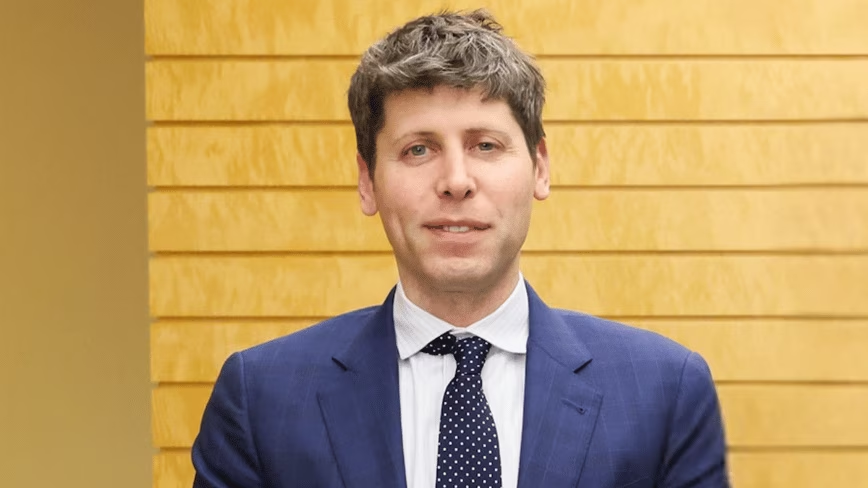
Sam Altman at the Japanese Prime Minister’s Office in Tokyo in February 2025.

OpenAI chief executive Sam Altman has set out how he thinks the AI industry should slow down. He also said OpenAI will not wait for Congress to act. In a post on X early on Monday, he welcomed “a federal framework that sets consistent safety requirements for frontier AI”.
He added a condition. “But we do not believe we need to wait for an anti-trust exemption or legislation to begin the work of providing this confidence,” he wrote. CNBC’s Kai Nicol-Schwarz described the posts as Altman’s most detailed comments yet on how AI safety frameworks could work.
On Saturday, Altman had backed Anthropic chief executive Dario Amodei’s call to “pace the frontier”. Amodei had asked Washington for an antitrust waiver, so AI companies could coordinate a slowdown without legal risk.
What OpenAI says it is changing
Altman wrote that older tools such as Responsible Scaling Policies and Preparedness Frameworks focused mainly on releasing finished models. They did not cover what happens while a model is being developed.
OpenAI now writes “explicit safety cases” before training runs it expects to “significantly increase capability”, he said. That is on top of the safety work it already does before releasing models. He said shared industry standards for misalignment, monitoring and safety would lead to better outcomes. OpenAI is also “excited by ideas like independent auditors”, he wrote.
He was clear about the limits of the slowdown. “When we talk about ‘pacing’, we do not mean ‘stopping’,” Altman wrote. Progress should still be “slower than it otherwise could be”, he added, because safety cases and monitoring have significant costs.
“No amount of American competitive pressure should justify recklessness, or let capabilities get ahead of alignment and monitoring,” he wrote. OpenAI will need the government’s help with international coordination, he said. But companies should first do what they can themselves.
Two risks Altman wants to avoid
In a second post 13 minutes later, Altman named two ways AI progress “could go very badly”. The first is that humanity loses “control of the future to AI”, which he called unacceptable.
The second is “too much concentration of power”. One person or company could use an extraordinarily powerful AI to impose its worldview on everyone else. In that case, “the results could be extremely dystopian”, he wrote. He gave one country, or one lab, gaining too much power as examples.
Altman made similar points in an interview with Fortune editor-in-chief Alyson Shontell, recorded on Friday. “We are clearly, today, at a point on the curve with great potential and real risk,” he told Fortune. In the same interview, he said OpenAI would not go public this year.
A shift in OpenAI’s policy line
The posts follow OpenAI’s call last week for mandatory national AI safety rules in the US. On Monday, its European policy lead also said the company would back binding AI rules in the UK.
OpenAI has not always taken this position. In a 2025 letter, it warned California Governor Gavin Newsom that a “patchwork of state rules” could slow innovation. Emily Forlini reported the shift for Fortune. The company now works with state lawmakers to shape their bills, according to Fortune.
The sceptics
Not everyone takes the industry’s calls at face value. David Sacks, the former White House AI and crypto czar, said he supports companies that choose to slow down. But he told them to “stop pretending the motivation to slow down is purely altruistic”, The Wall Street Journal reported. TNW covered his response on Saturday.
Some sceptics argue that OpenAI and Anthropic have financial reasons to delay their listings, not only safety ones, the Journal reported. AI safety campaigner Max Tegmark called the executives’ statements a step in the right direction. He told the Journal they must go further and make their voluntary commitments legally binding.
President Donald Trump dismissed the calls on Sunday. A slowdown was not needed and would put America’s lead over China at risk, he said, according to CNBC.
Get the TNW newsletter
Get the most important tech news in your inbox each week.


