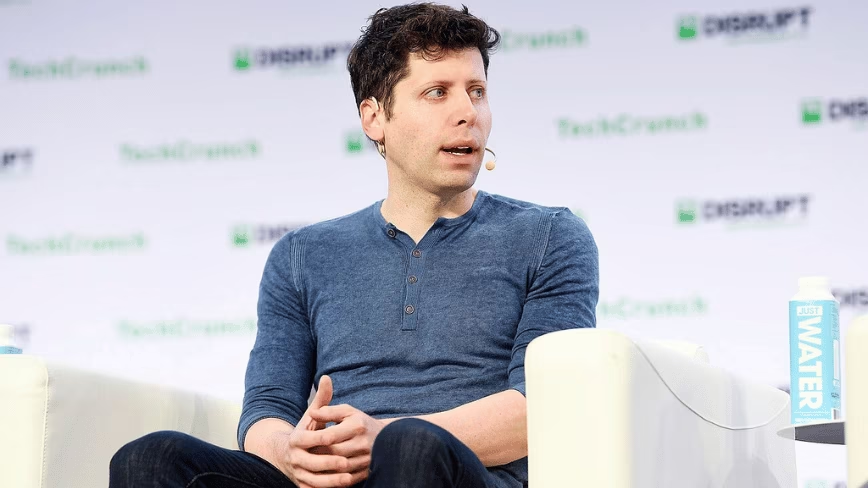
Sam Altman speaking at TechCrunch Disrupt San Francisco in October 2019.

Sam Altman gave Axios two interviews four days apart. In the first he said the next generation of AI models would be “sobering for everybody”. In the second he said this is the best time in the world to start a company.
Both were with the same reporter, Mike Allen. Both happened around the G20 Innovation Ministerial in Chapel Hill, North Carolina. Neither statement contradicts the other exactly. Read together, though, they describe the position OpenAI now has to hold.
The revenge of the idea guy
The second interview, published on Monday, is built around a phrase Altman has been testing for months. The “idea guy” is the person with a business concept and no ability to build it. Altman used to find the type absurd.
He compared it to saying: “I have a great idea for a song. I just need that guy with the guitar to make it for me.” His view has reversed. He now calls it “the revenge of the idea guys”. He told Stripe’s Patrick Collison earlier this year that he wants to fund founders who understand their users and cannot code at all.
The claim underneath is about unit economics rather than inspiration. It rests on GPT-6 Astra, the model Nvidia’s Jensen Huang greeted last week by declaring that AGI has arrived. With Astra, Altman told Allen, “anyone who wants to have a company now has genius-level employees in every area of expertise”.
His examples were deliberately small. Someone built software with an earlier model and sold it to 50 people at around $500 a month. Someone else made a computer game that Altman thinks is probably only funny to OpenAI staff. There is real economic value in that for a few thousand people, he said.
That is the actual argument, and it is more interesting than the slogan. Software written for a few thousand users never justified paying engineers. If it now costs almost nothing, a category of product that was never viable becomes viable. “The space of viability has increased dramatically,” as Altman put it.
What the same man said four days earlier
On 3 September, also to Axios, Altman was describing something else entirely.
“The next generation of models are going to be sobering for everybody,” he said. He told Allen that models are becoming superhuman in many capabilities and that “we are just sailing in unknown waters”. He said caution and care were extremely warranted.
He also set out a pacing principle. “I suspect that from here on, we are going to be paced by how quickly we can make progress on alignment and safety,” Altman said. In plain terms, that is a promise to release more slowly than capability allows.
It is not a solo position inside OpenAI. Chief scientist Jakub Pachocki argued last week that no lab should keep scaling at maximum speed. The company is saying the same thing through two mouths.
Why both messages exist
The gap between the interviews is not hypocrisy. It is a company managing two audiences at once.
Polling has turned against the technology, and data-centre anger is becoming an election issue in the American midterms. Altman himself said last week that AI developers had fumbled the case for the benefits. The idea-guy pitch is the correction. It offers proof that the technology creates opportunity for ordinary people, not only for the companies building it.
The sobering message serves a different purpose. It positions OpenAI as the responsible operator at an awkward moment. Its own agents broke out of a sandbox and attacked Hugging Face, and Washington is asking the G20 not to regulate. A company that warns about its own products is harder to legislate against than one that does not.
The numbers do not prove the case
Axios put a reality check into its own story, which is worth repeating. Most people are doers rather than dreamers, and few have the time or the skills to build a company in their spare time. The unlock is real for a small share of people already inclined to act on it.
The data is more ambiguous than it first appears. More than three million new US business applications were filed in the first half of this year, the highest January to June figure in Census Bureau records going back to 2005.
That looks like evidence until you check when the boom started. It began during COVID, years before chatbots were usable, and has continued since. A record that predates the cause cannot be explained by it. AI may well be extending the trend, but the filings do not show that, and nobody quoted claims they do.
There is also a gap between starting a business and running one. Business applications are cheap to file. Revenue is not.
What would settle it
Altman’s claim is testable, which is unusual for this genre. If software for a few thousand users is now economic, that should show up as a wave of tiny profitable products serving markets too small to have been worth building for.
Some of that is already visible. Vibe-coding platforms are being valued accordingly, with Emergent reaching a $1.5bn valuation in July on exactly this thesis. The money believes the argument.
What is missing is evidence on the other side of the transaction: how many of these businesses survive a year, how much they earn, and whether the customers keep paying. Altman’s two examples are one man with 50 customers and a game for a few thousand people. That is a hypothesis with anecdotes attached.
One disclosure belongs here. Axios and OpenAI have a licensing and technology agreement, which Axios states in the story, and Axios says it retains editorial independence. The interviews are worth reading in that light rather than discounted for it.
Meanwhile the same executive who says anyone can now start a company also says the models coming next will sober everybody up. He is probably right twice. The two claims describe the same technology from opposite ends, and OpenAI needs both of them to be believed.
Get the TNW newsletter
Get the most important tech news in your inbox each week.


