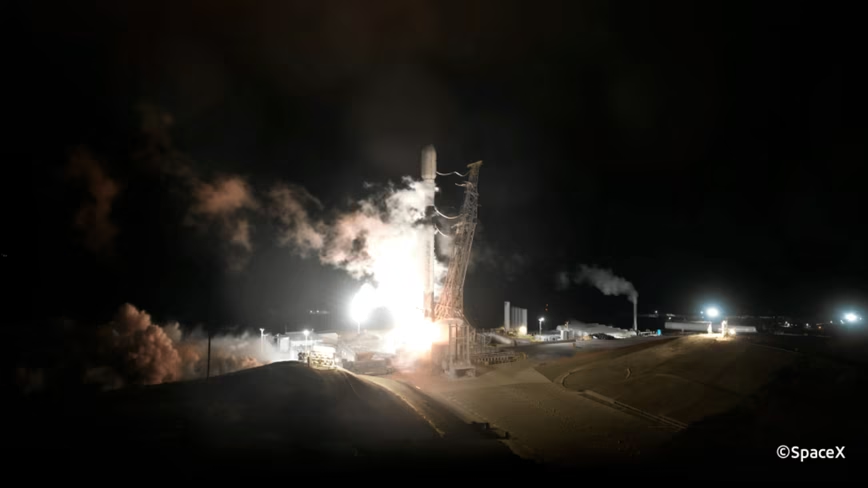

A Falcon 9 rocket lifted off from Vandenberg Space Force Base in California on the morning of 7 July, carrying a satellite roughly the size of a loaf of bread that will spend the next year probing how European spacecraft can be attacked. The payload, called CyberCUBE, is the first European Space Agency mission run from start to finish by a private company based in Romania.
The distinction carries weight in a sector where ESA missions have long been led from the agency’s larger member states. It lands as private spacetech investment across the continent reaches record levels, and as Brussels grows more anxious about the security of the orbital systems it now depends on.
GMV Romania, the local arm of the Spanish technology group, acted as prime contractor and steered the mission through design, integration, launch and in-orbit validation. That makes CyberCUBE the first ESA satellite delivered under the coordination of a Romanian company, according to GMV.
“We have demonstrated that Romanian experts can lead an ESA mission from start to finish,” said Cristian Chițu, space director at GMV Romania. He framed the launch as a milestone for the country’s wider space sector rather than a win for a single firm.
Romanian engineers also chose the launch provider and helped integrate the satellite into Exolaunch’s EXOpod deployment system, from which SpaceX’s Falcon 9 released it into orbit. The team supervised the launch operations on the ground in California.
The flight hardware is a 3U CubeSat built by Alén Space, the Spanish smallsat specialist that GMV acquired in 2023. It carries reprogrammable onboard processing and a payload dedicated to watching for cyber threats while in orbit.
The aim is to give ESA a secure, reconfigurable testbed for security tools before they fly on operational missions. Planned experiments include detecting unauthorised access to command systems and validating post-quantum cryptography, the encryption designed to hold up against future quantum computers.
Two threats sit at the centre of the work. Jamming drowns a signal in deliberate interference, while spoofing feeds a spacecraft convincing but false data, and both have shifted from theoretical worry to documented tactic as Europe leans harder on its satellites.
The mission carries a budget of about €1.9mn and an expected operational life of at least twelve months, according to GMV. ESA has issued an open call inviting outside researchers to run their own experiments on the platform, part of the agency’s growing appetite for ESA-backed satellite work with commercial partners.
The satellite’s primary user will be ESA’s Cybersecurity Operations Centre, which will coordinate experiment requests and process the data that comes back. Day-to-day operations will run from the agency’s centre in Redu, Belgium, with high-speed communications handled from its operations hub in Darmstadt.
On the ground, GMV Spain supplied key parts of the control segment, including a mission control centre built on the company’s commercial FocusSuite software. Engineers also assembled a flatsat, a simplified twin of the satellite that lets operators rehearse commands on the ground before sending them to the real spacecraft.
“The successful launch demonstrates the growing maturity of Romania’s space ecosystem and the value of continuous participation in ESA programmes,” said Daniel-Eugeniu Crunțeanu, director general of the Romanian Space Agency. He tied further ambitions to Romania’s ability to keep contributing to ESA’s optional programmes.
The launch arrives amid a broader European effort to harden digital defences, from NATO’s cyber partnerships with private vendors to national space strategies. Space, once treated as a remote and largely untouchable frontier, is increasingly viewed as another surface to defend.
GMV will oversee several weeks of in-orbit validation before handing control to ESA for the mission’s operational phase. Its findings are meant to shape how the agency protects the satellites it sends up next.
Get the TNW newsletter
Get the most important tech news in your inbox each week.


