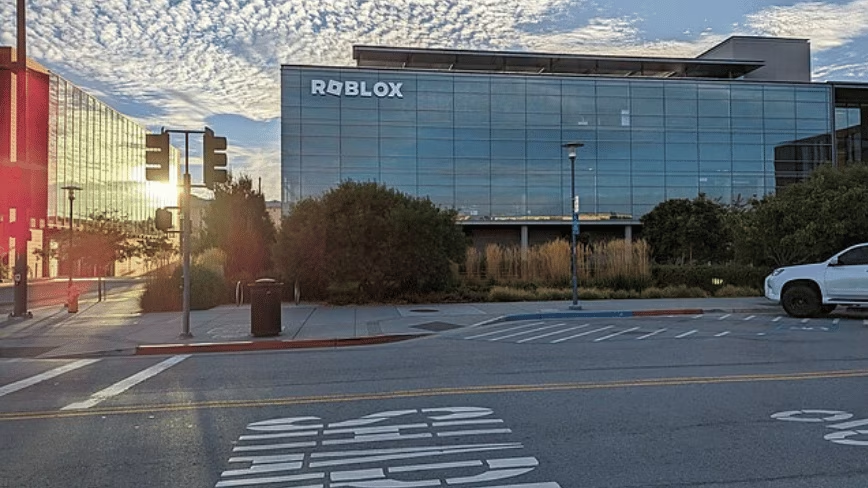
Roblox
 Credit: Roblox
The complaint accuses the gaming platform of misleading the public about its safety and pressuring young users to spend. Roblox ‘strongly disputes’ the claims; the FTC has declined to comment.
Two children’s advocacy groups, Fairplay and the National Center on Sexual Exploitation, asked the US Federal Trade Commission on Wednesday to investigate Roblox, Reuters reported, in a letter that calls the gaming platform’s design features and marketing techniques ‘unfair and deceptive’.
The groups have asked the agency to determine whether Roblox has violated Section 5 of the Federal Trade Commission Act, which prohibits unfair or deceptive practices affecting commerce.
The two-strand complaint, on the letter’s account, is that Roblox is deceiving the public about the safety of its platform and that it unfairly pressures young users to spend money to access in-game privileges.
The groups have filed the underlying materials with the FTC under docket 2026-00096. An FTC spokesperson declined to comment to Reuters.
Roblox said it ‘strongly disputes’ the claims in the letter. A company spokesperson said US users are required to complete an age check before being able to chat with other players, and that minors can only chat with users close to their own age.
The age-verification architecture sits on the facial-estimation system Roblox introduced earlier this year through Persona, which places users into one of six age brackets and is supposed to delete the underlying biometric data after processing.
The complaint extends a regulatory and litigation arc that has been building around the platform over the past twelve months.
Roblox is currently defending more than 140 lawsuits in US federal court, accusing it of knowingly facilitating child sexual exploitation, with claimants saying the platform was designed and marketed to minors in a way that allowed predators to target and contact them.
Attorneys general in Texas, Louisiana, Florida, Kentucky, Iowa, Tennessee, Nebraska, and Arkansas have separately filed lawsuits against the company over child-safety failures.
The age-check architecture Roblox cites as its defence has itself drawn scrutiny. The mandatory age-gated chat tiers have been undermined by a secondary market in pre-verified accounts, with age-verified Roblox logins appearing for sale on eBay for as little as $4 within days of the mandate taking effect.
The Persona-based facial estimation system also surrendered no signal on whether the user behind the camera is the user the account is registered to, a gap Fairplay and the NCSE both reference in their wider commentary on the platform.
The international regulatory backdrop is heavier still. The UK’s Ofcom included Roblox in its March letters demanding evidence of further child-safety improvements from the largest platforms reaching children, alongside Facebook, Instagram, Snapchat, TikTok, and YouTube.
The Online Safety Act enforcement track has produced fines of £520,000 against 4chan and £1.05m against the AVS Group in the past six months for age-check failings.
The FTC complaint lands on a comparable enforcement trajectory in the US, where Section 5 cases have historically taken between 12 and 36 months to produce a public order if the agency formally opens an investigation.
The Fairplay-NCSE letter does not set a specific timeline for FTC action, and the agency has not signalled whether it will open a formal investigation. The next visible procedural step is a public response from the FTC’s Bureau of Consumer Protection, which can take weeks to months.
Roblox’s existing 140-plus federal lawsuits remain on separate dockets and are unaffected by the FTC referral; the next consolidated motion-hearing dates in the federal multidistrict cases will be the more immediate proof points of how the broader child-safety case against the platform is moving.
Get the TNW newsletter
Get the most important tech news in your inbox each week.


