TL;DR
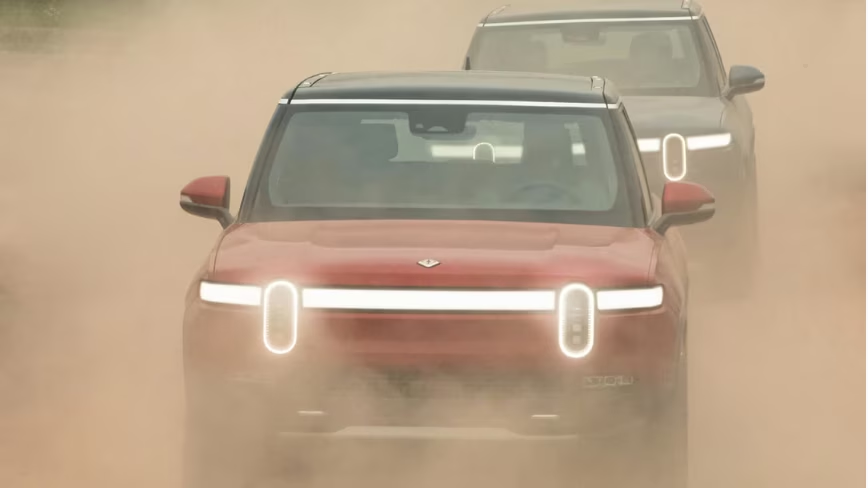
Rivian began delivering R2 SUVs on Tuesday, targeting 20,000-25,000 by year-end as it bets on fewer US EV competitors and a path to robotaxis.
The $57,990 SUV is the centrepiece of Rivian's push toward mass-market scale and eventual autonomy, arriving after the federal tax credit's expiration and as legacy automakers retreat from electric vehicles in the United States
EV
 Credit: Rivian
Rivian began delivering R2 SUVs on Tuesday, targeting 20,000-25,000 by year-end as it bets on fewer US EV competitors and a path to robotaxis.
Rivian began handing over the first R2 SUVs to paying customers on Tuesday, opening a new chapter for a company that has burned through billions of dollars trying to prove it can build electric vehicles at scale. The R2 starts at $57,990 for the Performance trim with Launch Package, considerably above the $45,000 price point Rivian teased when it revealed the vehicle in 2024. A sub-$50,000 version is not expected until 2027, and an entry-level model at roughly $45,000 is planned for later that year, meaning the R2’s most accessible configurations remain unavailable at a time when affordable EVs are disappearing from the US market.
Rivian is targeting 20,000 to 25,000 R2 deliveries by the end of 2026, a figure that would make it one of the fastest-scaling EV launches in US history if achieved, according to the company. Production has begun at the company’s factory in Normal, Illinois, on a single shift, with a second shift planned for the second half of the year. The company’s total 2026 delivery guidance of 62,000 to 67,000 vehicles implies that R1 and commercial van volumes will remain roughly flat at around 42,000 units, with the R2 carrying the growth.
Founder and CEO RJ Scaringe has described the R2 as “maybe the most important thing we’ve launched to date,” and has framed the hostile US EV environment as an opportunity. The Trump administration weakened environmental regulations that pressured automakers toward electrification, and Congress eliminated the $7,500 federal EV tax credit in the One Big Beautiful Bill Act, effective September 2025. Most legacy automakers have shelved or cancelled US EV plans, leaving virtually no federal purchase support for electric cars in 2026 and even Tesla’s sales are declining.
That thinning competitive field is precisely the opening Scaringe is banking on. With fewer new EVs reaching American showrooms, the R2 has a chance to capture buyers who have limited alternatives, particularly in the mid-size SUV segment where it competes with the Tesla Model Y. Whether that logic holds depends on whether consumers are willing to pay $58,000 for an electric SUV without a federal tax credit, in a market where the average new car transaction price already exceeds $48,000.
The R2 is also central to Rivian’s ambitions in autonomous driving. In December, the company unveiled a custom 5nm autonomy processor delivering up to 1,600 trillion operations per second, alongside plans to integrate lidar sensors into future R2 models. Rivian’s Autonomy+ system, included with the Launch Package, offers hands-free assisted driving across 3.5 million miles of roads in the US and Canada.
The company expects the R2 to eventually drive itself, a capability it is developing alongside a $1.25 billion deal with Uber announced in March. The Uber partnership calls for an initial $300 million investment and the purchase of 10,000 fully autonomous R2 robotaxis, with an option for up to 40,000 additional vehicles, according to Uber’s investor filing. Commercial deployment is targeted for San Francisco and Miami in 2028, scaling to 25 cities by 2031, an ambitious timeline given that Rivian has not yet demonstrated a fully autonomous vehicle and the regulatory framework for robotaxi operations remains incomplete in most US cities.
Rivian is simultaneously building a new factory in Stanton Springs, Georgia, after renegotiating its Department of Energy loan from $6.57 billion down to $4.5 billion under the Trump administration’s review of Biden-era EV commitments. The Georgia plant’s initial capacity has been raised to 300,000 vehicles per year by compressing what had been a two-phase build into a single first phase. Production is targeted for late 2028, and the facility will build the R2, the smaller R3, and robotaxis for the Uber partnership.
The financial picture remains fragile. Rivian achieved its first full-year positive gross profit in 2025 at $144 million, but still posted a net loss of $3.63 billion. First-quarter 2026 revenue came in at roughly $1.4 billion, up 11% year on year, with $119 million in gross profit but an adjusted EBITDA loss of $329 million and negative free cash flow of $526 million.
The company ended the quarter with $4.83 billion in cash, bolstered by a $1 billion share purchase from Volkswagen, which overtook Amazon as Rivian’s largest shareholder in May with a 15.9% stake tied to a software joint venture. The R2 arrives at a moment where Rivian’s survival depends on proving it can sell a vehicle in volumes that have eluded every EV startup except Tesla. The company has never delivered more than 51,579 vehicles in a year.
Reaching 25,000 R2 deliveries in roughly six months of production would require a pace that most analysts describe as ambitious. Chinese automakers are flooding overseas markets with competitively priced EVs, and Canada’s recent tariff reduction on Chinese-made vehicles has brought that competition closer to North America. Whether Rivian can overcome those headwinds while burning through cash at its current rate is the question investors are watching most closely.
Scaringe has bet that the convergence of a retreating competitive field, advancing autonomous technology, and Volkswagen’s software billions can carry Rivian from niche to mass market. The R2 is the vehicle that will test whether that bet was right. The first customers took delivery on Tuesday, and the next 25,000 will determine whether this launch becomes a turning point or another chapter in the long history of EV startups that promised scale and could not deliver it.
Get the most important tech news in your inbox each week.


