
The cost of the tokenmaxxing
 Credit: Vwalakte via Magnific
Lately, we have seen a surge in a practice called Tokenmaxxing. More and more companies are tracking their employees’ productivity with tokens spent on AI usage. Jensen Huang, CEO of Nvidia, summarizes the sentiment clearly: “If that $500,000 engineer did not consume at least $250,000 worth of tokens, I am going to be deeply alarmed.”
Critics might argue that Jensen has an incentive to vouch for higher token usage,, as it directly translates into higher revenue for Nvidia.
This sentiment in corporate America is evident across several product companies and startups. Databricks CEO Ali Ghodsi singled out a single engineer who spent over $7000 in AI tokens, while startups like Sendbird have a leaderboard that is tracking each employee’s token expenditure.
The push for more token consumption is not limited to just tech companies, but it has been across the board. Legal tech startup Harvey’s token spend has increased by roughly 12X to 12 trillion tokens a month. It is clear at this point that everybody wants to increase their token spend, but it is worth exploring the reason behind it.
More tokens equal more productivity, or at least that’s the claim being made by AI enthusiasts and early adopters of tokenmaxxing. There is a race to spend as many tokens as possible, and companies are happily footing the bill. Adoption of large language models (LLMs) is a completely new way of working across different sectors, and the companies that do not evolve fast enough will be left behind.
The LLM bill is here, and it’s massive
Since the early 2026 fervor of token maxxing, we have seen a lot more companies implement caps on token usage as the costs have grown exponentially.
One of the largest stories in this area came in early 2026 when Uber CTO Praveen Neppalli Naga, in an interview with The Information, reported that they had burned through their annual AI budget in just 4 months, and they were back to the drawing board to figure out next steps.
As Sarah Perez reported, Uber is not the only company that has faced an AI reckoning due to blowing their AI budget. Meta’s Adam Mosseri sees a future where they will have token limits on each employee. They have already added policies to lower their token consumption by cutting wasteful usage.
The AI spend leaderboard that made news earlier in the year has already been shut down. Microsoft cancelled Claude code licenses and consolidated everyone under Copilot.
The cost of the tokenmaxxing trend is here, and it is important to explore the root cause of this massive increase in costs on enterprise balance sheets.
There are several factors that lead to the rising costs associated with LLM usage. Some of these reasons are related to the first-time widespread adoption of AI usage across corporate America. In 2026, companies built internal dashboards to track AI spend and actively encouraged their employees to use more AI in their day-to-day tasks.
Model selection is crucial
Other than the widespread adoption, one of the main intrinsic reasons for high token cost is model selection. Top-tier models cost 5 to 10 times more than their more optimized counterparts.
The following table provides a close look at Claude’s optimized and top-tier models. All the pricing is listed on a per-million-token basis. Please note that the pricing is from July 2026, and it might change, but it still helps to drive the main point.
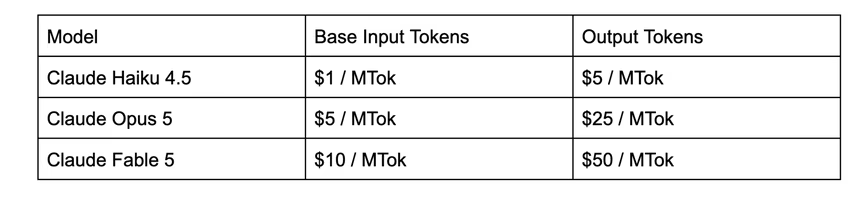
Using Haiku as our baseline, we notice that Opus 5 is 5x more expensive. Newer flagship models are even more expensive, where models like Fable 5 are 10x more expensive than an optimized model like Haiku. These pricing differences highlight model selection as one of the best cost optimization strategies.
To battle the rising costs associated with high token consumption, companies are advised to choose the models wisely. The large frontier models like Opus are recommended for complex coding sessions, while models like Haiku are recommended for quick lookup questions and subagent tasks.
Larger context window drives up cost
On the same-sized frontier model, such as Opus 5, a large context window acts as a crucial factor in the overall cost. In simple terms, the context window is the working memory of the LLM for the session, which includes prompts, conversation history, retrieved documents, and the model’s responses. Doubling the context window size can quadruple the computation needed.
To observe the impact of context consumption on cost, I will perform a simple test. Two identical Claude sessions will be started. The same question will be asked, but the difference will be that one of the sessions will be fed The Odyssey by Homer in the context window.
Both the sessions will answer the same question: “Who is Calypso and why did she keep Odysseus captive?”
This question about a novel is chosen because the text of the writing is 132,953 words, which is approximately 177,000 tokens. Compared to a coding session where new dependencies might be downloaded and third-party packages might be inspected, this method of passing context to a session leads to a predictable amount of context consumption.
The Claude session that does not have the text copied into the context will be able to perform a web search and answer the question at a fraction of the token consumption. The following table lists the token consumption of the sessions.
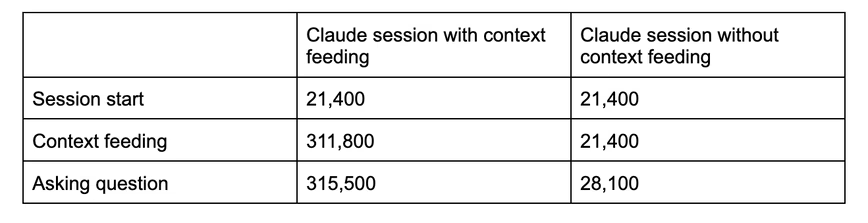
This large difference in token consumption maps to a wide difference in cost for sessions.
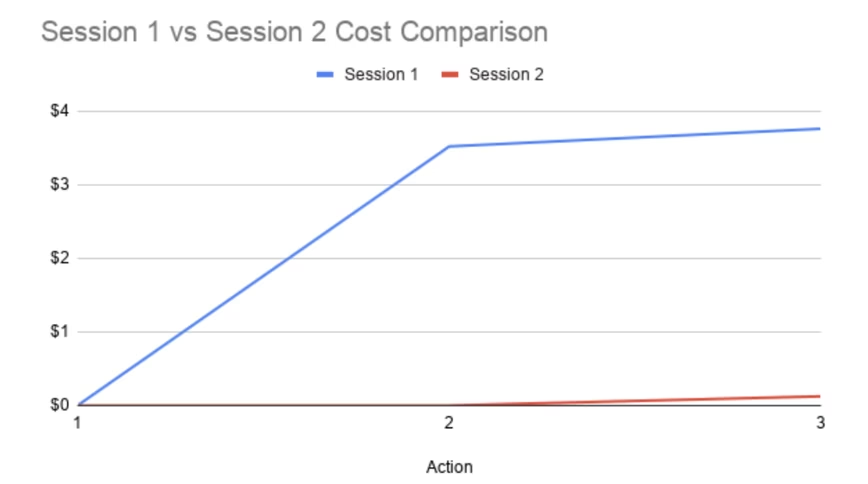
One interesting finding to note here is that without the context feeding, the question asked from both the Claude sessions is the same, but the cost of each session shows a big difference.
For the same question, the session with context feeding cost $0.24, while the session without context only cost $0.12. When the session continues to grow, this cost becomes a floor being added to each new query of the LLM. The answer received in the session with all the context was more detailed and of a higher quality, but it was 2 times more expensive.
For a lot of practical applications, it is necessary to pass in the exact context that the LLM needs, but finding the line to draw is a much harder problem. At some point, the user trades off context and cost for response quality. Constantly increasing the context window is not a viable option, and models like Haiku prevent this problem by restricting the token window to 200k.
Outcome maxxing >> token maxxing
By selecting large models for every task and padding sessions with extra context, users can easily increase their LLM bills. There have been incentives for users across corporate America to boost AI usage.
There are critics of the token maxxing trend who argue that tokens spent is a flawed metric, and as Bousquette reports, we should be calculating the increased output associated with LLM usage. Yamini Rangan, chief executive of HubSpot, summarized it best in her LinkedIn post: “Outcome maxxing >> token maxxing”.
The tokenmaxxing trend is similar to the early 2000s, when companies calculated lines of code committed. The volume of code being generated or documents being reviewed is at best a proxy and at its worst a flawed metric.
Sonya Huang from Sequoia Capital admits to Bousquette that token maxxing is a flawed metric and may be necessary to drive fast adoption of LLMs. In the future, I expect to see a lot of optimizations and tools being built around the model selection and context window optimization problem.
Get the TNW newsletter
Get the most important tech news in your inbox each week.
Expertise from selected TNW Council members, admitted through an application and review process to a fee-based program. Opinions expressed by the authors are their own.


