TL;DR
Reallusion launched AI Studio, a production platform that pairs its iClone 3D animation tools with ByteDance’s Seedance 2.0 to give filmmakers spatial precision that text-prompt-only AI video generators cannot match. The multi-model platform also supports Veo 3, Kling AI, and others.
Reallusion, the 3D animation software company behind iClone and Character Creator, has launched AI Studio, a production platform that pairs traditional 3D scene-building with generative AI video models. The centrepiece is a direct integration with ByteDance’s Seedance 2.0, currently the top-ranked AI video model on the Artificial Analysis leaderboard.
The pitch is straightforward. AI video generators like Seedance, Google’s Veo 3, and Runway’s Gen-4 can produce impressive footage from text prompts, but they struggle with precision. Complex character motion, camera choreography, and spatial continuity break down when the AI is working from language alone. Objects warp, perspectives shift, and directors have limited control over what actually appears on screen.
Reallusion’s answer is a hybrid workflow. Artists build their scene in iClone, a real-time 3D animation tool, setting camera paths, character positions, skeletal motion, and lighting. That 3D data then serves as what the company calls a “precision control layer” for the AI model. Seedance 2.0 handles the visual rendering, textures, and cinematic quality, while the 3D scene provides the spatial structure. The artist retains directorial control. The AI handles execution.
Seedance 2.0 is well suited to this approach. ByteDance designed it with strong spatial intelligence, meaning it can interpret exact scene layouts, camera paths, and skeletal data without the guesswork that plagues other models. It generates clips up to 15 seconds in length with camera choreography and motion dynamics that feel intentional rather than random. China’s AI video industry has moved faster than any other market on production tooling, and Seedance reflects that momentum.
AI Studio is not limited to a single engine. Reallusion has built it as a multi-model platform, consolidating Flux and Nano Banana for image generation alongside Kling AI, Veo 3, Wan, LTX, and Scail for video. Users can switch between models depending on the shot, choosing one for photorealism and another for stylised animation. The idea is to give studios the flexibility to use whichever model best fits each scene rather than locking into a single provider.
The timing matters. OpenAI shut down Sora in April after the video tool peaked at one million users and reportedly cost $1 million per day to operate. The shutdown rattled creators who had built workflows around it and underscored the risk of depending on a single AI platform. The AI-animated film Critterz missed its Cannes market debut as a direct consequence.
Reallusion is positioning AI Studio as a more stable alternative. Because the 3D scene data lives locally in iClone, the creative work is not lost if a particular AI model is discontinued or repriced. The 3D assets, motion data, and camera setups remain usable. Only the rendering layer changes. That is a meaningful difference for studios investing in long-term production pipelines.
The company, founded in 1993 with R&D centres in Taiwan and offices in Silicon Valley, Canada, Germany, and Japan, has spent decades building tools for real-time 3D character animation. iClone and Character Creator are used in game development, film pre-visualisation, and virtual production. AI Studio extends that ecosystem into generative video without abandoning the 3D skill set that existing users have invested years in developing.
Adobe has taken a similar approach with its Firefly AI Assistant and Project Graph, integrating generative models into existing creative software rather than replacing it. The pattern across the industry is converging: the most useful AI creative tools are not standalone generators but hybrid systems that augment professional workflows.
Whether AI Studio gains traction will depend on whether the hybrid model delivers on its promise. Pure AI video generation is improving rapidly, and each new model narrows the gap between what a text prompt can produce and what a 3D-controlled pipeline delivers. Reallusion is betting that the gap will never fully close, that professional filmmakers will always need spatial precision, repeatable camera setups, and frame-level control that language-driven generation cannot guarantee.
For an AI video market in flux, where the leading model changes every few months and platforms can vanish overnight, a tool that keeps the creative decisions in the artist’s hands rather than the model’s weights is a bet on stability over spectacle. Whether that bet pays off will depend on how many filmmakers prefer control to convenience.


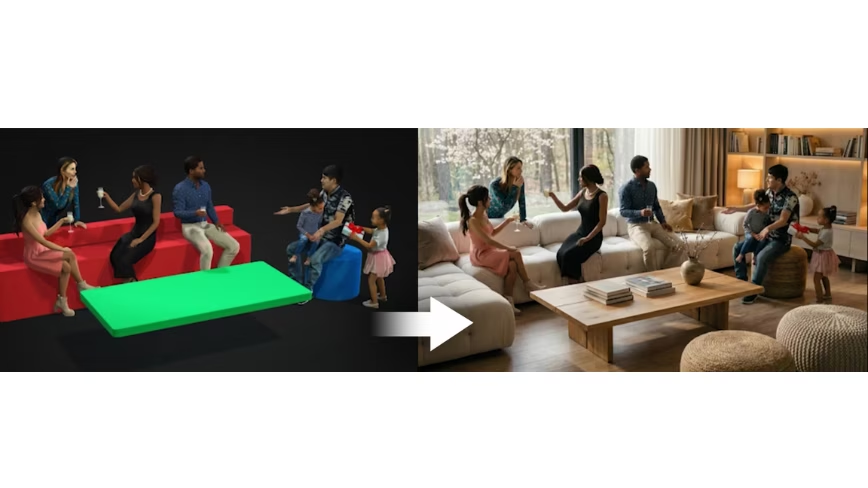
 Credit: Reallusion