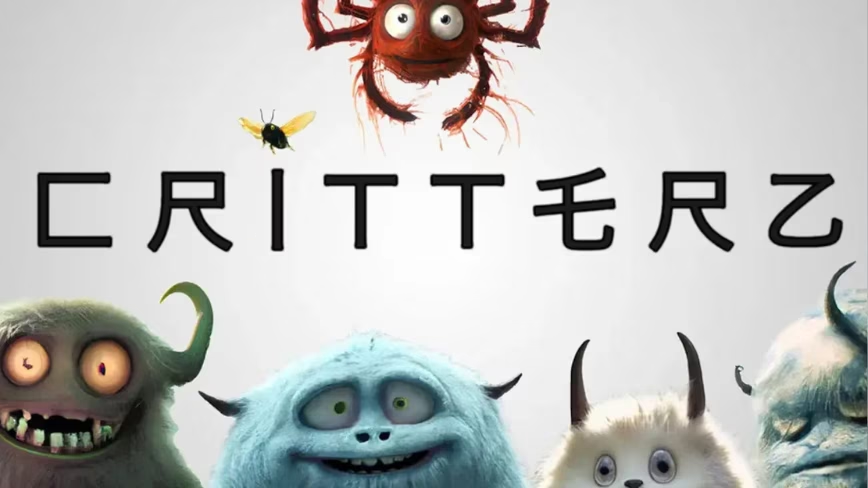
The OpenAI-backed family animation that was meant to prove generative AI could ship a real movie has missed its festival window, in part because the video model it was built on no longer exists.
Critterz, the OpenAI-backed animated feature that was being positioned as the first mainstream commercial film made through a generative AI pipeline, has missed its planned Cannes debut, according to Bloomberg.
The project, produced by AGC International, London-based Vertigo Films and AI specialist Native Foreign, did make it to the Cannes market this week, where AGC has been screening first-look footage to international buyers, but it did not land the in-festival premiere the producers had targeted.
Part of the explanation is the tool the film was built on no longer exists in usable form. OpenAI shut down Sora in March, after the consumer app peaked at roughly a million users, collapsed below half that, and burned through about $1m a day in compute.
The web and app experience went dark on 26 April, with the API set to follow on 24 September. Critterz, which had been built across OpenAI’s full creative stack, including Sora for sequence generation, lost a meaningful part of its production pipeline mid-flight.
The film itself is a feature-length adaptation of a 2023 short Chad Nelson made at OpenAI using DALL-E and early Sora. Nelson is producing on the feature alongside Vertigo’s Allan Niblo and James Richardson, with Nik Kleverov of Native Foreign directing.
The script is by Lamont, Foster and Butterworth, working from a brief that called for a “human-led but AI-assisted” production. The stated budget sits under $30m, and the team had publicly aimed to deliver the film in roughly nine months rather than the three years a comparable traditional animation would take.
The pitch to buyers in Cannes was a proof-of-concept for that timeline. A family-aimed animated feature, made for a fraction of a Pixar budget, marketed as the first to demonstrate that the generative stack could actually ship.
That pitch only works if the production hits its premiere window. Missing Cannes in-festival, even if AGC walks away with sales from the market, is the part of the launch that mattered.
The Sora shutdown is the more telling story underneath. The video app’s economics, as TNW and others have detailed, never worked: too expensive to run, not enough returning users, and Disney reportedly informed of the shutdown less than an hour before it was made public, after committing $1bn to the partnership.
OpenAI has been migrating its video research effort toward what it calls world-simulation work for robotics, a pivot Bloomberg has reported and that the company has not formally announced.
What Critterz inherits from that decision is uncertainty about its own technical heritage. The film’s marketing positions it as a generative-AI milestone; the model that made it possible has been quietly retired.
Producers have so far not publicly disclosed what tooling has replaced Sora in the back end of the project, although Native Foreign works across multiple generative platforms.
Cannes 2027 is now the most obvious next window. Whether Critterz will be carrying the same “first AI feature” framing by then, in a market that already has half a dozen contenders for the title, is the open question. The film made it to the Croisette; it did not make it onto the screen.
Get the TNW newsletter
Get the most important tech news in your inbox each week.


