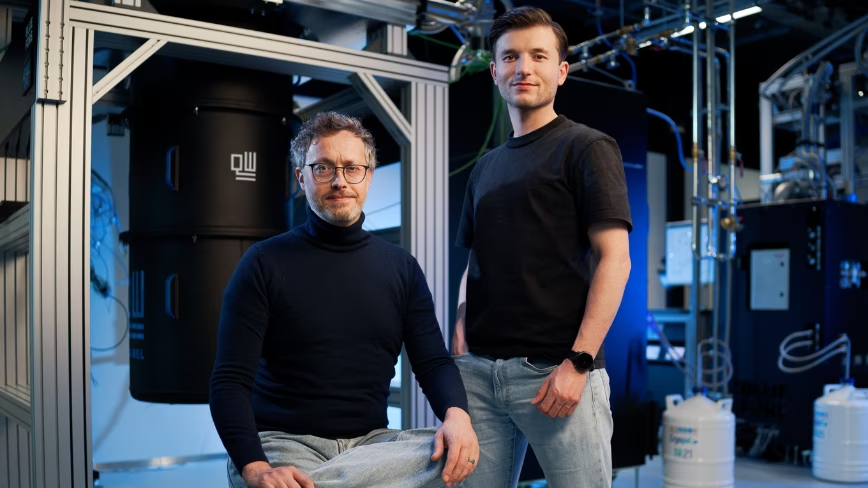
The Series B is the largest ever raised by a Dutch deeptech company, and the largest private round any dedicated quantum-processor company has closed. Intel Capital, In-Q-Tel, and ETF Partners are joining a syndicate that already had FORWARD.one and Invest-NL.
There is, in 2026, a very specific kind of European deeptech success story that policy-makers spend a lot of time trying to engineer and that the market produces only intermittently. Delft-based QuantWare announced that it has closed a Series B round of €152m ($178m), the largest ever raised by a Dutch deeptech company and the largest private round any dedicated quantum-processor company has closed worldwide.
The round was oversubscribed. The new investor list is unusually heavyweight: Intel Capital, In-Q-Tel (the CIA-backed strategic investor), and ETF Partners join an existing syndicate that includes FORWARD.one, Invest-NL Deep Tech Fonds, InnovationQuarter Capital, Ground State Ventures, and Graduate Ventures.
It is the second European quantum scale-up Series B of the week. It is also, by some distance, the larger of the two.
What QuantWare actually does
QuantWare was founded in July 2021 by Matthijs Rijlaarsdam (chief executive) and Dr Alessandro Bruno (chief technology officer), both of whom came out of QuTech, the quantum-research institute jointly run by TU Delft and TNO. TNW first profiled the company more than a year ago, at a moment when its commercial volumes were already conspicuous.
The company has shipped working quantum processors to more than 50 organisations across 20 countries and is, by its own framing and HPCwire’s description, the largest commercial supplier of quantum processors by volume in the world.
What separates QuantWare from the wider quantum-computing field is the architectural choice it has made. Most superconducting-qubit systems use 2D chip designs in which signal lines are routed laterally across the surface of a single processor, an approach that consumes space exponentially as qubit counts grow and that has, in practice, capped commercial systems at modest scale.
QuantWare’s VIO architecture is three-dimensional: chiplet modules are stacked vertically and connected through ultra-high-fidelity chip-to-chip links, with signal lines running between layers rather than across them. The architecture, in the company’s framing, scales the way commercial semiconductor processes have always scaled.
VIO-40K and the 10,000-qubit claim
The Series B follows the company’s late-April announcement of VIO-40K, a new generation of the architecture rated for processors with 10,000 qubits. The number is roughly 100x the current commercial state of the art, and the architecture supports up to 40,000 input-output lines through the chiplet-stack approach.
Quantum Computing Report’s coverage of the architecture launch described the design as the first credible commercial path to processors of that scale that does not rely on networking together many smaller systems, an approach that introduces its own latency and fidelity costs.
Reservations for VIO-40K are available now; first customer shipments are expected in 2028, according to QuantWare’s own announcement. The architecture is what made the Series B size economically defensible. Without a credible scaling roadmap, no quantum-hardware company has yet attracted private rounds of this scale. With one, the addressable market changes substantially.
KiloFab: where the cheque is being spent
Most of the new capital will go to KiloFab, which QuantWare describes as the world’s first dedicated fab for Quantum Open Architecture devices and one of the largest quantum-processor production facilities anywhere. The facility, located at the company’s Delft headquarters, is intended to expand QuantWare’s production capacity by roughly 20x.
Every other major quantum-computing company in the world either fabricates its own processors in vertically integrated facilities or buys from a small set of academic-scale fabs with limited capacity. KiloFab is designed to break that constraint by operating as an open-architecture commercial supplier to the wider industry.
If QuantWare can sustain its open-architecture supplier role across the next phase of quantum-processor demand, the company occupies a structurally similar position in quantum to what TSMC occupies in classical semiconductors: not the brand the customer sees, but the fabrication operation everyone else’s brand depends on.
QuantWare’s customer mix is unusually broad for the stage of the industry. The company sells to a combination of national technology institutes, large technology companies, and other commercial quantum-computing firms. The 20-country distribution is meaningful: most quantum hardware companies sell predominantly to local or single-region customers, and the geographic spread suggests QuantWare’s open-architecture proposition appeals to buyers who want to control their own quantum-software stack rather than buy a vertically integrated system.
The investor configuration reflects the same dynamic. Intel Capital’s participation is, in part, a strategic hedge: Intel itself has been pursuing trapped-ion quantum research, and a stake in the leading commercial superconducting-QPU supplier gives Intel optionality across architectures.
In-Q-Tel’s involvement signals US-government-adjacent customer interest. ETF Partners’ climate-orientated investment thesis ties into the energy efficiency of QuantWare’s chiplet approach, which the company says delivers exponentially more compute per watt than competing scaling strategies.
The named existing investors matter too.
General partner Robin van Boxsel framed his firm’s continued participation as supporting QuantWare’s path “to becoming one of the world’s most important technology companies.”
Yvonne Greeuw at Invest-NL framed the deal as a contribution to Dutch “strategic autonomy and future earnings capacity,” the kind of language that, when applied to a private financing round, signals that this is being read by the Dutch state itself as an industrial-policy outcome.
Three things follow from the announcement that go beyond QuantWare itself. The first is that European deeptech can, in 2026, attract Series B rounds at a scale historically associated with US Series Cs and Ds. €152m is not a US-style late-stage round, but it is the largest such round any Dutch deeptech company has closed, and it suggests the European ceiling for hardware-led deeptech financings has moved up materially.
The second is that quantum computing has, finally, attracted strategic-investor capital from outside the dedicated quantum-VC pool. Intel Capital and In-Q-Tel are not quantum-thesis funds. Their participation, alongside ETF Partners’ climate-thesis cheque, suggests that the quantum sector has crossed a threshold from speculative-research investment into adjacent strategic interest. That changes the funding ecosystem for the whole category.
The third is industrial policy. Europe has been talking about “sovereign” quantum infrastructure for years, with limited concrete output. QuantWare’s KiloFab, by contrast, is a real building with real capital behind it, designed to be the world’s largest open-architecture quantum-processor production facility.
If it operates as planned, the Netherlands will host one of the most strategically consequential commercial-quantum operations in the world. That outcome was, two years ago, a policy aspiration. On Monday’s evidence, it has become a financing reality.
Rijlaarsdam, in his own framing of the announcement, kept the message simple. “Quantum computers will help solve humanity’s biggest challenges, but only if they can be built at industrial scale,” he said. “That is exactly what we’re working on.”
The Series B has now provided the capital.
The 2028 first-shipment commitment provides the deadline. Between those two dates, what was, until recently, a TU Delft research project becomes either the European semiconductor success story of the decade or a cautionary tale about the limits of architectural ambition. The investors backing it have seen enough of the engineering to bet on the first outcome. What follows is execution.
Get the TNW newsletter
Get the most important tech news in your inbox each week.


