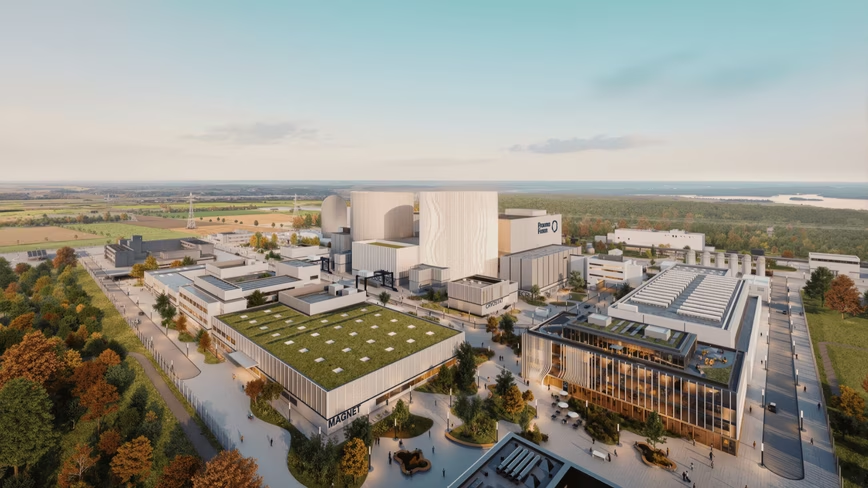

Proxima Fusion, a Munich-based nuclear energy startup, has outlined plans to raise about €2 billion to build a major fusion test facility in Germany that could be a milestone on the path to commercially viable fusion power.
The company expects more than half of that, roughly €1.2 billion, to come from the German federal government, with the rest supplied by regional support and private investment.
Proxima Fusion was formed in 2023 as a spin-out from the Max Planck Institute for Plasma Physics, bringing together scientists and engineers from Europe’s established fusion research ecosystem.
It is developing a specific type of fusion reactor called a stellarator, which uses twisted magnetic fields to hold super-hot plasma in place. Proxima’s leadership argues this design could offer greater stability and continuous operation compared with the more widely known tokamakapproach.
The planned facility, provisionally called Alpha, would be built near Munich and would aim to prove two things that fusion scientists call critical: that a device can hold a fusion plasma safely and that it can produce more energy than it consumes.
Success at this stage, expected in the early 2030s if construction starts later this decade, would shift fusion from a purely experimental field into engineering reality.
So far, the state of Bavaria has pledged €400 million toward the project, and Proxima itself plans to contribute another €400 million or more through private funds and investor support.
The remaining funding is expected to come from the federal government under Germany’s High-Tech Agenda and broader commitment to fusion research, which already includes over €2 billion of planned support through 2029.
Fusion is often described as the “holy grail” of energy because it mimics the reactions that power the sun, offering the prospect of vast amounts of clean, low-carbon energy with little long-term radioactive waste.
Engineers have been chasing this goal for decades, but no facility has yet generated sustained net energy. Proxima’s approach builds on decades of research in stellarators and attempts to translate that scientific foundation into a scalable engineering design.
Advocates say Europe needs to bridge the gap between research and industrial deployment if it wants to compete with large efforts in the United States and Asia.
Opponents caution that fusion remains risky and that securing multi-billion-euro funding for infrastructure that may not reach commercial operation for many years is politically and economically challenging.
If Germany’s government follows through on its support, Proxima Fusion’s test facility could become a central piece of Europe’s effort to bring fusion energy into the grid and reduce dependence on fossil fuels and imported energy.
Get the TNW newsletter
Get the most important tech news in your inbox each week.


