 Credit: interstid / Canva
Retail investors who rely on social media answered only 42% of investment knowledge questions correctly. But 63% rated their own knowledge as high, according to FINRA Foundation research published in April 2026. That’s a big contradiction in modern trading. People have market data, trading tools, and confidence, but not the knowledge to use them.
Becoming a serious trader used to mean getting inside a bank, hedge fund, or trading firm. That was where the capital was. It was also where traders learned how to manage risk, size positions, and analyse markets, all within a clear system.
Retail traders had a very different experience. They could open a brokerage account and access the market, but the learning was left to them.
Technology changed that. Data is widely available, trading costs have fallen, and analysis can reach anyone with a phone or laptop. The Bank for International Settlements has documented the growing influence of retail investors. Meanwhile, no-fee brokerages and online communities have brought more people into financial markets.
But easier access has exposed another problem. Being able to trade is not the same as knowing how to trade well. Opening an account is easy. Knowing how much to risk, when to cut a loss, and how to stay disciplined under pressure is much harder.
That gap is where proprietary trading firms, or prop firms, are filling in.
The real advantage is not the money
Prop trading is built off a simple idea. Prove you can trade, and get access to more capital than you have. A trader completes an evaluation and follows certain performance and risk rules. They then qualify to trade a larger funded account while keeping a share of the profits.
But more capital does not automatically make a better trader. An undisciplined trader with more buying power can make bigger mistakes.
The important thing comes with the account. Some prop firms are adding education, coaching, market analysis, risk controls, and AI-powered tools that mimic the support professional traders have inside institutions.
LEVERAGED is one firm putting a focus on what comes before the trade through education with live training, courses, market reviews, and coaching. It also offers ClayAI, an AI trading assistant designed to help traders identify possible market opportunities.
AI cannot turn someone into a professional trader, but it does show how much more sophisticated the infrastructure around independent trading is becoming.
The point is not about how much capital a trader can access, but really about the quality of the tools and systems helping them make better decisions.
The trading desk loses out to a laptop
The traditional route into professional trading required the right education, the right contacts, and a move to a financial centre like London, New York, or Hong Kong.
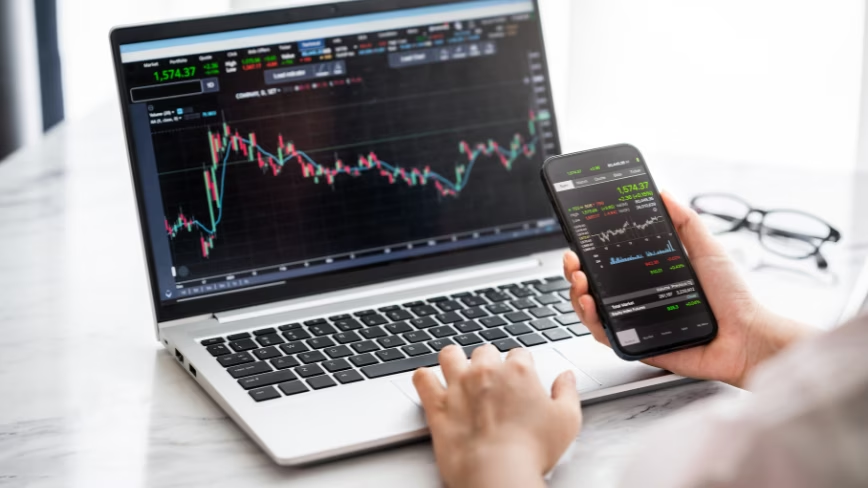
Today, a trader can complete an evaluation online, work within predefined risk limits, access training, and potentially qualify for funded capital from anywhere.
Some firms are also reducing the cost of proving that ability. LEVERAGED’s Turbo Trade programme allows traders to begin an evaluation for $8.88. The evaluation includes a 6% profit target and defined drawdown limits. It is a pay-after-you-pass structure, so the balance falls due only on passing, which the firm lists as $540.12 on a $100,000 account.
The low price gets attention, but it is also a guardrail, a way to prove that you can trade before making a larger financial commitment. This is due diligence to identify traders who can actually manage capital.
The industry still has a problem
The prop trading model has a major tension: not every firm needs its traders to succeed in order to make money. For some firms, evaluation fees can become a meaningful source of revenue. Traders pay to enter a challenge, and those who fail may pay again for another attempt.
That begs the question: does the firm make more money when traders succeed, or when they keep trying?
A prop firm that depends on successful traders has a strong reason to invest in education, risk management, and better tools. A firm that earns heavily from repeated challenge fees has different incentives.
Regulators have started paying attention. Belgium’s financial watchdog, the FSMA, warned consumers about prop trading firms in March 2024, raising concerns about paid challenges, simulated trading environments, and complex financial products.
That does not make evaluation fees automatically problematic. Firms need a way to test traders and cover the cost of running programmes. But the big difference is between charging for an assessment and building a business that works best when traders repeatedly fail it.
Wall Street is not the only way in
Online brokerages made it easier for almost anyone to place a trade. Prop trading could go a step further by widening access to capital, education, risk systems, and professional-style tools.
The biggest question is whether prop firms can build a model where the trader and the firm ultimately want the same thing: consistent performance over time.
If they can, the next generation of traders do not need Wall Street. They only need a laptop.
Get the TNW newsletter
Get the most important tech news in your inbox each week.
Contributed article. Not produced by the TNW newsroom and does not reflect the editorial stance of TNW.


