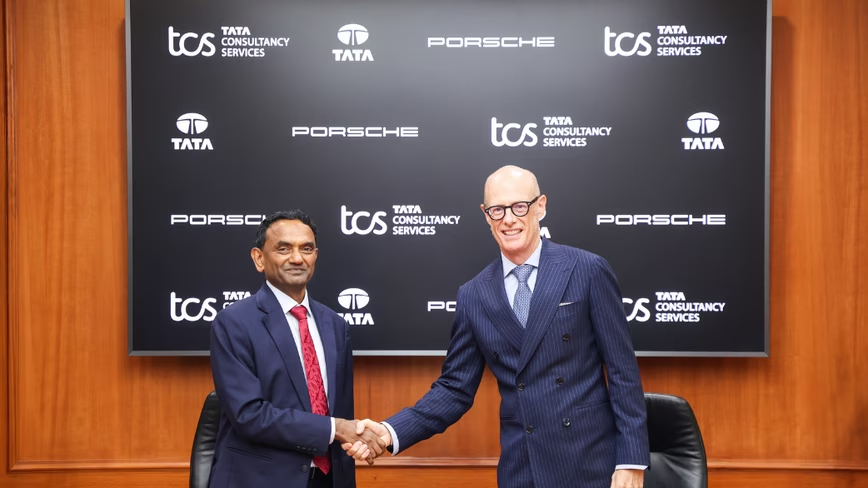
K. Krithivasan, CEO and Managing Director, Tata Consultancy Services and Michael Leiter, Chairman of the Executive Board of Porsche AG.
 Credit: Porsche AG
Tata Consultancy Services is buying MHP, the management and IT consultancy Porsche has owned for years, for €320m, and signing a five-year engagement with the carmaker worth €1.25bn on top of it.
The two halves are what make the deal worth reading, because Porsche is simultaneously disposing of an asset and committing to buy back a version of what it produced from a firm rebuilding itself around deployed AI engineers.
MHP is a substantial business rather than a captive department. It employs about 4,500 people, generated €742mn of revenue in 2025, and serves more than 300 clients across automotive and industrial sectors, with practices spanning SAP implementation, manufacturing digitalisation, and software-defined mobility.
All 4,500 employees move to TCS when the transaction closes, which both companies expect within three to four months. Porsche will remain a customer rather than an owner, and TCS will set up a dedicated centre of excellence for the carmaker.
“This partnership brings together TCS’ capabilities in AI, engineering, technology and business transformation with MHP’s strong automotive consulting expertise,” said K Krithivasan, the Indian firm’s chief executive. Porsche’s chief executive Michael Leiters framed it as combining the carmaker’s domain knowledge with outside digital capability to strengthen its innovative power.
The commercial logic on Porsche’s side is less about innovation than about a balance sheet under pressure. The disposal is part of a broader turnaround programme at a company squeezed by weak Chinese demand, a costly retreat from its electrification timetable, and tariffs on cars it exports to the United States.
Selling a profitable consultancy and signing a long-term services contract converts a fixed cost base into a variable one, which is a standard move for a manufacturer trying to shrink without losing capability. Whether it also loses institutional knowledge is the part that only becomes visible in a few years.
The Indian IT sector has been buying European consultancies for precisely this reason, since the constraint on growth is no longer engineering capacity but proximity to the client and familiarity with how European industry actually procures. MHP supplies both in a single transaction.
For TCS, the appeal is the client list as much as the technology. Manufacturing accounted for 8.7% of its revenue in the first quarter of its current financial year, and MHP brings 300 industrial and automotive customers along with a European delivery footprint that Indian IT firms have historically found harder to build than their American ones.
Porsche also becomes a marquee logo, which matters in a services market where reference accounts do a lot of selling. TCS has been reshaping itself for exactly this kind of work, hiring thousands of engineers to sit inside customer organisations rather than delivering from a distance.
The underlying problem the deal is aimed at is genuine. European carmakers have spent five years discovering that they are software companies with factories attached, and most of them have been poor at it, with even basic questions like how long a software-defined car should be supported still unresolved across the industry.
Volkswagen Group, which controls Porsche, has been through a particularly expensive version of that lesson with its Cariad software division. Outsourcing to a specialist is the alternative strategy, and this deal is a fairly clear statement about which of the two Porsche now prefers.
It also lands while the wider European automotive sector looks for ways to redeploy engineering capacity, with several manufacturers pivoting towards defence work as electric vehicle demand disappoints and military budgets expand.
The staff is the variable nobody controls. Consultancies are worth what their people are worth, and 4,500 of them are now being told they work for a company headquartered in Mumbai rather than Ludwigsburg, at a moment when European technology talent has plenty of alternatives.
Neither company has said what the €1.25bn buys in practical terms, or which systems the centre of excellence will work on first. The figure is a commitment to spend rather than a description of anything yet built.
Get the TNW newsletter
Get the most important tech news in your inbox each week.


