TL;DR
Planet Labs launched three additional Pelican high-resolution satellites on 3 May, bringing the constellation to nine spacecraft as the company builds toward 32 satellites capable of imaging any point on Earth up to 30 times daily at 30 centimetre resolution. The first New Space company to turn profitable, Planet has a $900 million backlog driven by defence contracts including a €240 million German government deal and NRO, NGA, and NATO agreements.
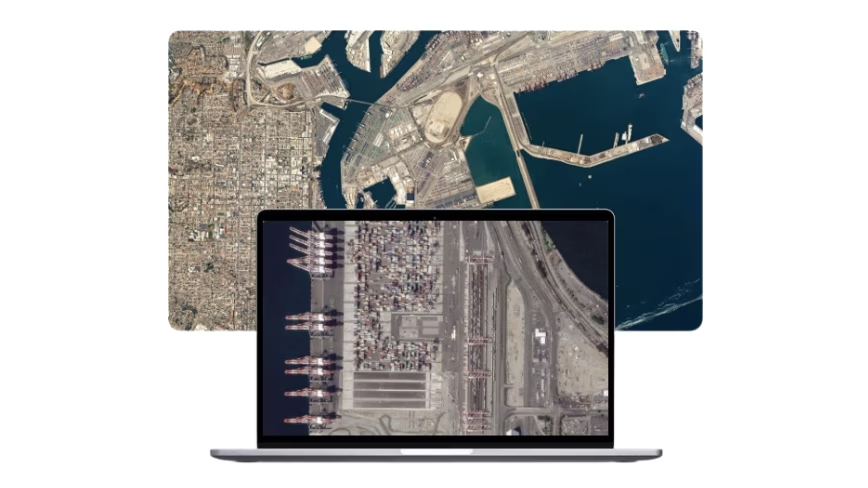
At 2:59 a.m. Eastern Time on 3 May, a SpaceX Falcon 9 rocket launched from Vandenberg Space Force Base carrying 45 satellites, three of which belonged to Planet Labs. Pelicans 7, 8, and 9 are the latest additions to Planet’s next-generation constellation of high-resolution Earth observation satellites, bringing the Pelican fleet to nine spacecraft. Each captures imagery at 50 centimetre resolution across six multispectral bands and carries Nvidia’s Jetson AI platform for onboard data processing, enabling the satellites to analyse what they see before transmitting the results to the ground. Planet plans to begin launching its second-generation Pelicans later in 2026, with resolution improving to 30 centimetres. The full constellation will consist of 32 satellites capable of revisiting any point on Earth up to ten times per day globally and up to 30 times at mid-latitudes.
The launch is a milestone, but it is not the story. The story is what Planet is building with these satellites and what that capability is worth to governments, militaries, and enterprises that need to watch the planet change in something close to real time.
The business
Planet Labs became the first New Space company to turn profitable on both an annual EBITDA and free cash flow basis in late 2025. In its fiscal third quarter of 2026, the company reported revenue of $81.3 million, a 33 per cent increase year on year that exceeded analyst estimates. Revenue guidance for fiscal year 2027 is $415 million to $440 million, roughly 39 per cent above fiscal 2026 revenue. Total contract backlog reached $900 million by March 2026. More than 90 per cent of revenue comes from recurring subscriptions. Gross margins have expanded to 58 per cent.
The financial trajectory reflects a structural shift in how Earth observation data is consumed. Planet does not sell individual satellite images. It sells subscriptions to a continuously updated data feed covering the entire planet. The earth observation market is being reshaped by AI companies that need planetary-scale data infrastructure, and Planet’s constellation of more than 200 PlanetScope Dove satellites, which photograph the entire landmass of the Earth every 24 hours at 3.7 metre resolution, provides exactly that. Pelican adds the high-resolution layer: the ability to task specific satellites to photograph specific locations at 50 centimetre detail, with AI processing the imagery in orbit before it reaches the customer.
The contracts
The defence and intelligence sector is driving Planet’s most significant revenue growth. In 2025, the company signed a 240 million euro multi-year deal with the German government for dedicated Pelican satellite capacity over European regions, along with PlanetScope and SkySat data and AI-powered situational awareness tools. The US National Reconnaissance Office renewed its baseline contract for PlanetScope data under the Electro-Optical Commercial Layer programme and established a framework for ordering high-resolution Pelican imagery. The National Geospatial-Intelligence Agency awarded a $12.8 million contract for AI-enabled maritime domain awareness across the Asia-Pacific region. NATO selected Planet for a seven-figure persistent surveillance contract. NASA awarded a $13.5 million task order.
AI-powered satellite surveillance is becoming central to European maritime security, and the demand is not limited to traditional defence applications. Insurers use Planet’s data to assess crop damage and property risk. Commodity traders use it to estimate agricultural yields and port activity. Environmental agencies use it to monitor deforestation, illegal mining, and methane emissions. The common thread is that all of these customers need frequent, reliable, global coverage, and Planet’s constellation architecture is designed to deliver exactly that at a cost per image that no traditional satellite operator can match.
The competition
The earth observation satellite market was valued at approximately $7 billion in 2025 and is projected to reach $14.5 billion by 2034, growing at roughly 8 per cent annually. Vantor, formerly Maxar Intelligence, led the market in 2024 with a 21.3 per cent share, followed by Airbus Defence and Space. Planet, BlackSky, ICEYE, and Capella Space compete across different resolution tiers, revisit frequencies, and imaging modalities. Vantor and Airbus offer the highest-resolution optical imagery. ICEYE and Capella specialise in synthetic aperture radar, which can image through clouds and at night. Planet’s advantage is not resolution but coverage and revisit rate.
The Pelican constellation is designed to close the resolution gap with Vantor and Airbus while maintaining Planet’s structural advantage in frequency. A 32-satellite constellation delivering 30 centimetre imagery with up to 30 daily revisits would be unprecedented in commercial Earth observation. The defence technology market has accelerated sharply since 2022, driven by geopolitical demand for persistent surveillance, and Planet’s backlog of $900 million reflects the degree to which governments are willing to commit multi-year budgets to commercial satellite data providers that can deliver what government-owned satellites cannot: daily global coverage at scale.
The edge
The Nvidia Jetson platform aboard each Pelican satellite represents a shift in how satellite data is processed. Traditional Earth observation satellites capture images, downlink the raw data to ground stations, and process it in terrestrial data centres. Pelican processes imagery in orbit, running AI models that can detect changes, classify objects, and flag anomalies before the data reaches the ground. This reduces latency from hours to minutes for time-critical applications like maritime surveillance, disaster response, and military intelligence.
The AI inference chip market is reshaping how and where AI computation happens, and Planet is applying that logic to space. Onboard AI processing means that a Pelican satellite tasked to photograph a port does not need to transmit every pixel of every image. It can identify which ships have moved, which berths have changed, and which structures are new, and transmit only the relevant information. The bandwidth savings alone make the constellation more efficient to operate. The intelligence value of near-real-time change detection makes it more useful to customers who are paying for answers, not photographs.
The trajectory
Planet’s path from a startup that launched shoe-box-sized Dove satellites in 2013 to a profitable public company with $900 million in backlog and government contracts across the United States, Europe, and NATO has been longer and harder than its founders expected. The company went public via SPAC in 2021, spent several years burning cash while building its constellation and customer base, and did not reach profitability until late 2025. The stock has reflected that volatility. Morgan Stanley raised its price target to $35 in March 2026, citing the defence contract pipeline and Pelican’s commercial potential.
The commercial satellite industry is entering a phase where launch costs and satellite manufacturing costs have fallen far enough that companies can build constellations of dozens or hundreds of spacecraft for what a single government satellite programme would have cost a decade ago. Planet has used that economics to build the largest commercial Earth observation constellation in history. The Pelican fleet, when fully deployed, will add the high-resolution capability that defence and intelligence customers require while maintaining the daily global coverage that commercial customers depend on. Three more satellites launched this morning. Twenty-three more are planned. What Planet is building is not a constellation. It is a sensor network for the entire planet, updated every day, analysed by AI, and sold as a subscription. The market for watching the world change in real time turns out to be large, growing, and willing to pay.


 Credit: Planet Labs