TL;DR
Berlin’s Peec AI hit $10M ARR six months after a $21M Series A at $4M. It helps brands optimise for AI search results.
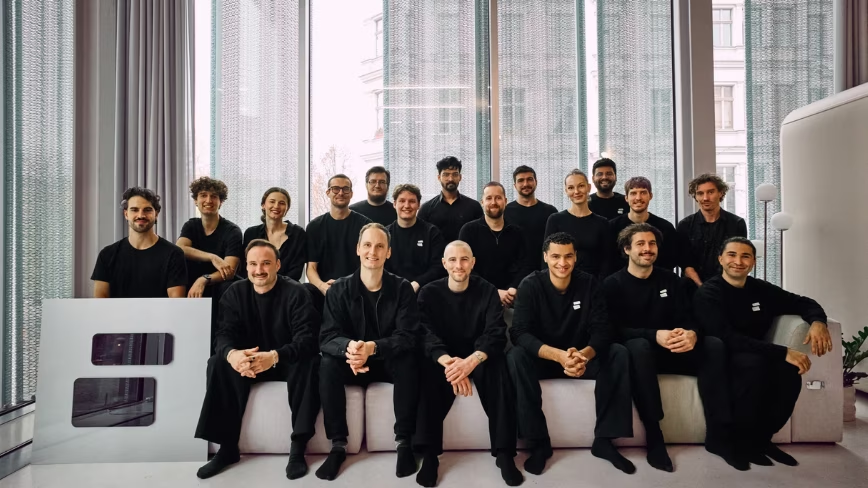
AI
 Credit: Peec AI
Berlin’s Peec AI hit $10M ARR six months after a $21M Series A at $4M. It helps brands optimise for AI search results.
Peec AI, a Berlin-based startup that helps brands track and improve their visibility in AI-generated search results, has crossed $10 million in annualised revenue, according to internal dashboard data seen and verified by TechCrunch. The milestone comes six months after the company raised a $21 million Series A at a valuation above $100 million, when it was running at just over $4 million ARR. Revenue has more than doubled, and the pace of growth has accelerated.
The product occupies a category that barely existed 18 months ago: generative engine optimisation, or GEO. Where traditional SEO dashboards track a brand’s ranking on Google, Peec’s platform visualises whether a brand appears when users type a given set of prompts into ChatGPT, Claude, Gemini, Perplexity, or any other AI chatbot that is increasingly replacing the search bar. As consumers shift from clicking links to asking questions, the brands that show up in conversational AI responses capture attention that search engine results pages once monopolised. Peec gives marketers a dashboard to monitor, measure, and influence that visibility.
CEO Marius Meiners, a former professional esports athlete who once ranked among the top 100 League of Legends players globally, has built the company’s internal culture around competitive transparency. Peec’s revenue tracker is visible to all employees, a practice Meiners attributes to his background in competitive gaming: everyone on the team sees the score, in real time, at all times.
Antler partner Christoph Klink, whose portfolio includes both Peec and vibe-coding platform Lovable, described the company as one of the most successful investments in his fund. Speaking to TechCrunch at an event in Berlin, Klink framed Peec’s trajectory as evidence of a structural shift in the European startup ecosystem. “Founders these days track revenue much more closely,” he said. After the 2021 valuation bubble and its painful correction, success in European venture is now defined by growth, not valuation. Revenue cannot be an afterthought, and startups that treat ARR as a live metric rather than a quarterly reporting exercise are outperforming those that do not.
Peec has taken an unusual approach to talent acquisition for a European startup. Like Bay Area companies but very few Berlin firms, it invested in physical billboards to recruit engineers and sell to prospects simultaneously. The billboards were, according to Klink, “more often than not strategically placed in front of other tech companies across the city.” The tactic is part of a broader positioning effort to make Peec feel like a company worth leaving a comfortable job for, a signalling strategy that matters particularly in the current AI cycle, where the window to build a category-defining product is narrow and the competition for engineers is intense.
The GEO category is growing in parallel with the shift in consumer behaviour it serves. Canva’s State of Marketing and AI Report, published this week, found that 97% of marketing leaders now use AI daily. Google’s own data shows that AI Overviews now appear on roughly 60% of US search queries, fundamentally changing which brands get seen and which disappear. For any company whose customer acquisition depends on being found online, the transition from SEO to GEO is not optional. Peec is building the measurement layer for that transition.
The competitive landscape includes HubSpot’s recently launched AI search analytics tools, Semrush’s GEO features, and a growing number of point solutions from startups in the US and Israel. Peec’s advantage, according to Meiners, is that it was built for GEO from the ground up rather than bolted onto an existing SEO platform. The company recently opened an office in New York to serve US enterprise clients, a move that reflects where the largest marketing budgets are and where the GEO adoption curve is steepest.
The revenue trajectory places Peec in a small cohort of European AI startups that are growing at a pace previously associated only with US companies. Lovable, also in Klink’s portfolio, added $100 million in revenue in a single month in March with just 146 employees. Mistral, the Paris-based foundation model company, reached $300 million ARR earlier this year. The pattern suggests that the gap between European and American AI startups, long defined by slower growth and smaller rounds, is narrowing for the companies that are building products in categories where demand is genuinely new rather than incremental.
Klink’s explanation for why companies like Peec and Lovable publicly disclose revenue milestones despite having no obligation to do so is simple: “That’s a way to show it’s working. It also shows a focus on growth that sets the culture.” In a market where investors have been burned by companies that optimised for valuation over substance, a $10 million ARR number verified by a journalist carries more weight than a press release about a funding round. As AI chatbots begin monetising through advertising, the question of who controls brand visibility inside those conversations will only become more commercially significant. Peec is betting that the answer is: whoever can measure it.
Get the most important tech news in your inbox each week.


