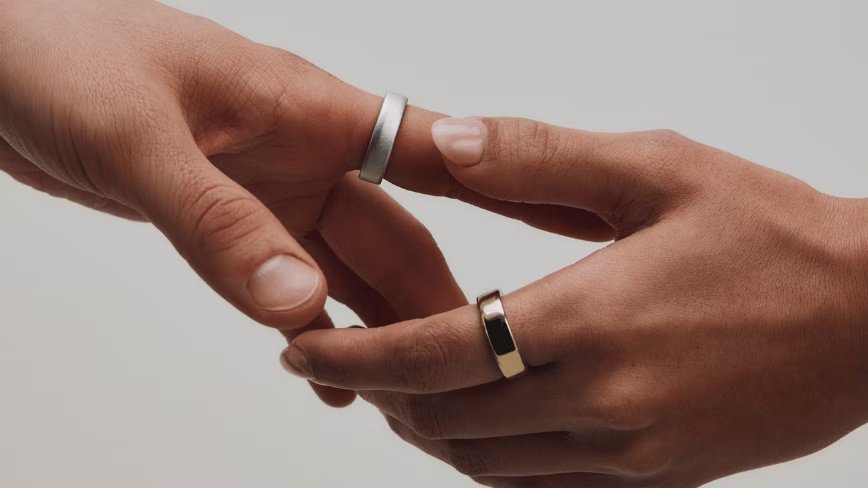
The Oura Ring 5 in Silver and Gold.
 Credit: Oura
Oura filed to go public on Nasdaq on 3 September, and the coverage split within hours. Reuters reported that the smart ring maker had recently turned profitable. The Wall Street Journal told its readers the same.
Bloomberg’s Subrat Patnaik led on a loss of $924.3m. Business Insider’s Kelsey Vlamis carried both figures without reconciling them. All four were reading the same page of the same document.
The Oura IPO filing carries both numbers, three lines apart. In the Form S-1 lodged with the Securities and Exchange Commission, net income for the nine months to 30 June 2026 is $60.8m. Directly beneath it sits a deemed dividend to holders of redeemable convertible preferred stock of $985.0m. Subtract one from the other and the result is $924.3m, which the filing labels net loss attributable to common stockholders.
That is the reconciliation the coverage skipped. The rest of it is more interesting.
The $985m is a share buyback bill
A deemed dividend of this kind arises when a company buys back preferred shares above the value they carry on its books. Oura’s own accounting notes spell it out. The excess of the purchase price over the carrying value of the redeemable convertible preferred stock was $985.0m. Of that, $979.5m was charged straight to accumulated deficit.
So the figure is not an operating loss. It is what Oura paid to buy shares back from its own early investors at 2026 prices. That premium becomes an accounting charge against the shares everyone else holds.
It bought a great many. In the nine months to 30 June, Oura spent $1,172.9m repurchasing its common and preferred stock. A tender offer in February took out 13,295,528 preferred shares at $40.18 each, for $534.2m. In January it settled a forward equity arrangement with two investment banks, retiring 5,438,236 shares at $17.71 for $96.4m. Net cash used in financing activities for the period was $741.8m.
Oura borrowed to fund the buybacks
The filing is direct about where the money came from. Oura drew $375.0m on its revolving credit facility during the nine months. It used the proceeds, in its own words, primarily to fund repurchases of its stock. It repaid $25.0m on 13 August, leaving $350.0m outstanding.
The balance sheet at 30 June shows cash of $371.8m. Total liabilities are $1,181.2m against total assets of $1,063.2m, and total stockholders’ deficit is $1,617.7m. Those are ordinary figures for a company whose preferred stock has not yet converted, and all of it flips at listing. They are still worth reading alongside the buyback line.
Oura presents the outcome as a feature. The filing notes that the price of its most recent preferred round rose from $14.87 in June 2024 to $53.57 in June 2026, a 260% increase. Over the same two years, implied enterprise value grew 215%, from $3.065bn to $9.656bn. The company offers the gap as evidence of disciplined capital allocation. It is also what happens when a company retires more than a billion dollars of its own shares.
The subscription is growing faster than the ring
Revenue for the nine months was $1,214.5m, up 74%. Hardware contributed $974.0m of that, up 65%. Membership contributed $240.5m, up 121%, and now accounts for 20% of revenue against 16% a year earlier. Membership gross margin was 89%.
Paid members doubled to 5.0 million. Oura says roughly 94% of ring activations convert to a paid membership, and that weighted-average 12-month retention is about 85%. Some 63% of new members start on the annual plan at $69.99 rather than $5.99 a month.
Hardware economics moved the other way. Average revenue per ring fell to $311 from $326 in fiscal 2025 and $332 in fiscal 2024. Oura sold 3.1 million rings in the nine months and 3.6 million over the trailing year. It puts that at about 2% of the global wearables market. The Ring 5 launched on 4 June at $399 to $499. Rivals including Garmin now ship bands with no subscription fee, which the filing names as a pricing risk.
The June quarter went backwards
The quarterly tables complicate the growth story. In the three months to 30 June 2026, Oura recorded revenue of $408.7m. It also recorded a loss from operations of $5.0m and a net loss of $10.0m. Adjusted EBITDA for the quarter was $10.7m, a 3% margin, against 19% in the March 2025 quarter.
The spending explains it. Sales and marketing reached $103.2m in that single quarter, research and development $88.7m, and general and administrative $56.8m. Across the nine months, adjusted EBITDA margin fell to 9% from 12% even as revenue grew 74%.
Batteries, patents, and a former chief executive
Oura discloses that certain production batches of Ring 4 have shown battery performance problems. Warranty expense rose $84.4m in fiscal 2025 as a result. The warranty accrual stood at $132.3m at 30 June, and the company paid $75.5m of claims during the nine months.
The litigation list is long. Samsung filed a complaint with the US International Trade Commission in December 2025, alleging infringement of four patents and seeking restrictions on imports of Oura rings. Oura had spent the previous year on the other side of that forum. In September 2025 the same commission ruled in its favour against the rival ring makers Ultrahuman and RingConn.
Omni MedSci is suing in Texas for about $120m. In August a plaintiff filed a class action alleging Oura overstates the accuracy of its sleep tracking. Harpreet Singh Rai, who ran the company until December 2021, has two suits pending. The second alleges he was misled into a September 2024 agreement to sell his shares back. General and administrative costs rose $71.9m for the period, with $48.3m of that in professional fees mostly tied to intellectual property litigation.
Oura filed confidentially in May. Reports in August put the raise at up to $3bn. The number of shares and the price range are still blank. Goldman Sachs, Morgan Stanley and J.P. Morgan lead an 18-bank syndicate that includes Robinhood. A $50m instrument issued to Eli Lilly in July converts to stock at pricing.
Get the TNW newsletter
Get the most important tech news in your inbox each week.


