TL;DR
The Academy of Motion Picture Arts and Sciences announced new rules for the 99th Oscars requiring that acting nominations go only to roles “demonstrably performed by humans with their consent” and that screenplays be “human-authored,” with producers required to sign an Affidavit of Human Origin. AI tools remain eligible in VFX, sound, and editing categories, drawing a line between AI as a production tool and AI as creative author.
The Academy of Motion Picture Arts and Sciences announced new eligibility rules on 2 May for the 99th Academy Awards, and the two that matter most are about seven words each. Acting nominations will be limited to roles “demonstrably performed by humans with their consent.” Screenplays must be “human-authored.” Producers will be required to sign an Affidavit of Human Origin during the submission process. The Academy reserves the right to request additional information about a film’s use of generative artificial intelligence and the degree of human authorship involved.
The rules will take effect for the ceremony on 14 March 2027, and they represent the most significant intervention by a major cultural institution into the question of what counts as human creative work in the age of AI. The Academy has not banned AI from the Oscars. It has defined what it means to be the author of a film, and it has decided that machines do not qualify.
The distinction
The new rules draw a precise line. AI tools used in visual effects, sound design, and film editing remain eligible for nominations in their respective technical categories. A visual effects artist who uses AI to generate crowd simulations, de-age an actor, or composite a digital environment can still win an Oscar. A sound designer who uses AI to clean dialogue or generate ambient textures can still be nominated. The Academy is not pretending that AI is not part of modern filmmaking. It is acknowledging that AI has become a standard tool in post-production while insisting that the performances and the screenplays, the two categories that define a film’s artistic core, must originate from human beings.
The Affidavit of Human Origin is the enforcement mechanism. Producers must certify, under penalty of disqualification, that the credited performances were performed by humans and the credited screenplays were written by humans. The Academy can investigate if it has doubts. This is not a vague principle. It is a contractual obligation with consequences.
OpenAI shut down Sora in March 2026 after six months, and the collapse of its AI video generation platform illustrates why the Academy’s timing matters. The technology to generate photorealistic video from text prompts exists. It is not yet good enough to replace filmmakers, but it is good enough to generate performances that look like performances and scripts that read like scripts. The Academy is drawing its line before the technology forces the question rather than after.
The context
The 2023 SAG-AFTRA strike, the longest in the union’s history, was driven in part by AI. Actors demanded protections against studios using AI to replicate their likenesses without consent. The resulting contract required studios to obtain explicit permission before creating digital replicas of performers and established that AI-generated performances could not replace contracted human work. The Academy’s new rules extend that principle from labour contracts to artistic recognition: even if a studio has the legal right to use an AI-generated performance in a film, that performance cannot be nominated for an Oscar.
The Writers Guild of America secured similar protections in its 2023 contract, establishing that AI-generated text cannot receive screenwriting credit and that studios cannot use AI-generated material to undermine writers’ compensation. The Academy’s Affidavit of Human Origin codifies the same principle at the awards level. A screenplay can be written with the assistance of AI tools, in the same way a screenplay can be written with the assistance of research, outlines, or conversations with collaborators. But the credited writer must be a human being who demonstrably authored the work.
The EU struck a deal in March 2026 to ban AI-generated non-consensual intimate deepfakes, and the Academy’s rules participate in the same regulatory moment: institutions across the world are drawing lines around what AI can and cannot do with human identity and human creative output. The Academy’s line is narrower than the EU’s, applying only to Oscar eligibility rather than to legality, but it carries cultural weight that legislation does not. An Oscar is not a regulation. It is a statement about what the film industry values. The Academy has decided that it values human performance and human authorship above technical capability.
The technology
The practical challenge of enforcing the new rules will grow as the technology improves. Current AI systems can generate short video clips, synthesise voices, and produce screenplays that are competent if formulaic. None of this is yet at a level that would fool a knowledgeable voter watching a two-hour film. But the trajectory is clear. Within several years, it will be technically possible to generate a performance that is indistinguishable from a human actor’s work, or a screenplay that reads as though a human wrote every word.
ByteDance has added watermarking and IP guardrails to Seedance 2.0 ahead of its global rollout, and the push toward machine-readable provenance marks in AI-generated content may eventually provide the technical infrastructure for the Academy’s enforcement. If AI-generated video carries embedded metadata identifying it as synthetic, the Affidavit of Human Origin becomes verifiable rather than merely declarative. Without such infrastructure, the affidavit relies on the honesty of producers and the investigative capacity of the Academy, neither of which is unlimited.
The VFX exception is telling. Visual effects have used digital tools to create, modify, and enhance imagery for decades. The Academy has never required that every pixel in a visual effects shot be manually created by a human artist. What it requires is that the creative decisions, the composition, the timing, the aesthetic choices, be made by human practitioners. The same logic now applies to acting and writing: AI can be a tool in the process, but the authorship must be human.
The other changes
The AI rules were announced alongside two other significant changes to Oscar eligibility. Performers may now receive multiple nominations in the same category if their performances rank among the top five vote-getters, ending a decades-old restriction that limited actors to one nomination per category per year. The international feature film category has been expanded to accept winners of select major film festivals, opening eligibility to films from countries with restrictive or politically influenced submission processes.
The UK has failed to reach consensus on an AI copyright code, leaving artists without clear protections, and the Academy’s rules highlight the gap between cultural institutions that are acting and governments that are stalling. The multiple nominations change is a recognition that the quality of performances in a given year should not be constrained by arbitrary administrative limits. The international film change is a recognition that the Academy’s geographic reach has been limited by the politics of national film commissions. Both reforms are about removing barriers between great work and recognition. The AI rule is about erecting a new one: the barrier between human work and machine output.
The line
Encyclopedia Britannica and Merriam-Webster have sued OpenAI over the use of their copyrighted content to train ChatGPT, and the question of who owns what in the age of generative AI is being litigated across courts, legislatures, and now awards bodies simultaneously. The Academy’s intervention is smaller in legal scope than any of these proceedings. It carries no force of law. It does not affect what studios can produce, what audiences can watch, or what AI companies can build. It affects only what can receive the film industry’s highest honour.
That limitation is also its strength. The Academy is not trying to regulate AI. It is trying to define what a film is, and it has decided that a film, at least one worthy of its highest recognition, is something made by people. The performances must be performed. The writing must be written. The humans must be demonstrably involved, demonstrably consenting, and demonstrably responsible for the creative work that bears their name. In an industry that spent the past three years arguing about whether AI would replace actors and writers, the Academy has offered an answer that is less about technology than about principle: the Oscar goes to the human.


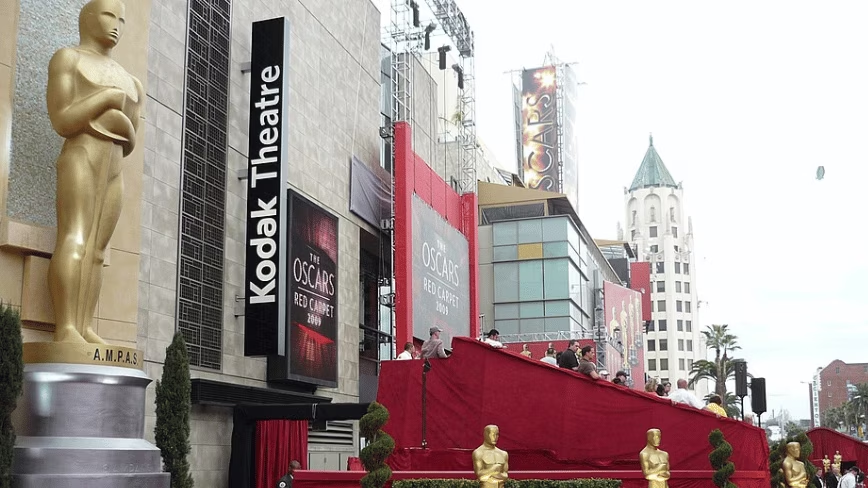
 Credit: Greg in Hollywood (Greg Hernandez)