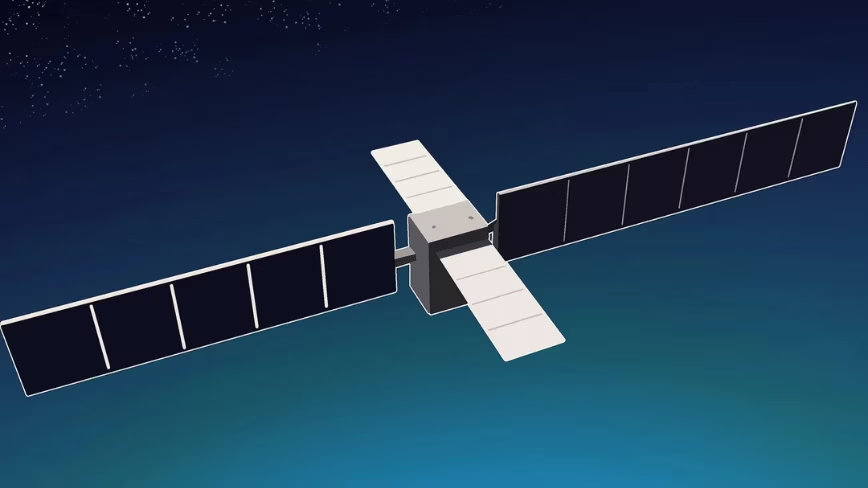
 Credit: Orbital
AI is running out of power, and out of places to put it, on Earth. A Los Angeles startup wants to solve both problems by leaving the planet.
Orbital, a space-infrastructure company building AI data centres in low Earth orbit, has raised a $5mn oversubscribed pre-seed round led by a16z speedrun, with a long list of venture investors alongside.
The money funds its first in-orbit technology demonstration, Pathfinder, which is slated to fly a hosted GPU payload on a SpaceX Falcon 9 rideshare in 2027, plus early development of Orbital-1, what the company calls its first purpose-built compute satellite. Its founder and chief executive, Euwyn Poon, previously co-founded the e-scooter company Spin.
The pitch starts with a real and worsening problem. The International Energy Agency expects global data-centre electricity use to more than double to around 945 terawatt-hours by 2030, roughly the annual consumption of Japan, while on the ground, strained grids, cooling, land, and permitting have all become bottlenecks on new builds.
Orbital’s answer is to put the computers where those constraints loosen: in orbit, solar power is continuous in the right orbit, and waste heat radiates into the void rather than needing water and fans.
“The sun is the most abundant and accessible source of energy in the universe, yet we’ve barely begun to tap into it,” said Poon. “We’re building AI data centres in orbit, where solar power is continuous and heat dissipates into the void of space. Advances in launch infrastructure are making this an imminent reality, not science fiction.”
Orbital’s twist is architectural. Rather than assembling one enormous structure in space, it plans to distribute compute across many small, independently deployable satellites, a constellation it can scale satellite by satellite. The hardware is being designed around Nvidia’s announced Space-1 Vera Rubin-class GPUs and aimed at AI inference, the fastest-growing slice of compute demand.
Production satellites are designed for 100 kilowatts of compute each, with a long-term vision of more than 100,000 satellites delivering over 10 gigawatts, supported by a Los Angeles assembly plant the company calls Factory-1.
That vision collides with a crowded and sceptical field. Starcloud has already raised $170mn at a $1.1bn valuation and run a language model in orbit, SpaceX has filed to launch up to a million data-centre satellites, and Google is paying SpaceX for orbital compute.
Against those balance sheets, $5mn is a rounding error, and Orbital’s first hardware will not fly until 2027.
The bigger doubts are physical, not financial. Even SpaceX, in its pre-IPO filing, warned that orbital AI data centres rely on “unproven technologies” and may never reach commercial viability, and scientists keep pointing at the thermodynamics: dumping heat in a vacuum is brutally hard, with roughly 1,200 square metres of radiator, about four tennis courts, needed to shed a single megawatt.
Orbital’s distributed design is partly an attempt to engineer around exactly those thermal and manufacturing walls.
For now, Orbital is a small cheque, a rideshare slot two years out, and a very large idea. Whether orbital data centres become real infrastructure or stay a pitch deck depends on physics and economics nobody has cracked yet.
But with AI’s appetite for power outrunning the grid, investors are increasingly willing to fund the moonshots, in this case almost literally.
Get the TNW newsletter
Get the most important tech news in your inbox each week.


